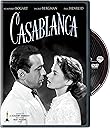
Casablanca 70th Anniversary: Special Edition (DVD)
Product ID: 16760323
Details
- ContributorHumphrey
- FormatBlack & White
- GenreDrama/Love &
- LanguageEnglish
- Runtime1 hour and 42
Desertcart purchases this item on your behalf and handles shipping, customs, and support to Iceland.
Casablanca: 70th Anniversary - Special Edition : The romantic lovers' triangle between the impossible heroic Czech Resistance leader Victor Laszlo (Paul Henreid), his beautiful wife Ilsa (Ingrid Bergman) and her ex-lover, cynical American Rick Blaine (Humphrey Bogart), is still the same old story, but it's never looked better! Casablanca's new 4K resolution scan achieves the richest, most dynamic image possible, rendering the most romantic movie of all time the most beautiful it's ever been. So no matter how often you've seen the timeless classic that won 3 Academy Awards including Best Picture, you'll want to play it again and again. Review: One of the Greatest Films Ever Made - Casablanca is undeniably one of the greatest films ever made. Up there with The Godfather, this movie has stood the test of time for nearly 75 years. The acting is perfect, the story is perfect, the movie is all around perfect. If you are showing a child the magic of black and white movies, start with Casablanca. It's a classic. As for the 2003 2-disc DVD release, it's definitely the DVD release to stick with (considering all of the double-dips Warner Bros. has been putting out lately). The transfer is great, as is the audio, especially considering this disc is over a decade old. There's also a commentary by Roger Ebert and an introduction by Lauren Bacall. On disc two, there's two documentaries- You Must Remember This, hosted by Bacall (other than her marriage to Bogart, I have no idea why she's all over this release) and Bacall on Bogart, a 1980's documentary on Bogart's life hosted by, once again, Lauren Bacall. Then there's "The Children Remember," which features Bogart's son and Bergman's daughters talking about their parents. As for added bonuses, we have "Who Holds Tomorrow?" a 1955 T.V. adaption of Casablanca that was featured on "Warner Bros. Presents." It's not good, but there are some old '50s ads included, which make it worth it. With that is "Carrotblanca," a 1995 Looney Tunes homage that is even worse than the T.V. adaption, but it's inclusion is nevertheless interesting. Finally, there's a "Screen Guild Players Radio Production" whit the original stars. The DVD is very impressive for one of the greatest motion pictures ever created. (4/12/15) An Update: I purchased the 2012 70th Anniversary Edition Blu-ray box set, and I must say it's even more impressive. The transfer is fantastic, and every single extra from the DVD release has found its way here. New are "Michael Curtiz: The Greatest Director You Never Heard Of" (detailing the director's impressive body of work-Adventures of Robin Hood, Mildred Pierce, White Christmas, etc) and "Casablanca: An Unlikely Classic" (Just another retrospective), as well as an entire bonus Blu-ray disc of special features. This disc includes the 4 and a half hour doc "You Must Remember This: The Warner Bros. Story" narrated by Clint Eastwood, "The Brothers Warner" and "Jack L. Warner: The Last Mogul". While the documentaries have little to do with Casablanca, it's still fun to learn about the studio that created the classic film. A DVD copy of the film is also included. This set goes for about $25 here on desertcart, so I say you can't go wrong with buying Casablanca on Blu-ray. Review: Classic example of Hollywood's Golden Era - After having watched "Casablanca" for the first time, it has become quite clear to me why the period from the 1940's through the 1950's was considered Hollywood's 'Golden Era'. I suspect that is was still the relative newness of the medium that enabled movies of this period to be of such high quality, a quality lacking in almost all of today's films. During that period, gratuitous sex and violence were not permissible and there were no special effects to distract the audience from a poor story. As a result, the way directors were able to engross the audiences in their films was by telling compelling stories and developing their characters with great depth and care. These movies also involved some of quickest, sharpest, wittiest dialogue ever committed to the big screen. The only director today who shows any understanding of the importance of clever and intelligent dialogue is Quentin Tarantino, but he makes overly violent movies and only makes about one film every 5 years. "Casablanca" may be the pantheon of the 'Golden Era'. It is easily one of the most quoted movies in cinematic history and it has some the most memorable scenes. For anyone who has not actually seen the movie, the plot centers on French Morocco during World War II in the city of Casablanca. The fear of the German war machine drives people to Casablanca to seek any form of passage to the United States. Business is fertile for men possessing the exit visas to get people across the Atlantic. Much of the business takes place at Rick's Cafe Americain, run by a jaded Rick Blaine (played masterfully by the legendary Humphrey Bogart). He was idealistic in his younger days, but now is a cynic and only helps people when it benefits him. His world gets turned upside down when the former love of his life Isla (played by the luminous Ingrid Bergman) enters the Cafe with her husband, the revolutionary leader Victor Lazlo, looking for passage to the States. It evokes one of the greatest lines in cinematic history and sets in motion series of events involving intrigue, passion, and suspense. The wordplay between Bogart's Rick and any one of the other characters is true treat to behold. It is sharp and witty and seems so perfectly timed. The only other movie I have ever seen that comes close to this level of dialogue is the old Cary Grant film "His Girl Friday". Rick's enigmatic moods always leave the viewer wondering what path he'll choose. Will it be the one of selfish interest or the one of greater good? The viewer never knows until the very end. Bergman's Ilsa is one of the most beautiful female characters in the history of film. Bergman's beauty would be just as captivating today as it was back in the 1940's. The passion of lost love between Ilsa and Rick is largely unspoken, but it's very palpable. Unlike today's films, which feel the need show too much, "Casablanca" uses subtlety to convey the emotion and passion. "Casablanca" is considered a violent movie without ever being too violent. The threat of the German 'Gestapo' hanging over every action and every scene creates a tension, a fear, and a suspense that few movies can match. There is not one single wasted motion, scene, or character in this film. There is purpose in everything that happens. Characters from the shifty street vendor all the way to the shady Captain Renault have purpose and meaning. "Casablanca" has been termed by some to be the 'perfect film'. That's a lofty claim as some of the movies that were thought to be great in their time, now prove to be dated and almost a parody of themselves ("2001" and "The Graduate") are classic examples. "Casablanca", however, earns that praise and proves to be a timeless classic that is as moving today as it was in 1942.


| Contributor | Humphrey Bogart, Ingrid Bergman, Michael Curtiz |
| Customer Reviews | 4.8 out of 5 stars 13,488 Reviews |
| Format | Black & White, Multiple Formats, NTSC, Special Edition |
| Genre | Drama/Love & Romance |
| Language | English |
| Runtime | 1 hour and 42 minutes |
M**2
One of the Greatest Films Ever Made
Casablanca is undeniably one of the greatest films ever made. Up there with The Godfather, this movie has stood the test of time for nearly 75 years. The acting is perfect, the story is perfect, the movie is all around perfect. If you are showing a child the magic of black and white movies, start with Casablanca. It's a classic. As for the 2003 2-disc DVD release, it's definitely the DVD release to stick with (considering all of the double-dips Warner Bros. has been putting out lately). The transfer is great, as is the audio, especially considering this disc is over a decade old. There's also a commentary by Roger Ebert and an introduction by Lauren Bacall. On disc two, there's two documentaries- You Must Remember This, hosted by Bacall (other than her marriage to Bogart, I have no idea why she's all over this release) and Bacall on Bogart, a 1980's documentary on Bogart's life hosted by, once again, Lauren Bacall. Then there's "The Children Remember," which features Bogart's son and Bergman's daughters talking about their parents. As for added bonuses, we have "Who Holds Tomorrow?" a 1955 T.V. adaption of Casablanca that was featured on "Warner Bros. Presents." It's not good, but there are some old '50s ads included, which make it worth it. With that is "Carrotblanca," a 1995 Looney Tunes homage that is even worse than the T.V. adaption, but it's inclusion is nevertheless interesting. Finally, there's a "Screen Guild Players Radio Production" whit the original stars. The DVD is very impressive for one of the greatest motion pictures ever created. (4/12/15) An Update: I purchased the 2012 70th Anniversary Edition Blu-ray box set, and I must say it's even more impressive. The transfer is fantastic, and every single extra from the DVD release has found its way here. New are "Michael Curtiz: The Greatest Director You Never Heard Of" (detailing the director's impressive body of work-Adventures of Robin Hood, Mildred Pierce, White Christmas, etc) and "Casablanca: An Unlikely Classic" (Just another retrospective), as well as an entire bonus Blu-ray disc of special features. This disc includes the 4 and a half hour doc "You Must Remember This: The Warner Bros. Story" narrated by Clint Eastwood, "The Brothers Warner" and "Jack L. Warner: The Last Mogul". While the documentaries have little to do with Casablanca, it's still fun to learn about the studio that created the classic film. A DVD copy of the film is also included. This set goes for about $25 here on Amazon, so I say you can't go wrong with buying Casablanca on Blu-ray.
I**H
Classic example of Hollywood's Golden Era
After having watched "Casablanca" for the first time, it has become quite clear to me why the period from the 1940's through the 1950's was considered Hollywood's 'Golden Era'. I suspect that is was still the relative newness of the medium that enabled movies of this period to be of such high quality, a quality lacking in almost all of today's films. During that period, gratuitous sex and violence were not permissible and there were no special effects to distract the audience from a poor story. As a result, the way directors were able to engross the audiences in their films was by telling compelling stories and developing their characters with great depth and care. These movies also involved some of quickest, sharpest, wittiest dialogue ever committed to the big screen. The only director today who shows any understanding of the importance of clever and intelligent dialogue is Quentin Tarantino, but he makes overly violent movies and only makes about one film every 5 years. "Casablanca" may be the pantheon of the 'Golden Era'. It is easily one of the most quoted movies in cinematic history and it has some the most memorable scenes. For anyone who has not actually seen the movie, the plot centers on French Morocco during World War II in the city of Casablanca. The fear of the German war machine drives people to Casablanca to seek any form of passage to the United States. Business is fertile for men possessing the exit visas to get people across the Atlantic. Much of the business takes place at Rick's Cafe Americain, run by a jaded Rick Blaine (played masterfully by the legendary Humphrey Bogart). He was idealistic in his younger days, but now is a cynic and only helps people when it benefits him. His world gets turned upside down when the former love of his life Isla (played by the luminous Ingrid Bergman) enters the Cafe with her husband, the revolutionary leader Victor Lazlo, looking for passage to the States. It evokes one of the greatest lines in cinematic history and sets in motion series of events involving intrigue, passion, and suspense. The wordplay between Bogart's Rick and any one of the other characters is true treat to behold. It is sharp and witty and seems so perfectly timed. The only other movie I have ever seen that comes close to this level of dialogue is the old Cary Grant film "His Girl Friday". Rick's enigmatic moods always leave the viewer wondering what path he'll choose. Will it be the one of selfish interest or the one of greater good? The viewer never knows until the very end. Bergman's Ilsa is one of the most beautiful female characters in the history of film. Bergman's beauty would be just as captivating today as it was back in the 1940's. The passion of lost love between Ilsa and Rick is largely unspoken, but it's very palpable. Unlike today's films, which feel the need show too much, "Casablanca" uses subtlety to convey the emotion and passion. "Casablanca" is considered a violent movie without ever being too violent. The threat of the German 'Gestapo' hanging over every action and every scene creates a tension, a fear, and a suspense that few movies can match. There is not one single wasted motion, scene, or character in this film. There is purpose in everything that happens. Characters from the shifty street vendor all the way to the shady Captain Renault have purpose and meaning. "Casablanca" has been termed by some to be the 'perfect film'. That's a lofty claim as some of the movies that were thought to be great in their time, now prove to be dated and almost a parody of themselves ("2001" and "The Graduate") are classic examples. "Casablanca", however, earns that praise and proves to be a timeless classic that is as moving today as it was in 1942.
J**I
“We’ll always have Paris”…
“Casablanca” is an enduring classic, a cultural touchstone that has several memorable lines that are now part and parcel of the popular American culture, such as the subject one. Two of the greatest actors of the era, Humphrey Bogart and Ingrid Bergman, play the lead roles. Claude Rains, as Captain Louis Renault, is also memorable. I had not seen the movie for three decades or so, and felt a re-viewing was in order. Naturally it is a love story, though there are no torrid scenes. A kiss, an arm around the shoulder and some imagination must suffice. The woman, Bergman, is torn between two men. As the story evolves, the circumstances, involving war and political upheaval, that led to that dilemma are revealed. The setting is Casablanca, Morocco, which is considered part of “unoccupied France,” meaning – sorta – that it is being ruled by Marshall Petain (the “hero” of Verdun) from Vichy. His picture is prominently displayed on a billboard early in the movie. The “action” in Casablanca is at Rick’s café americain, run by the cynical Rick Blaine, played by Bogart. Running a bar may rank up there with the top ten oldest professions, so the movie also suggests his “heart of gold.” We also learn that he has some “good guy” credentials, having assisted in supplying Ethiopia with guns in ’35, and naturally saw the virtues of the Loyalist side in Spain, in ’36. I wondered, on the re-viewing, what percentage of the current viewers would know WHY Rick was supplying guns to Ethiopia in ’35. Meanwhile, the “action” seems to involve the intrigues of Europeans of many nationalities trying to get to America, via Lisbon and the machinations of the Nazis who are just on a “courtesy visit” while the French gendarmerie tries to placate them. The piano player, Sam, a Black, (“play it again Sam) tickles the ivories, looks after Rick, and makes “As Time Goes By” an American classic. The movie was made in the middle of World War II. The movie appears to be set in 1940-41. With its title, it took advantage of the recent Allied invasion of North Africa, which also featured Casablanca. The movie was released in November 1942 and the invasion, code name “Operation Torch,” occurred just a few weeks earlier. As time goes by, I noted a couple other touches I missed the first time. When Captain Louis Renault decides to get off the fence at the end of the movie, and go to Brazzaville, which was the headquarters of the “Free French,” he drops his bottle of Vichy water in the trash can. And in Rick’s, when the French decided to belt out the Marseillaise, to drown the German singing, it contained the now controversial verse “Qu’un sang impur” (of the impure blood) that has members of the French national soccer team doing the equivalent of “taking the knee.” Oh well, when it is time to “round up the usual suspects,” they will include “We will always have Paris,” as well as Marseilles, the “Île-de-France,” et plus. An enduring 5-stars.
C**E
Classic movie
The DVD came in good time and excellent shape. It played well. I enjoyed it.
P**B
A Timeless Masterpiece
There are great films, and then there are films that feel almost mythic—stories that transcend their era and become part of our cultural DNA. Casablanca is firmly in that second category, and for me, it stands as the greatest movie ever made. From the very first frame, Casablanca pulls you into a world that feels both intimate and immense. Set against the backdrop of World War II, the film somehow balances global stakes with deeply personal emotion. At the center of it all is Rick Blaine—a man who pretends not to care, yet whose every glance and line of dialogue reveals a storm of buried feeling. His journey isn’t just about love or sacrifice—it’s about rediscovering purpose in a broken world. What makes this film my all-time favorite is how effortlessly it blends everything: romance, political tension, humor, and heartbreak. The dialogue is unmatched—sharp, poetic, and endlessly quotable without ever feeling forced. Every line feels like it matters. Every scene moves with purpose. And then there’s the emotional core. The love story between Rick and Ilsa isn’t idealized or simple—it’s complicated, painful, and real. It’s about timing, sacrifice, and the understanding that doing the right thing doesn’t always align with personal happiness. Few films have captured that bittersweet truth so perfectly. Visually, the film is stunning in its simplicity. The shadows, the lighting, the smoky atmosphere of Rick’s Café—it all contributes to a mood that feels timeless. You don’t just watch Casablanca; you feel it. But more than anything, this movie endures because of what it says about people. In a world filled with uncertainty and moral gray areas, it reminds us that courage and selflessness still matter. That even the most cynical among us can choose to do something meaningful. That’s why Casablanca isn’t just a favorite of mine—it’s the favorite. It’s a film I can return to again and again, always finding something new in its performances, its writing, and its heart. Some movies entertain. Some movies impress. Casablanca stays with you forever. Product Note: This 4K Ultra HD edition of Casablanca is truly exceptional. I typically approach restorations of older films with measured expectations, given the inherent limitations and potential for source damage. However, this release far exceeded those expectations. The visual clarity, detail, and overall presentation are remarkable, bringing new life to a classic. This is an essential upgrade for any fan and comes highly recommended.
K**M
Classic
Classic
S**.
The movie is as great as ever; the transfer, not so much...
First, I'm not reviewing the movie, which in and of itself is worth 10 stars. Yes, it follows "Citizen Kane" as the second-best movie of all time. But it's probably the best overall and most enjoyable movie ever made. So enough about what we already know... Second, with a couple of exceptions, I'm not really reviewing the quality, quantity, or variety of extras in this special edition as a reason to purchase or not to purchase this movie. It's got some cool souvenirs, extras, etc. Some of the extras I watched appear to have been re-mastered vs. the 2008/2009 edition they were in. In that edition, the extras look as though they were poorly upscaled from the DVD version. The extras on this edition seem to be of better quality, and the menus are a bit more refined. What I am reviewing is the quality of this transfer vs. the 2008/2009 Blu-Ray edition of the movie. Sadly, I think the 2008/2009 edition is superior, both for the video and the audio. Let me start by saying I watched all versions on an HDTV and on a newer 1920x1080 Dell laptop with the appropriate player software. For the heck of it, I also took an HD recording off TCM, as well as a TCM standard DVD because I could not really believe what I was seeing, or rather, not seeing, with this edition. The problem with this edition is that the contrast/gamma is off. Way off, at least on my monitors, relative to the 2008/2009 edition Blu-Ray and DVD, and the TCM HD airing. While the other versions seem to have no problem with grays, this edition contains too much black. I had to create a custom setting on my monitor to expand the gamma. When I went back to other shows, they were far too bright and washed out, so I don't think it's in my monitor or laptop. And yes, I can watch the TCM edition on my laptop via SageTV. This leads me to believe one of two things is going on - either "Casablanca" has been transferred incorrectly all along, and this edition finally got it right, or this edition has a problem with its transfer. I think it's the latter. The gamma is just plain too low. Things are either too black, lost in the shadows, or too white. The good news is, relative to the 2008/2009 Blu Ray edition, the resolution appears even higher and more detailed. The grain of the film is so apparent it almost hurts your eyes, in a good way. Needless to say, either edition beats the TCM HD airing in that department, as one would expect with the lower bitrate of satellite TV. Obviously, they also beat the standard DVD, but not by as much as one might think. I take issue with the contrast/gamma so much because of the important use of shadow, both with the characters' faces and costumes, and with the backgrounds, to convey emotional states and atmosphere. It's not solely because the detailing on someone's top or sleeve gets lost due poor contrast/gamma, although that is almost as bad. The other issue is the audio. It's not that I expect surround; I never did from any edition. The problem is that the movie starts out loud and then gets softer. It's the same with dialogue normalization engaged or disengaged in my players/monitors. I was hoping that since the movie was in mono, and not being listened to with the expectation of a surround-sound festival, that I could correct the steadily-dropping level by using normalization and not destroy dynamic range that was never there to begin with. Unfortunately, that did not help either. Again, neither the 2008/2009 blu Ray or TCM DVD editions, or the TCM HD airing suffered from this, so I don't think it's my systems' fault. Am I saying not to buy this movie? No, I am not. Casablanca is hands-down my favorite movie. But at $45 for this edition, I think one should be prepared for what one might or might not get. Maybe it's my monitor and laptop. I doubt it's both, especially with three other versions to compare it to. If you think I may be right, rent the last release and watch them both and decide for yourself. As to the extras, the ones I have watched so far look as though they have been at least re-scanned in HD, even if their aspect ratios are not right when showing clips of the movie within them. I also recommend listening to Ebert's commentary at least one time while viewing the movie. He makes some great points about the composition of the movie itself and offers some compelling arguments against the popular "Casablanca" urban legends such as Bergman's alleged confusion about not knowing the eventual outcome of her character (aside from the order of the shooting, as an actress she had to know all along that her character could never go off with Bogart's character since her character was married and the film censors of the time would never have allowed her character to leave her husband for another single man in the movie). Details such as those might cause you to look further into the fascinating story of how this movie came to be so highly regarded, when in reality no one at the time expected it to be anythig more than one of the 50 or so movies Warner Brothers would make that year. ****Update**** Just for the heck of it, I purchased a used HD DVD copy as well. My above criticisms against this 70th. Edition would also stand as compared to the HD-DVD transfer. It also has much better contrast/gamma, but I still have to give a slight edge to the 70th. Edition for the detail. As I stated earlier, the resolution of the 70th. Edition is so good at revealing the grain of the film that it almost hurts to look at it.
H**B
Every Frame Feels Like Poetry
There are certain movies we watch because they're new, exciting, and packed with cutting-edge visual effects. Then there are movies we watch because they've somehow survived every trend, every technological leap, and every generation that insisted cinema had evolved beyond them. *Casablanca* belongs firmly in the second category. I finally sat down to experience it for myself, wondering whether a film released in 1942 could possibly live up to the impossible expectations created by more than eighty years of praise. The answer surprised me. It doesn't merely live up to its reputation—it quietly reminds you why it earned that reputation in the first place. What struck me immediately wasn't the story or the famous dialogue. It was the confidence of the filmmaking. Every scene has purpose. Every line of dialogue feels intentional. There isn't an ounce of wasted screen time. Modern films often rely on spectacle to capture your attention, but *Casablanca* accomplishes the same thing with writing, atmosphere, and performances. Before long, I realized I wasn't watching an old movie anymore. I was simply watching a great movie. Humphrey Bogart delivers one of the most magnetic performances I've ever seen. His character has an incredible presence without ever demanding attention. A slight change in expression or a pause before speaking communicates more than pages of dialogue ever could. Bogart understood the power of restraint, and it makes every conversation feel meaningful. Watching him work is like watching a master craftsman who never wastes a movement. Then there's Ingrid Bergman, whose performance is nothing short of mesmerizing. The camera seems to adore her, and it's easy to understand why. She conveys warmth, intelligence, vulnerability, and quiet strength with remarkable subtlety. The chemistry between Bogart and Bergman is among the finest I've ever seen on screen. It never feels forced or manufactured. Instead, it unfolds naturally through conversations, glances, and emotions that feel authentic decades later. It's the kind of chemistry many modern romantic films chase but rarely achieve. The supporting cast deserves just as much praise. Claude Rains is wonderfully charismatic, delivering wit and charm in nearly every scene. Several supporting characters leave lasting impressions despite limited screen time, and every performance contributes to making Casablanca itself feel like a living, breathing crossroads of humanity. The city isn't merely a backdrop; it becomes a character all its own. One of the film's greatest strengths is its screenplay. It's astonishing how many memorable lines originate from this movie. Even if you don't realize it beforehand, you'll recognize quote after quote that has become part of popular culture. Yet none of these moments feel like they're trying to be iconic. They arise naturally from the characters and situations, making their lasting impact all the more impressive. Visually, the film is breathtaking. The black-and-white cinematography isn't simply beautiful—it enhances every emotion. Shadows, lighting, smoke-filled rooms, and carefully composed frames create an atmosphere that many color films struggle to replicate. Every shot appears thoughtfully constructed, giving the movie a timeless elegance that has aged remarkably well. The musical score deserves special recognition as well. Rather than overwhelming the scenes, it quietly reinforces the emotions unfolding on screen. The music knows exactly when to step forward and when to remain in the background, allowing the performances to shine while deepening the emotional resonance of the story. What impressed me most, however, was how modern the film still feels. Its themes remain just as relevant today as they were in the early 1940s. It explores love, duty, sacrifice, friendship, courage, regret, and personal conviction with maturity and intelligence. It trusts its audience to think, to feel, and to draw their own conclusions. That confidence is refreshing. As someone who enjoys contemporary cinema, I expected to appreciate *Casablanca* more as a historical artifact than as an entertaining film. Instead, I found myself completely invested. It never felt like homework. It never felt dated. It simply felt timeless. If you've been putting this film off because you assumed it couldn't possibly live up to its legendary reputation, consider this your sign to finally watch it. Great movies don't remain classics because people are nostalgic. They remain classics because every new generation discovers them and understands exactly why audiences fell in love with them in the first place. Some films entertain you for an evening. Others stay with you long after the credits roll. *Casablanca* is unquestionably one of the latter, and after finally experiencing it, I understand why it continues to be celebrated as one of the greatest films ever made.
C**E
Satisfaisant
Commande livrée dans les délais.Produit correspondant à mon attente
L**.
it came in good shape
no dislike it ome of the best movie made
S**R
Der beste Hollywood-Film aller Zeiten
Ja, es stimmt: Dieses Attribut bekam die Hal B. Wallis Produktion aus dem Jahr 1942 unter der Regie von Michael Curtiz tatsächlich von renommierten Filmkritikern. Es ist in der Tat so, dass die Planungen und Vorbereitungen für diesen Film weitaus umfangreicher waren, als normalerweise in Hollywood üblich. Anfang der 40er Jahre, als die Studios noch jede Woche einen Film fertigstellten, wurde vieles zur Routine. Nicht in diesem Fall. Hal Wallis verkaufte Jack Warner die Idee und suchte mit Julius und Philip Epstein auch gleich 2 Drehbuchautoren aus, die sich bereits mit anderen Filmen einen Namen gemacht hatten. Das waren so viele, dass man sie hier gar nicht aufführen kann. Vielleicht "Arsen und Spitzenhäubchen", "Das Leben der Mrs. Skeffington" und "Zaubernächte in Rio". Über Regisseur Michael Curtiz muss man nichts berichten, er ist schon Legende genug! Ingrid Bergman, die die weibliche Hauptrolle spielt, musste von David O. Selznick freigekauft werden und Paul Henreid von RKO-Pictures. Nur Bogart war Vertragsschauspieler bei Warner. Bei Produktionsbeginn war nur der Teil des Films bis nach dem "Flashback" fertig geschrieben, so dass Hal Wallis noch Howard Koch als weiteren Drehbuchautor verpflichten musste, der dann den zweiten Teil schrieb. Das Ende des Films wurde von Wallis selbst inszeniert - ihm schwebte eine ganz bestimmte Schlußsequenz vor, die genauso zur Legende wurde wie Bogarts "Schau mir in die Augen, Kleines" und wie der Song, den Barpianist Sam (Dooley Wilson) immer und immer wieder spielt: "As Time Goes By". ".Zum Inhalt muss nicht viel gesagt werden: Es war Krieg und Casablanca war Teil des freien Frankreich unter Marschall Petain. Zum ersten Mal spielte Bogart einen romantischen Helden, der seine große Liebe in den Wirren des Krieges wiederfindet. "Ricks Café Americaine" ist der Treffpunkt der Verzweifelten, die nach Portugal oder USA ausreisen wollen, aber auch der skupellosen Geschäftsmacher und Spieler - ein Schmelztiegel der Gestrandeten. Inmitten dieses Umfelds treffen sich Ilsa Lund (Ingrid Bergman), Victor Laszlo (Paul Henreid) und Rick Blaine (Humphrey Bogart). Lund und Blaine hatten eine heftige Affäre in Paris und verloren sich dann aus den Augen. Die Zeit in Paris wird in einem ausführlichen "Flashback" geschildert. Victor Laszlo, ein Resistance-Kämpfer, hat Ilsa inzwischen geheiratet und wartet in Casablanca auf das Ausreise-Visum. Doch im Grunde sind Ilsa und Rick einander verfallen. Nazi-Major Heinrich Strasser (Konradt Veidt) will Laszlos Ausreise verhindern und Captain Louis Renault (Claude Rains), der Polizeipräfekt, hat seine Finger überall im Spiel. Der Zuschauer taucht ein in die Szenerie und nimmt teil sowohl am Schicksal der Gestrandeten, als auch an dem der Geschäftemacher - so wie den Herren Ferrari (Sydney Greenstreet) und Ugarte (Peter Lorre). Der Film wurde für 8 Oscars nominiert und erhielt 3 Oscars für den besten Film, die beste Regie und das beste Drehbuch. Schade, dass es solche Filme und solche Schauspieler nicht mehr gibt. Insofern ist "Casablanca" ein Stück Zeitgeschichte. Das Bild ist Fullscreen 4:3 (schwarz/weiß), der Ton Dolby Digital 2.0 Mono. Sprachen Deutsch, Englisch, Spanisch. Als Bonusmaterial gibt es den Original-Trailer und die hochinteressante Original-Dokumentation "You Must Remember This", die viele Details der Produktion widergibt. Dies ist ein Film, den man gesehen haben muss!
N**H
Impeccable
Très beau film
G**S
Aankoop Casablanca Blu-ray
100 % OK Goede verzending van besteld item beantwoorde volledig aan de beschrijving van de verkoper ( uiterst tevreden ) :-):-):-)
Trustpilot
1 month ago
1 week ago