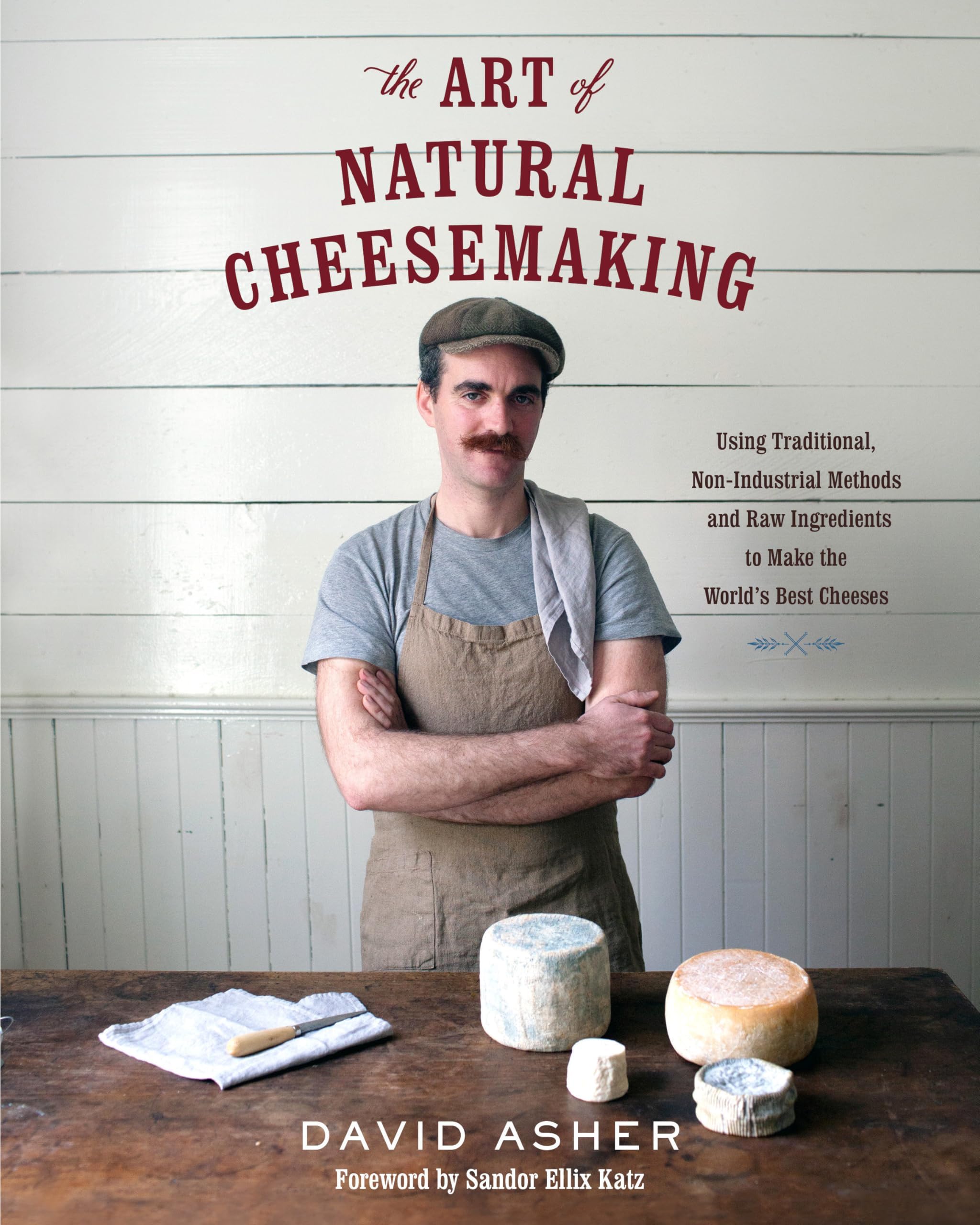
The Art of Natural Cheesemaking: Using Traditional, Non-Industrial Methods and Raw Ingredients to Make the World's Best Cheeses
Product ID: 16070412
Buy anything from 5,000+ international stores. One checkout price. No surprise fees. Join 2M+ shoppers on Desertcart.
Desertcart purchases this item on your behalf and handles shipping, customs, and support to Iceland.
The Art of Natural Cheesemaking: Using Traditional, Non-Industrial Methods and Raw Ingredients to Make the World's Best Cheeses [Asher, David, Katz, Sandor Ellix] on desertcart.com. *FREE* shipping on qualifying offers. The Art of Natural Cheesemaking: Using Traditional, Non-Industrial Methods and Raw Ingredients to Make the World's Best Cheeses Review: The Cheesemaking book I've been waiting for. - I write this review on the day of release, after having read through the book somewhat thoroughly. Obviously, It's hard to write a review on a recipe book without having tried a few recipes from it at least, this being a cheesemaking book and having most of the recipes require months, I hope you'll humor me. I have many cheesemaking books. I've had successes making various cheeses, but I've never gotten serious about the craft. I just may after reading this. The reason? Everything is so APPROACHABLE. David Asher is to cheesemaking as Sandor Katz is to fermentation (a point further made since Mr. Katz wrote the foreword.) He takes something that's been done for ages that's been so sterilized to be unrecognizable, and takes it back to how it's been done for ages. I'm sure many of you who are interested in cheesemaking have looked at recipes for a cheese and thought "how did they get a thermophilic culture, keep it at exactly 82 degrees for 80 minutes over a wooden fire, and keep it in a sterile cheese cave?" Of course they didn't, they had tradition. What we have now is meticulous and repeatable, but I'd argue is a bit soulless. What Mr. Asher is bringing back is the soul. He steps you logically through every step. He even shows you how to HARVEST YOUR OWN RENNET. Think about that for a second. When was the last time you saw a cheesemaking book go into more than a page of info about rennet? I actually happened upon David's (very infrequently updated) blog by happenstance, looking for a recipe for homemade blue cheese. I loved the way he wrote, and the passion he clearly held for cheesemaking. It carried over well in this book. It's an absolute joy, and so approachable. If you're anything like I am, a lot of cheesemaking is a mystery. Why should I get this culture over that one? How did these cultures come about? Why can't I use what's floating around my house? It's all explained here, simple enough for a dummy like me to be excited to try it out. Blue cheese culture? He shows you how to cultivate it on your own. It's amazing. Who'd have thought a moldy piece of sourdough bread was something you didn't want to throw out? I've learned more in this book in one day of owning it than I have reading my (I think 8 now) other cheesemaking books over years. Perhaps they primed me to know what Mr. Asher is talking about a bit better. I've had several "aha" moments though, things I didn't even know I didn't know suddenly making a whole lot of sense. I know I've said it before, but again, the word of the day here is "approachable". It takes away the mystery and puts the power of cheesemaking in your hands. I haven't been so excited about a cookbook in a long time. He discusses and shows how to make pretty much any cheese I can think of. From fresh cheeses such as paneer and mozz, to goat cheeses (chevre) to blue cheeses, to swiss cheeses. Common standbys like cheddar are obviously included as well. He takes you through all the important parts of cheesemaking, from his chapter on why he wrote this book and why natural cheesemaking is something worth pursuing, to milk and how to source it (raw, please!). He talks about all the different cultures and how to...culture them (a real eye opener for me. Honestly, this is worth buying the book for alone, knowing how all this stuff comes about). Tools you need, making a cheese cave, even goes over salt and it's importance over a whole chapter. Guys, if you skipped down to the bottom of this review, I don't blame you. I'm rarely long winded or as verbose as I have been here. I only get that way when I'm excited about something, and I rarely get excited. Get this book. Get it if you love cheese. Get it if you hate factory cheese and want to shove some artisinal gouda up their factory's tailpipe. Get it if you're curious about how cheese USED to be made before you could buy a packet of "thermophilic A". Get it if you want to support a passionate author seemingly reviving the craft singlehandedly. The point is: Buy. This. Book. Review: It taught me to learn from milk - I learned many things from this book, the types of cheeses, the quality of the milk, the instructions for the process, temperatures, what to expect, the mistakes, the procedure, the tools, the accessories, the additional products for perfect cheese making, etc,,, But after experimenting (and watching many videos), I learned the most important lesson of them all, the understanding of the milk and the temperature are the key ingredients, I have been making my own cheese for about a year, I buy raw milk from the local farm and the cheese I produce will differ every time, the main reason is temperature during the heating of the milk and time you take it out and the ambient temperature after it is placed in the form. Alkalinity and acidity are highly sensitive and will affect the taste. The size and the firmness of curds also depend on the temperature. To produce cheese, requires experience and fill. That being said, the book is good and is exactly what is promised to be. But for me it made me realize, that if you want to learn cheese making, you have to forget everything you know and observe the behavior of the milk. It will tell you everything, if you are ready to listen. I did not mention the humidity factor, but it will affect the cheese during the aging process. I also did not mention the salt, which is a lot more important than I initially realized. It use it a lot and it always changes the taste for the better.
| Best Sellers Rank | #50,303 in Books ( See Top 100 in Books ) #18 in Cheese & Dairy Cooking #43 in Food Science (Books) #93 in Cooking, Food & Wine Reference (Books) |
| Customer Reviews | 4.7 4.7 out of 5 stars (787) |
| Dimensions | 7.98 x 0.65 x 9.95 inches |
| Edition | Illustrated |
| ISBN-10 | 1603585788 |
| ISBN-13 | 978-1603585781 |
| Item Weight | 1.15 pounds |
| Language | English |
| Print length | 320 pages |
| Publication date | July 8, 2015 |
| Publisher | Chelsea Green |
B**Y
The Cheesemaking book I've been waiting for.
I write this review on the day of release, after having read through the book somewhat thoroughly. Obviously, It's hard to write a review on a recipe book without having tried a few recipes from it at least, this being a cheesemaking book and having most of the recipes require months, I hope you'll humor me. I have many cheesemaking books. I've had successes making various cheeses, but I've never gotten serious about the craft. I just may after reading this. The reason? Everything is so APPROACHABLE. David Asher is to cheesemaking as Sandor Katz is to fermentation (a point further made since Mr. Katz wrote the foreword.) He takes something that's been done for ages that's been so sterilized to be unrecognizable, and takes it back to how it's been done for ages. I'm sure many of you who are interested in cheesemaking have looked at recipes for a cheese and thought "how did they get a thermophilic culture, keep it at exactly 82 degrees for 80 minutes over a wooden fire, and keep it in a sterile cheese cave?" Of course they didn't, they had tradition. What we have now is meticulous and repeatable, but I'd argue is a bit soulless. What Mr. Asher is bringing back is the soul. He steps you logically through every step. He even shows you how to HARVEST YOUR OWN RENNET. Think about that for a second. When was the last time you saw a cheesemaking book go into more than a page of info about rennet? I actually happened upon David's (very infrequently updated) blog by happenstance, looking for a recipe for homemade blue cheese. I loved the way he wrote, and the passion he clearly held for cheesemaking. It carried over well in this book. It's an absolute joy, and so approachable. If you're anything like I am, a lot of cheesemaking is a mystery. Why should I get this culture over that one? How did these cultures come about? Why can't I use what's floating around my house? It's all explained here, simple enough for a dummy like me to be excited to try it out. Blue cheese culture? He shows you how to cultivate it on your own. It's amazing. Who'd have thought a moldy piece of sourdough bread was something you didn't want to throw out? I've learned more in this book in one day of owning it than I have reading my (I think 8 now) other cheesemaking books over years. Perhaps they primed me to know what Mr. Asher is talking about a bit better. I've had several "aha" moments though, things I didn't even know I didn't know suddenly making a whole lot of sense. I know I've said it before, but again, the word of the day here is "approachable". It takes away the mystery and puts the power of cheesemaking in your hands. I haven't been so excited about a cookbook in a long time. He discusses and shows how to make pretty much any cheese I can think of. From fresh cheeses such as paneer and mozz, to goat cheeses (chevre) to blue cheeses, to swiss cheeses. Common standbys like cheddar are obviously included as well. He takes you through all the important parts of cheesemaking, from his chapter on why he wrote this book and why natural cheesemaking is something worth pursuing, to milk and how to source it (raw, please!). He talks about all the different cultures and how to...culture them (a real eye opener for me. Honestly, this is worth buying the book for alone, knowing how all this stuff comes about). Tools you need, making a cheese cave, even goes over salt and it's importance over a whole chapter. Guys, if you skipped down to the bottom of this review, I don't blame you. I'm rarely long winded or as verbose as I have been here. I only get that way when I'm excited about something, and I rarely get excited. Get this book. Get it if you love cheese. Get it if you hate factory cheese and want to shove some artisinal gouda up their factory's tailpipe. Get it if you're curious about how cheese USED to be made before you could buy a packet of "thermophilic A". Get it if you want to support a passionate author seemingly reviving the craft singlehandedly. The point is: Buy. This. Book.
J**H
It taught me to learn from milk
I learned many things from this book, the types of cheeses, the quality of the milk, the instructions for the process, temperatures, what to expect, the mistakes, the procedure, the tools, the accessories, the additional products for perfect cheese making, etc,,, But after experimenting (and watching many videos), I learned the most important lesson of them all, the understanding of the milk and the temperature are the key ingredients, I have been making my own cheese for about a year, I buy raw milk from the local farm and the cheese I produce will differ every time, the main reason is temperature during the heating of the milk and time you take it out and the ambient temperature after it is placed in the form. Alkalinity and acidity are highly sensitive and will affect the taste. The size and the firmness of curds also depend on the temperature. To produce cheese, requires experience and fill. That being said, the book is good and is exactly what is promised to be. But for me it made me realize, that if you want to learn cheese making, you have to forget everything you know and observe the behavior of the milk. It will tell you everything, if you are ready to listen. I did not mention the humidity factor, but it will affect the cheese during the aging process. I also did not mention the salt, which is a lot more important than I initially realized. It use it a lot and it always changes the taste for the better.
L**C
The answer to my 'what does making cheese involve so many chemicals' question.....it doesn't.
Yes. Just yes. Each year I expand my little suburban homestead and old world skills A little more and this year seemed right to add home cheese making to the roster. What can I say.... I like feta and it's bloody expensive and likely made by a machine and full of chemicals.... I can always do better at home. When I first started consulting the Internet on my endeavor it was all calcium chloride, dyes, citric acid. I did buy a small kit full of these things and had an attempt with so so results. As I was approaching my second attempt with a different cheese the itch in the back of my mind became stronger..... There has to be a better way.... People have been making cheese for thousands of years without online cheese making suppliers and why do I need dye! I came back to Amazon again in search of an 'off the grid' book and here it was! The answer to my cheesy problems! I ordered the book and (I'm a prime member) it arrived right away. I read the entire book that evening...at least as far until the recipes began. This was the book that had been looking for. This had the background on cheese, what it really is, how it forms, the information about the animalls and heavy focus on non commercial production and really....about the milk. We are a family that has already made the change away from commercial production....I have a pig farmer, a cow farmer, a local dairy, a vegetable farm and an extensive home garden. I preserve and prepare almost all that we eat from scratch. It's a big undertaking but gets easier with time and skill. Due to these skills and a basic understanding of farming (the right way)I was able to easily absorb the information in this book and understand everything fairly easily. It made much more sense than the ultra sterilization techniques and chemical additives found on YouTube. I don't think it's necessary to have these skills and experiences in order to understand this pool and use it successfully.... But you might have a few shocking moments if you do not already know the basic principals of where cheese comes from and how it comes to be. I'm a firm believer that people should know where their food comes from and how it is produced so that they can make informed and ethical decisions to source their food and this book accomplishes that from the cheese perspective. There is a very heavy focus on raw milk. Most people will not be able to have access to this or like me are still not convinced of its safety....now if I were an organic farmer and owned the cow and was a part of every single minute of its care and processed it myself would I feel differently about raw milk? Probably...but the fact is I'm an event planner with a small suburban back yard homestead and my milk comes from somewhere else so I feel safer on the side of pasteurization. Even with that the writer gives you all of the information you need to work with and source appropriate good milk. Personally I already have home delivery from a local dairy and know that the milk is from local pastured animals raised in a respectful conscious ways...what I didn't know is that there is a difference between pasteurized and ultra pasteurized as well as what homogenized is. After this book I now know and can order the right product for cheese making for my home delivery... Before this book I would not have know to get the organic cream line non-UHT milk...cause I had no idea what that meant! I'm already on to sourcing kefir grains so I can get started on some REAL cheese! Thank your for an amazing book.
D**S
Super Buch! Ausführlich, trotzdem leicht verständlich, interessant und anschaulich! Macht sehr Spaß, Käse selber zu machen! Unbedingt zu empfehlen
E**A
I saw this book talked about on Permies(dot)com. it is an amazing book containing all the knowledge you'll need to start making your own natural cheeses. I am now using Milk Kefir as my starter culture which saves me buying separate cultures for each type of chess, plus it's safer (buy the book and find out why!) What I particularly like about this book is that it is not simply a collection of recipes, it's a full course on what why and how. David Asher is passionate about his cheeses and he explains in a very readable way what to do and why to do it so you gain a deeper understanding of how to achieve success. The proof is in the pudding(or the cheese) in the past month I've made clabber, ricotta, basic rennet cheeses and am currently raging some camembert and a 4lb Cheddar. This book demystifies the process, dispels a lot of myths and gives you the confidence to make wholesome, tasty high nutrient no additive cheeses. What more could you want. Oh, and my cheese loving husband thinks I'm wonderful!
R**N
excellent book :: must have
P**N
I bought this book over a year ago and there it sat, on my shelf, looking interesting for 12 months. It was a fascinating read and I love the *idea* of making my own cheese using Kefir rather than expensive freeze dried cultures. Yet I baulked at the time investment and apparent unsanitary nature of the whole process (David Asher is not a believer in hyper-sterilised environments). One day a few weeks ago I was clearing out some old cookbooks and got around to looking at this book again. I pondered giving it away, "You haven't used it in a year..." said my significant other. She was right. Yet something about the book held my attention. "I have to at least try one recipe," I said, smiling guiltily. She rolled her eyes. I made a list. A few days later (we had to wait for the Kefir to mature) we were both enjoying fresh Mozzarella. This was a turning point for me. I had always assumed it was a complicated, expensive process. Now, much the wry amusement of those around me, I am ageing a Camembert and Elderflower Wine-washed rind cheese in my dining room. Made only for the cost of 4 pints of milk from the supermarket (About £1.40 where I am) and some Kefir (Negligible cost once it gets going). If you can find a handmade cheese for that price let me know, for comparison a nearby farm shop sells small batch cheeses and their small brie (about the size of the one I am making) is £5. So... take that however you want. The book contains recipes for goats cheese, blue cheese, hard cheeses, soft cheeses, and some other interesting ones which I won't spoil. There is a master "cheese curd" recipe that makes up the foundation of almost all the cheeses and I have found that the instructions are very accurate and easy to follow. To the fellow moaning about the need for "unpasteurised milk", have you not read the clear section highlighting the use of Kefir in place of raw milk? The only fault I have is that the book simply isn't big enough to satisfy my appetite! I want to see a follow up to this book perhaps covering some rare and usual cheeses. Overall I highly recommend this book to anyone interested in a little side hobby or making impressive (and cheap) gifts. 5/5
K**R
So very informative, even fun to read! I learnt so much about raw milk, yoghurts and cheeses culturally, traditionally and functionally. All recipes are easy to follow and laid out from easiest to more challenging. I don’t tend toward recipe books as most recipes I won’t use but this will be a staple to go to on my shelf.
Trustpilot
3 days ago
1 month ago