
DOWNLOAD THE APP


Customer Services
Copyright © 2025 Desertcart Holdings Limited
DOWNLOAD THE APP
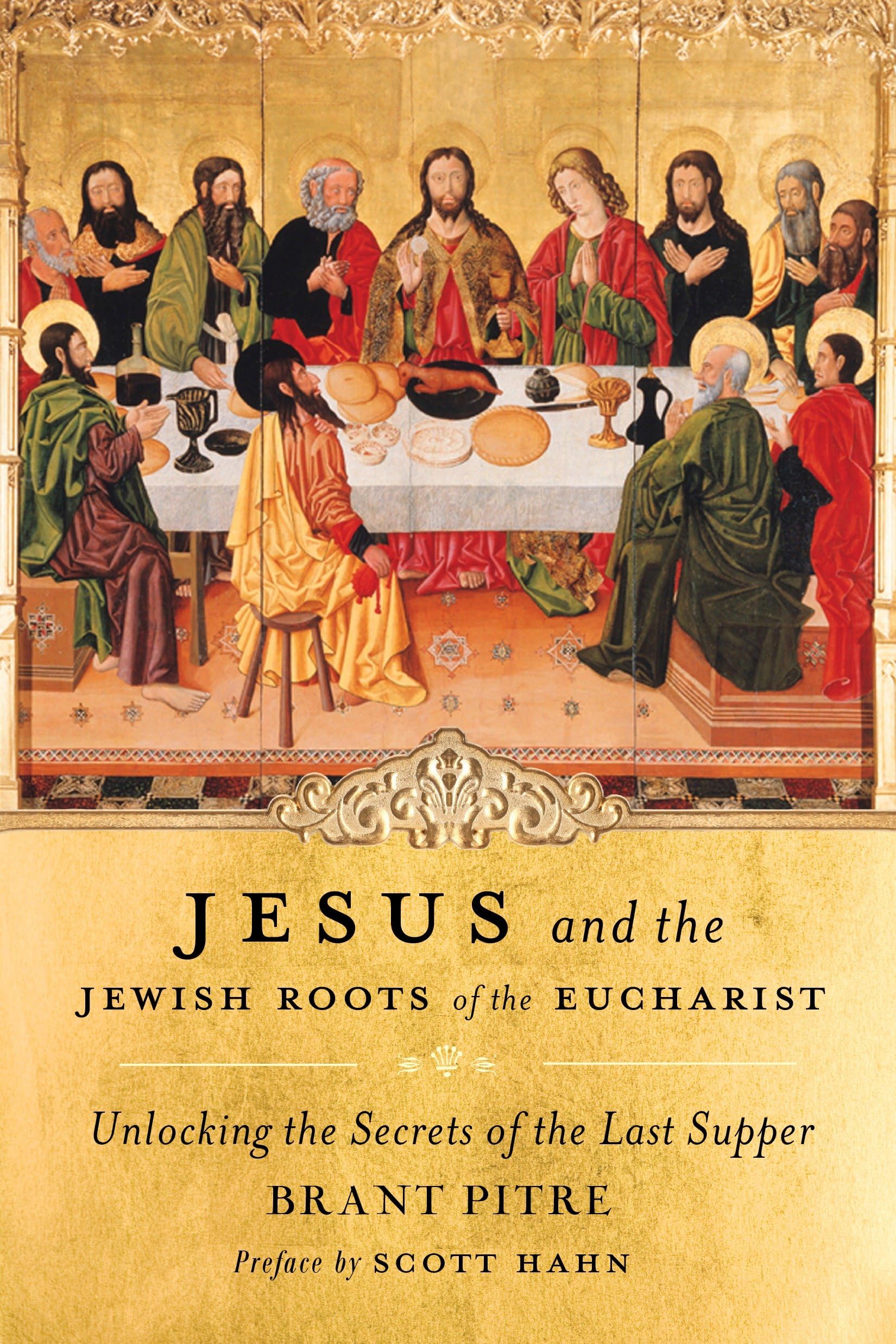
Jesus and the Jewish Roots of the Eucharist: Unlocking the Secrets of the Last Supper [Brant Pitre, Scott Hahn] on desertcart.com. *FREE* shipping on qualifying offers. Jesus and the Jewish Roots of the Eucharist: Unlocking the Secrets of the Last Supper Review: Behold, God's Love for You! - Jesus and The Jewish Roots of the Eucharist by Dr. Brant Pitre Review by Christine Calabrese “Behold, God’s love for you!” This book is a scholarly work, bringing us back to the cultural, liturgical and seasonal traditions of Judaism when Jesus of Nazareth graced the earth. I learned that there was a tradition handed down by Melchizedek, offering bread and wine as a sacrifice to the Lord God. The Ark of the Covenant contained bread (manna) from the exodus along with other important relics. This bread was brought out three times a year by the priests and held before the congregation with the words, “Behold, God’s love for you.” The manna during the Jewish exodus never lasted more than a day. Yet, as Catholics, we enjoy the Eucharist daily in every Mass we celebrate. Strikingly interesting! I knew from my protestant background that Jesus is the Passover Lamb, but the details escaped me. The lambs slain for Passover in Jesus’ time were tied to a cross. Passover was a big feast day for the Jews and thousands of spotless lambs were slain on the altar, which Jesus must have seen over his lifetime as He celebrated Passover annually. He knew exactly what lay ahead of Him. I also didn’t know that Jesus never finished the Passover meal with the disciples in the Upper Room – the last cup of wine was not drunk at that meal because it was His sacrifice. “By refusing to drink of the fruit of the vine until He gave up His final breath, He joined the offering of himself under the form of bread and wine to the offering of Himself on Calvary.” * Furthermore, the concept that Jesus is the new manna, and that the Jews were looking for the new manna, had escaped me prior to reading this book. To embrace the full meaning of this, one must truly understand Jewish historical culture: This bread was called, “The Bread of the Presence” and also “The Bread of the Face,” the tangible and physical sign of God’s presence on earth. The exodus from Egypt was truly a miraculous occurrence, and the Jews carried this hope of the new manna in their liturgy and hearts. Even though other religions believed in an afterlife, what separated them from the Jews was how the latter believed in the resurrection of the body. The Eucharist is closely tied to the resurrected body of our Lord. Jesus in His resurrected body is not limited by space and time and form. He can and will appear under any form He pleases, and He instituted and willed to appear under the form of the Eucharist. The author, Dr. Brant Pitre, captured my attention immediately upon describing an intense interview from a well-meaning Baptist pastor at a pre-marital interview. Dr. Pitre’s wife was a Baptist, and the marriage of a Baptist to a Catholic with strong beliefs can cause debate and conflict. Here, as a young man, he was questioned about the validity of the Eucharist, and this challenge spurred him on to deeper study and comprehension of his Catholic faith. Clearly Dr. Pitre has surpassed his goal because he now travels the country and lectures regarding the Eucharist and its incredibly beautiful history. Dr. Pitre makes it plain that none of his discoveries are new, and that in fact, they are clearly written in the Catholic Catechism. Unfortunately, an unstudied and unschooled Catholic can be caught off-guard by well-meaning protestants who question without understanding. This book, therefore, is a great accompaniment to any apologetic library. After reading the entire book, I discovered a lovely study guide supplied in the back! I’d recommend using this study guide in a bible study or book club, as it would help tremendously digging deeper into your faith. “Behold, God’s love for you!” *Jesus and the Jewish Roots of the Eucharist, p. 169 Review: An instant classic written by a true scholar - Brant Pitre's book, "Jesus and the Jewish Roots of the Eucharist", is a tour-de-force of biblical scholarship and theology. Although Jesus clearly stated that "salvation is from the Jews" (John 4:22) and although he told his disciples "The scribes and the Pharisees sit on Moses' seat; so practice and observe whatever they tell you" (Matt 23:2-3), far too often the Jewish roots of Christianity have been ignored. Although this is not true of works by Doctors of the Church--Jerome studied with Jewish rabbis before translating the Vulgate and Thomas Aquinas regularly drew from rabbis such as Maimonides in works like the Summa Theologiae--too many Christians today fail to see the unity of the Old and New Testaments. Moreover, too many modern Jews mistakenly suppose Christianity represents a denial and rejection of their tradition. This book successfully attempts to remedy these problems by, as I explain at the end of this review, challenging some common stereotypes. First, it is worth noting that Pitre's unimpeachable credentials as a scholar. Among other things, Pitre studied archaeology in Israel and received his Ph.D. from Notre Dame where he worked under world-class scholars such as John P. Meier and David Aune. His roughly 600-page doctoral dissertation ("Jesus, the Tribulation, and the End of the Exile") has been published by the prestigious German publisher Mohr Siebeck. It was later reprinted for American audiences by Baker Academic. The back cover of this edition contained endorsements by numerous leading historical Jesus scholars (Dale Allison, Scot McKnight, etc.). Yet, despite his first-rate training, Pitre has somehow figured out how to remain accessible to all audiences. Without oversimplifying, Pitre engages the reader with an easy-to-read style. The book, Jesus and the Jewish Roots of the Eucharist, displays his incredible grasp of scholarship. For example, in one end-note (12: "Jesus lived in an ancient Jewish context") Pitre draws from 12 independent sources, bringing together works written by Catholics (Pope Benedict XVI, John P. Meier, Ben Meyer), non-Catholic Christians (N.T. Wright, Craig Evans, E.P. Sanders) and Jewish scholars (David Flusser, Geza Vermes, A.J. Levine, Joseph Klausner). His familiarity with scholarship is stunning. In this one footnote alone Pitre lists works written from 1925 to 2009! Yet, because these notes are at the back of the book, they never muddle Pitre's lucid presentation. (The complaint made by a few of the other reviews here that the book is poorly researched is, simply put, laughable. Perhaps such reviewers were derailed by the fact that the notes are found only at the back of the book. Indeed, anyone who finishes the book finds a treasure-trove of bibliographic references. The only way to miss them is to fail to read the whole work--that might explain some of the other reviews.) One of the most impressive aspects of the book is Pitre's careful use of rabbinic sources such as the Mishna and the Babylonian Talmud. His appeal to such sources might at first be surprising. Not only were these works written after the time of Jesus, they also contain some problematic historical claims and even some shockingly anti-Christian messages. Yet (again contrary to what other reviews have claimed) Pitre is not oblivious to such problems. He writes, "I want to stress here that I am not suggesting that Jesus himself would have read any of these, some of which were written down long after his death" (p. 19). Nonetheless, Pitre shows that these sources contain material strikingly similar to what we find in the Gospels. Pitre thus shows an incredible continuity between ancient Jewish expectations and Christianity--i.e., the New Testament seems to describe the coming of what many Jews were looking to arrive in the Eschatological Age, i.e., the age of the Messiah. In other words, even anti-Christian rabbis expected the Messiah to look like Jesus in many ways and to do the kinds of things he did. In other words, studying the Old Testament hopes, the rabbis came to believe in a future age which, strikingly, looks like what Jesus came to proclaim as arriving. For example, as Pitre shows, such sources envision the future Messiah as a "New Moses" who will give "bread from heaven". Amazingly, this is also how the Gospels depict Jesus: he is like Moses (e.g., he fasts for forty days and forty nights, like Moses did in Exod 34:28) and he promises to deliver the true manna (cf. the Bread of Life discourse in John 6). What emerges from all of this is a clear impression that those who studied the Hebrew Bible would have recognized its hopes being fulfilled in Jesus' ministry--often in unexpected and striking ways. In fact, Pitre goes on to show how thoroughly saturated the New Testament is with such allusions to Jewish hopes. Even passages that are familiar to Christians, such as the Our Father, contain Old Testament imagery that is often overlooked. One of the most exciting sections, for example, examines the petition, "Give us this day our daily bread." Drawing on the work of other biblical scholars, Pitre shows how the redundancy in language here (this day. . . our daily) seems to evoke imagery of the manna in the desert--i.e., the bread which provided for the "daily" needs of Israel in the desert (Exod 16). Indeed, anyone with any familiarity of scholarship knows that these sources are--when used carefully--a valuable aid in understanding the Jewish world of the Gospels. One should not attempt to use them uncritically as previous scholars did, but at the same time one cannot dismiss them as completely irrelevant as, for example, anti-Semitic authors might advocate. While written down at a later time, they clearly contain ancient traditions that go back to the time of Jesus. As Pitre writes, "What I am arguing is that many [of these sources] bear witness to ancient Jewish traditions that may have circulated at the time of Jesus and which demonstrate the remarkable power to explain passages in the New Testament that reflect Jewish practices and beliefs" (p. 19). The power of such an approach is in the pudding. Here then is a brief overview. Chapter 1: Introduction to some of the problems (i.e., how could Jesus tell the disciples to eat his body when such a command clearly violated Old Testament laws). Chapter 2: The reader is introduced to some of the key texts in Scripture and later Jewish sources which detail what ancient Jews were expecting: a New Exodus, namely, (1) a New Moses, (2) A New Covenant, (3) A New Temple, and (4) A New Promised Land. Chapter 3: Pitre shows how Jesus is presented as the New Passover Lamb, offering a careful look in particular at the Gospel narratives of the Last Supper and Jesus' death. One things that especially stands out in this section is Pitre's use of recent Jewish scholarship which has shown that in the first century Passover lambs appeared to be "crucified," a tradition also attested in the early writing of Justin Martyr. The implications for understanding Jesus' death--e.g., why he chose the Passover as the context for his climactic confrontation with Jewish leaders that led to his death. Chapter 4: Pitre looks at Jesus' teachings which appear to relate to hopes for the coming of a New Manna, i.e., "bread of the angels" (cf. Ps 78:23-25, 29). In particular, Pitre examines the Bread of Life Discourse where this imagery is clearly alluded to by Jesus. The Eucharistic connection of the sermon is clear not only by the fact that the language ("eat my flesh. . . drink my blood") is especially similar to that used at the Last Supper ("Take. . . eat . . . this is my body. . . Drink . . . This is my blood"), but also by the fact that the sermon follows a miracle in which Jesus takes bread, blesses it, breaks it, and gives it to the disciples--actions early Christians would have clearly identified as Eucharistic. Chapter 5: Pitre looks at the mysterious Bread of the Presence in the Old Testament. At the end of the book the reader discovers that this element of Jewish worship was linked by the early Christians to the Eucharist. Pitre here makes sense of how this connection was made. Chapter 6: Pitre admits that this chapter is more "speculative" than the rest of his book (p. 148), however, his careful argumentation is entirely persuasive. Specifically, Pitre shows that in ancient Judaism the Passover meal was structured around four "cups" of wine. Pitre, drawing on other scholars such as Daube, shows that this structure seems attested to in the Gospel accounts of the Last Supper (cf. Luke 22:17, 20 which makes reference to multiple cups). Interestingly, in Jewish tradition the third cup seems to have been identified as the cup of blessing--the title St. Paul assigns to the Eucharistic cup (1 Cor 10:16). With these and other observations, Pitre concludes with other scholars that the Eucharistic words of Jesus were pronounced over the "third" cup. Pitre then looks at a number of passages in the Passion Narrative where the "cup" imagery is played out, e.g., Jesus vows not to drink wine until the coming of the kingdom, he prays that he will not have to drink the cup in the Garden, and he finally dies after drinking from a sponge. Speculative, perhaps; convincing, very much so--you'll just have to read it to find out. Chapter 7: Pitre demonstrates that nothing in the book is really all that new. Pitre demonstrates that the "ground-breaking" connections he has described throughout the book between Jewish images and the Last Supper were seen long ago in the writings of the early Christians. This ending is breath-taking--the incredible insights of the book are shown to be completely consistent with the approach of the earliest Christians, who clearly saw the Eucharist in terms of Passover imagery, Manna imagery, and the Bread of Presence, just as Pitre has argued. As another reviewer mentioned, Pitre is working on another book--an academic monograph devoted to the Last Supper. This book is a promising down-payment on that project. In sum, "Jesus and the Jewish Roots of the Eucharist" challenges many stereo-types. It definitely puts to rest the lie that Catholics are ignorant of the Bible. It may be uncomfortable for those who wish Jesus were nothing more than a Protestant preacher opposed to all forms liturgy (unlike ancient Jews!). It may also be problematic for radical traditionalists who cling to the idea that Judaism and Christian faith are diametrically opposed to one another (contrary to what Vatican II taught). But for those eager to delve deep into Scripture and the Eucharistic theology of historic Christianity with an open mind, it will not disappoint. In fact, it will likely change the way you look at Christian worship.


| Best Sellers Rank | #16,693 in Books ( See Top 100 in Books ) #2 in Worship Sacraments #7 in Christology (Books) #8 in History of Judaism |
| Customer Reviews | 4.8 4.8 out of 5 stars (2,768) |
| Dimensions | 5.7 x 1 x 8.52 inches |
| Edition | First Edition |
| ISBN-10 | 0385531842 |
| ISBN-13 | 978-0385531849 |
| Item Weight | 13.2 ounces |
| Language | English |
| Print length | 240 pages |
| Publication date | February 15, 2011 |
| Publisher | Image |
| Reading age | 1 year and up |
C**R
Behold, God's Love for You!
Jesus and The Jewish Roots of the Eucharist by Dr. Brant Pitre Review by Christine Calabrese “Behold, God’s love for you!” This book is a scholarly work, bringing us back to the cultural, liturgical and seasonal traditions of Judaism when Jesus of Nazareth graced the earth. I learned that there was a tradition handed down by Melchizedek, offering bread and wine as a sacrifice to the Lord God. The Ark of the Covenant contained bread (manna) from the exodus along with other important relics. This bread was brought out three times a year by the priests and held before the congregation with the words, “Behold, God’s love for you.” The manna during the Jewish exodus never lasted more than a day. Yet, as Catholics, we enjoy the Eucharist daily in every Mass we celebrate. Strikingly interesting! I knew from my protestant background that Jesus is the Passover Lamb, but the details escaped me. The lambs slain for Passover in Jesus’ time were tied to a cross. Passover was a big feast day for the Jews and thousands of spotless lambs were slain on the altar, which Jesus must have seen over his lifetime as He celebrated Passover annually. He knew exactly what lay ahead of Him. I also didn’t know that Jesus never finished the Passover meal with the disciples in the Upper Room – the last cup of wine was not drunk at that meal because it was His sacrifice. “By refusing to drink of the fruit of the vine until He gave up His final breath, He joined the offering of himself under the form of bread and wine to the offering of Himself on Calvary.” * Furthermore, the concept that Jesus is the new manna, and that the Jews were looking for the new manna, had escaped me prior to reading this book. To embrace the full meaning of this, one must truly understand Jewish historical culture: This bread was called, “The Bread of the Presence” and also “The Bread of the Face,” the tangible and physical sign of God’s presence on earth. The exodus from Egypt was truly a miraculous occurrence, and the Jews carried this hope of the new manna in their liturgy and hearts. Even though other religions believed in an afterlife, what separated them from the Jews was how the latter believed in the resurrection of the body. The Eucharist is closely tied to the resurrected body of our Lord. Jesus in His resurrected body is not limited by space and time and form. He can and will appear under any form He pleases, and He instituted and willed to appear under the form of the Eucharist. The author, Dr. Brant Pitre, captured my attention immediately upon describing an intense interview from a well-meaning Baptist pastor at a pre-marital interview. Dr. Pitre’s wife was a Baptist, and the marriage of a Baptist to a Catholic with strong beliefs can cause debate and conflict. Here, as a young man, he was questioned about the validity of the Eucharist, and this challenge spurred him on to deeper study and comprehension of his Catholic faith. Clearly Dr. Pitre has surpassed his goal because he now travels the country and lectures regarding the Eucharist and its incredibly beautiful history. Dr. Pitre makes it plain that none of his discoveries are new, and that in fact, they are clearly written in the Catholic Catechism. Unfortunately, an unstudied and unschooled Catholic can be caught off-guard by well-meaning protestants who question without understanding. This book, therefore, is a great accompaniment to any apologetic library. After reading the entire book, I discovered a lovely study guide supplied in the back! I’d recommend using this study guide in a bible study or book club, as it would help tremendously digging deeper into your faith. “Behold, God’s love for you!” *Jesus and the Jewish Roots of the Eucharist, p. 169
M**R
An instant classic written by a true scholar
Brant Pitre's book, "Jesus and the Jewish Roots of the Eucharist", is a tour-de-force of biblical scholarship and theology. Although Jesus clearly stated that "salvation is from the Jews" (John 4:22) and although he told his disciples "The scribes and the Pharisees sit on Moses' seat; so practice and observe whatever they tell you" (Matt 23:2-3), far too often the Jewish roots of Christianity have been ignored. Although this is not true of works by Doctors of the Church--Jerome studied with Jewish rabbis before translating the Vulgate and Thomas Aquinas regularly drew from rabbis such as Maimonides in works like the Summa Theologiae--too many Christians today fail to see the unity of the Old and New Testaments. Moreover, too many modern Jews mistakenly suppose Christianity represents a denial and rejection of their tradition. This book successfully attempts to remedy these problems by, as I explain at the end of this review, challenging some common stereotypes. First, it is worth noting that Pitre's unimpeachable credentials as a scholar. Among other things, Pitre studied archaeology in Israel and received his Ph.D. from Notre Dame where he worked under world-class scholars such as John P. Meier and David Aune. His roughly 600-page doctoral dissertation ("Jesus, the Tribulation, and the End of the Exile") has been published by the prestigious German publisher Mohr Siebeck. It was later reprinted for American audiences by Baker Academic. The back cover of this edition contained endorsements by numerous leading historical Jesus scholars (Dale Allison, Scot McKnight, etc.). Yet, despite his first-rate training, Pitre has somehow figured out how to remain accessible to all audiences. Without oversimplifying, Pitre engages the reader with an easy-to-read style. The book, Jesus and the Jewish Roots of the Eucharist, displays his incredible grasp of scholarship. For example, in one end-note (12: "Jesus lived in an ancient Jewish context") Pitre draws from 12 independent sources, bringing together works written by Catholics (Pope Benedict XVI, John P. Meier, Ben Meyer), non-Catholic Christians (N.T. Wright, Craig Evans, E.P. Sanders) and Jewish scholars (David Flusser, Geza Vermes, A.J. Levine, Joseph Klausner). His familiarity with scholarship is stunning. In this one footnote alone Pitre lists works written from 1925 to 2009! Yet, because these notes are at the back of the book, they never muddle Pitre's lucid presentation. (The complaint made by a few of the other reviews here that the book is poorly researched is, simply put, laughable. Perhaps such reviewers were derailed by the fact that the notes are found only at the back of the book. Indeed, anyone who finishes the book finds a treasure-trove of bibliographic references. The only way to miss them is to fail to read the whole work--that might explain some of the other reviews.) One of the most impressive aspects of the book is Pitre's careful use of rabbinic sources such as the Mishna and the Babylonian Talmud. His appeal to such sources might at first be surprising. Not only were these works written after the time of Jesus, they also contain some problematic historical claims and even some shockingly anti-Christian messages. Yet (again contrary to what other reviews have claimed) Pitre is not oblivious to such problems. He writes, "I want to stress here that I am not suggesting that Jesus himself would have read any of these, some of which were written down long after his death" (p. 19). Nonetheless, Pitre shows that these sources contain material strikingly similar to what we find in the Gospels. Pitre thus shows an incredible continuity between ancient Jewish expectations and Christianity--i.e., the New Testament seems to describe the coming of what many Jews were looking to arrive in the Eschatological Age, i.e., the age of the Messiah. In other words, even anti-Christian rabbis expected the Messiah to look like Jesus in many ways and to do the kinds of things he did. In other words, studying the Old Testament hopes, the rabbis came to believe in a future age which, strikingly, looks like what Jesus came to proclaim as arriving. For example, as Pitre shows, such sources envision the future Messiah as a "New Moses" who will give "bread from heaven". Amazingly, this is also how the Gospels depict Jesus: he is like Moses (e.g., he fasts for forty days and forty nights, like Moses did in Exod 34:28) and he promises to deliver the true manna (cf. the Bread of Life discourse in John 6). What emerges from all of this is a clear impression that those who studied the Hebrew Bible would have recognized its hopes being fulfilled in Jesus' ministry--often in unexpected and striking ways. In fact, Pitre goes on to show how thoroughly saturated the New Testament is with such allusions to Jewish hopes. Even passages that are familiar to Christians, such as the Our Father, contain Old Testament imagery that is often overlooked. One of the most exciting sections, for example, examines the petition, "Give us this day our daily bread." Drawing on the work of other biblical scholars, Pitre shows how the redundancy in language here (this day. . . our daily) seems to evoke imagery of the manna in the desert--i.e., the bread which provided for the "daily" needs of Israel in the desert (Exod 16). Indeed, anyone with any familiarity of scholarship knows that these sources are--when used carefully--a valuable aid in understanding the Jewish world of the Gospels. One should not attempt to use them uncritically as previous scholars did, but at the same time one cannot dismiss them as completely irrelevant as, for example, anti-Semitic authors might advocate. While written down at a later time, they clearly contain ancient traditions that go back to the time of Jesus. As Pitre writes, "What I am arguing is that many [of these sources] bear witness to ancient Jewish traditions that may have circulated at the time of Jesus and which demonstrate the remarkable power to explain passages in the New Testament that reflect Jewish practices and beliefs" (p. 19). The power of such an approach is in the pudding. Here then is a brief overview. Chapter 1: Introduction to some of the problems (i.e., how could Jesus tell the disciples to eat his body when such a command clearly violated Old Testament laws). Chapter 2: The reader is introduced to some of the key texts in Scripture and later Jewish sources which detail what ancient Jews were expecting: a New Exodus, namely, (1) a New Moses, (2) A New Covenant, (3) A New Temple, and (4) A New Promised Land. Chapter 3: Pitre shows how Jesus is presented as the New Passover Lamb, offering a careful look in particular at the Gospel narratives of the Last Supper and Jesus' death. One things that especially stands out in this section is Pitre's use of recent Jewish scholarship which has shown that in the first century Passover lambs appeared to be "crucified," a tradition also attested in the early writing of Justin Martyr. The implications for understanding Jesus' death--e.g., why he chose the Passover as the context for his climactic confrontation with Jewish leaders that led to his death. Chapter 4: Pitre looks at Jesus' teachings which appear to relate to hopes for the coming of a New Manna, i.e., "bread of the angels" (cf. Ps 78:23-25, 29). In particular, Pitre examines the Bread of Life Discourse where this imagery is clearly alluded to by Jesus. The Eucharistic connection of the sermon is clear not only by the fact that the language ("eat my flesh. . . drink my blood") is especially similar to that used at the Last Supper ("Take. . . eat . . . this is my body. . . Drink . . . This is my blood"), but also by the fact that the sermon follows a miracle in which Jesus takes bread, blesses it, breaks it, and gives it to the disciples--actions early Christians would have clearly identified as Eucharistic. Chapter 5: Pitre looks at the mysterious Bread of the Presence in the Old Testament. At the end of the book the reader discovers that this element of Jewish worship was linked by the early Christians to the Eucharist. Pitre here makes sense of how this connection was made. Chapter 6: Pitre admits that this chapter is more "speculative" than the rest of his book (p. 148), however, his careful argumentation is entirely persuasive. Specifically, Pitre shows that in ancient Judaism the Passover meal was structured around four "cups" of wine. Pitre, drawing on other scholars such as Daube, shows that this structure seems attested to in the Gospel accounts of the Last Supper (cf. Luke 22:17, 20 which makes reference to multiple cups). Interestingly, in Jewish tradition the third cup seems to have been identified as the cup of blessing--the title St. Paul assigns to the Eucharistic cup (1 Cor 10:16). With these and other observations, Pitre concludes with other scholars that the Eucharistic words of Jesus were pronounced over the "third" cup. Pitre then looks at a number of passages in the Passion Narrative where the "cup" imagery is played out, e.g., Jesus vows not to drink wine until the coming of the kingdom, he prays that he will not have to drink the cup in the Garden, and he finally dies after drinking from a sponge. Speculative, perhaps; convincing, very much so--you'll just have to read it to find out. Chapter 7: Pitre demonstrates that nothing in the book is really all that new. Pitre demonstrates that the "ground-breaking" connections he has described throughout the book between Jewish images and the Last Supper were seen long ago in the writings of the early Christians. This ending is breath-taking--the incredible insights of the book are shown to be completely consistent with the approach of the earliest Christians, who clearly saw the Eucharist in terms of Passover imagery, Manna imagery, and the Bread of Presence, just as Pitre has argued. As another reviewer mentioned, Pitre is working on another book--an academic monograph devoted to the Last Supper. This book is a promising down-payment on that project. In sum, "Jesus and the Jewish Roots of the Eucharist" challenges many stereo-types. It definitely puts to rest the lie that Catholics are ignorant of the Bible. It may be uncomfortable for those who wish Jesus were nothing more than a Protestant preacher opposed to all forms liturgy (unlike ancient Jews!). It may also be problematic for radical traditionalists who cling to the idea that Judaism and Christian faith are diametrically opposed to one another (contrary to what Vatican II taught). But for those eager to delve deep into Scripture and the Eucharistic theology of historic Christianity with an open mind, it will not disappoint. In fact, it will likely change the way you look at Christian worship.
R**.
Fascinating Study that Links the Manna of the Jewish Exodus with the Eucharistic Sacrifice of Jesus
This is a fascinating book that is concise and clearly written. The author gives modern Christians a new appreciation of how Jews regarded the Passover. The Jews regarded the Passover as a sacrifice in remembrance of their covenant with God. Also, the priests practiced a rite of un-bloody sacrifice with bread and wine in the Temple every Sunday. Furthermore, they expected a new manna from the Messiah. The author then establishes how Jesus Christ's teachings deal with those expectations of the 1st Century Jews. The Last Supper is a Passover sacrifice that comes to completion with Christ's crucifixion and death on the Cross. The author further demonstrates that Jesus is NOT speaking of a symbol when he tells his disciples several times that they must consume his flesh and drink his blood for eternal life. Yes, as the original Jewish disciples stated, "This is a hard saying" and many left Christ at that point. Christ is speaking of his resurrected body and blood hidden in the appearance of bread and wine. The author argues that this is also indicated within the Lord's Prayer in which we receive our "daily bread." The Greek word epiousios was used by the authors of the Gospels, and this was translated as supersubstantial (i.e., supernatural) in the Latin Vulgate by St. Jerome. The author is Catholic and this book has been granted an imprimatur. I highly recommend this book and it gave me additional background on the Eucharist. A minor criticism is that this book does not have a bibliography. However, the notes do indicate the sources used.
P**O
As a Protestant Christian, I found this book to be deeply enriching and insightful. It offered countless eye-opening moments that challenged and expanded my understanding. The wisdom and knowledge shared within these pages will undoubtedly deepen your faith and enhance your worship of Christ.
S**A
à lire pour comprendre ( découvrir je dirais en ce qui me concerne ) les racines dans le judaïsme de l'institution de l'Eucharistie : mieux comprendre la passion , la cène , les gestes et le projet de Jésus : vraiment une révélation +++ et cela malgré la non traduction( regrettable ) en français - l'anglais y est très facile à lire ( avec un lien "reverso" à portée de souris et c'est impeccable)
S**Y
Beautifully written highlighting many connections with the Jewish passover and the Eucharist. Gave me an appreciation of the Jewish roots of the Eucharist and how the early Church celebrated the Eucharist. It will strengthen your faith and make you appeciate the great gift of God in the most Holy Eucharist, the source and summit of our Christian faith.
A**O
Simplemente va uno quedando maravillado cada que el libro toca un elemento de la cena pascual y lo ilumina con su contexto judío y bíblico. Después de leerlo gusta uno más el rito, la significación y el misterio de la Eucaristía. Su autor fundamenta su opinión con razones percisas, cosa que hace también y más en otros de sus libros.
A**A
Dr. Brant pitre is just awesome...
Trustpilot
2 weeks ago
3 days ago