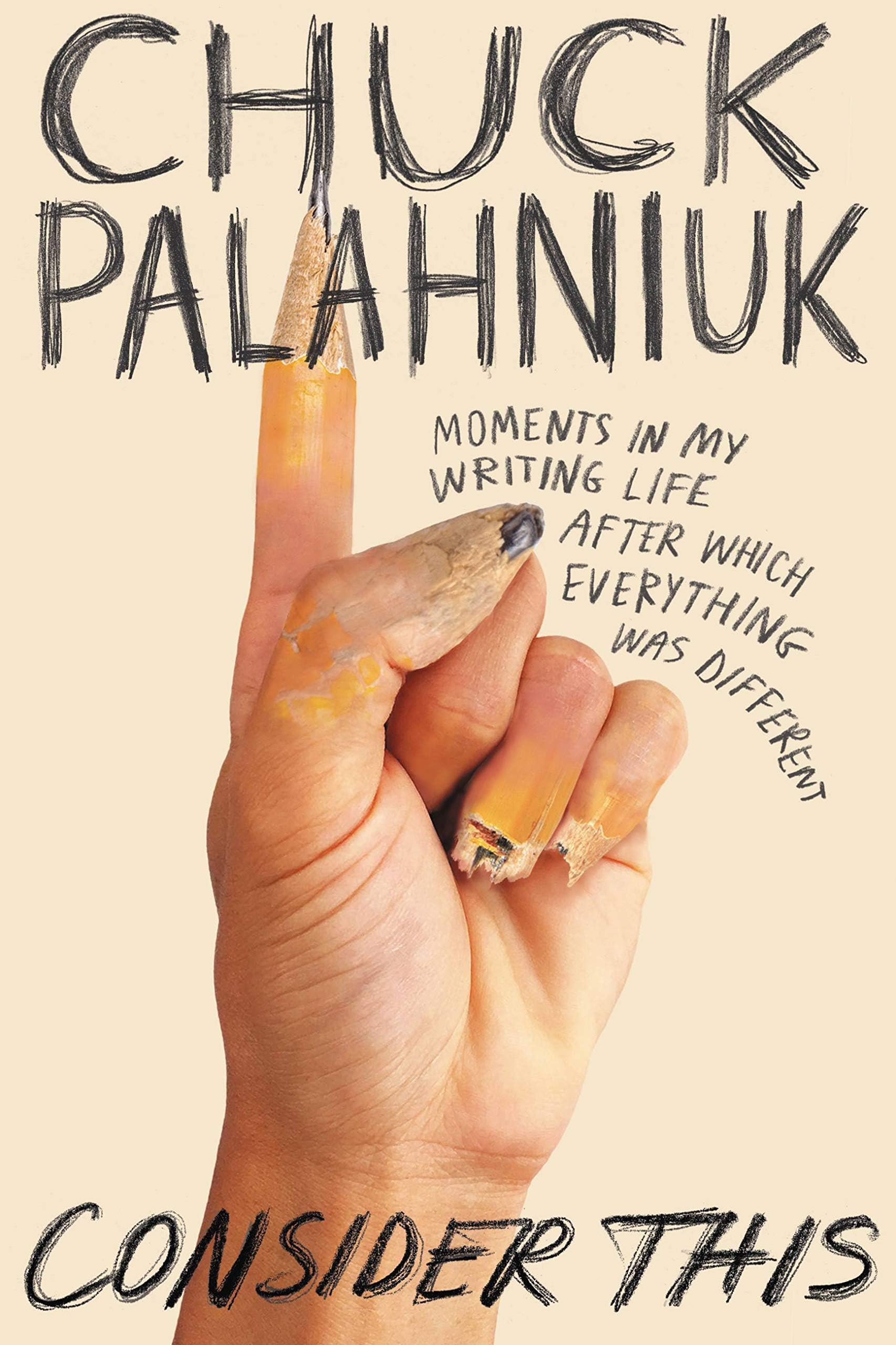
Consider This: Moments in My Writing Life after Which Everything Was Different
Product ID: 146276729
Buy anything from 5,000+ international stores. One checkout price. No surprise fees. Join 2M+ shoppers on Desertcart.
Desertcart purchases this item on your behalf and handles shipping, customs, and support to Iceland.
In this spellbinding blend of memoir and insight, bestselling author Chuck Palahniuk shares stories and generous advice on what makes for powerful writing. With advice grounded in years of careful study and a keenly observed life, Palahniuk combines practical advice and concrete examples from beloved classics, his own books, and a "kitchen-table MFA" culled from an evolving circle of beloved authors and artists, with anecdotes, postcards from the road, and much more. Clear-eyed, sensitive, illuminating, and knowledgeable, Consider This is Palahniuk's love letter to stories and storytellers, booksellers and books themselves. Consider it a classic in the making. Review: An outstanding, memorable book - Consider This: Moments in My Writing After Which Everything Was Different by Chuck Palahniuk is a practical guide to constructing novels/short stories according to Dangerous Writing. Dangerous Writing is a philosophy about how novels could be used as tools to engage readers into discussions, touch burning social topics, and do all that in a provocative, straightforward fashion. If you do not feel personally offended, reading about masturbation and defective sex dolls (and I forgot to mention graphic sexual scenes and profane language), the book would certainly be handy for writing your pieces. In the almost intimate manner that combines juxtaposed essays and step-by-step techniques, Palahniuk helps to understand the rules of keeping the reader constantly on the verge, unaware of what comes next. He talks about creating tension, effective use of dialogues (avoid them as much as possible!), and gives away his personal favorite fiction/nonfiction books. The fabulous vocabulary of the book is a cherry on the cake. I read three of Palahniuk’s books, all in Russian. Oh boy! How much I must have missed! Though one of his principles includes simple sentences, the overall flow of words is flawless. I swallowed the book; I can’t find another word to describe the process of reading. With half-opened eyes in the night, accompanied by cries of fighting children during the day, everything seemed like a pesky hindrance until the last page. And even then, I wanted more. Chuck Palahniuk confessed he had never read any reviews on his books, good or bad. So there is a slight chance he’d see my plea to publish another handbook about writing. I add the book into the category of the most notable books of 2021. Helpful, fast-pacing, engaging to the point of madness; in one word – a recommendation to all aspiring writers. (I ask for pardon for ignoring one of the basic rules of the book: use forms of ‘be’ and ‘have’ as little as possible.) Review: Thanks for the memories. - First of all, this is NOT a work of fiction, it's a compilation of anecdotes, teachings and ideas. That said, it is written in the same energetic way his novels are. So, if you like Chuck Palahniuk's storytelling you'll like this book. It is quite heart-warming and hopeful.
| Best Sellers Rank | #402,834 in Books ( See Top 100 in Books ) #24 in Creative Writing Composition #54 in Authorship Reference #1,307 in Memoirs (Books) |
| Customer Reviews | 4.7 out of 5 stars 1,489 Reviews |
D**N
An outstanding, memorable book
Consider This: Moments in My Writing After Which Everything Was Different by Chuck Palahniuk is a practical guide to constructing novels/short stories according to Dangerous Writing. Dangerous Writing is a philosophy about how novels could be used as tools to engage readers into discussions, touch burning social topics, and do all that in a provocative, straightforward fashion. If you do not feel personally offended, reading about masturbation and defective sex dolls (and I forgot to mention graphic sexual scenes and profane language), the book would certainly be handy for writing your pieces. In the almost intimate manner that combines juxtaposed essays and step-by-step techniques, Palahniuk helps to understand the rules of keeping the reader constantly on the verge, unaware of what comes next. He talks about creating tension, effective use of dialogues (avoid them as much as possible!), and gives away his personal favorite fiction/nonfiction books. The fabulous vocabulary of the book is a cherry on the cake. I read three of Palahniuk’s books, all in Russian. Oh boy! How much I must have missed! Though one of his principles includes simple sentences, the overall flow of words is flawless. I swallowed the book; I can’t find another word to describe the process of reading. With half-opened eyes in the night, accompanied by cries of fighting children during the day, everything seemed like a pesky hindrance until the last page. And even then, I wanted more. Chuck Palahniuk confessed he had never read any reviews on his books, good or bad. So there is a slight chance he’d see my plea to publish another handbook about writing. I add the book into the category of the most notable books of 2021. Helpful, fast-pacing, engaging to the point of madness; in one word – a recommendation to all aspiring writers. (I ask for pardon for ignoring one of the basic rules of the book: use forms of ‘be’ and ‘have’ as little as possible.)
G**G
Thanks for the memories.
First of all, this is NOT a work of fiction, it's a compilation of anecdotes, teachings and ideas. That said, it is written in the same energetic way his novels are. So, if you like Chuck Palahniuk's storytelling you'll like this book. It is quite heart-warming and hopeful.
H**S
Chuck at His Best
This is Chuck at his best. I've used Palahniuk's writing "craft" essays on LitReactor as a reference for years. Look them up if you've never heard of them. Those essays are so good I wondered if there was any way of topping them. Or if he would simply use this book to repeat what he had written there. What I discovered is that in "Consider This," he has managed to share all of that information in new ways, expand it, and share some great personal stories along the way. I've read a ton of writing books about writing. "Consider This" is now at the top of the list for books on writing I would recommend. All of the classic minimalist/dangerous writing principles are unpacked in helpful ways: Having horses and choruses, going on the body, burnt tongue, establishing authority, etc. On the subject of authority alone, he gives us around twenty ways to establish authority in a story. They're all helpful. He gives around the same amount of principles for building and sustaining tension as well. To top it off, the book is written very, very well. It was a pleasure to read. I was sad that it ended, but loved that Palahniuk tells his wonderful Eiffel Tower story to close the book. It's the first time I've seen it in print. I can't recommend this book more highly.
A**S
If You Have a Story to Tell
Chuck Palahniuk, the author of Fight Club, provides a no holds barred account of how to write fiction as well as an account of his writing life. Never having written a work of fiction, I can’t comment on the efficacy of Palahniuk’s writing exercises or his various tips on writing. To my amateur eye, they seem like good advice and, despite the obvious difference in tone, many seem similar to Strunk and White’s Elements of Style. What I can provide is a summary of what to expect if you read this guide as well as who should read it. A former blue-collar worker, Palahniuk intersperses the guide with personal anecdotes that in total encompass a philosophy, or at least, an outlook on life. Rough around the edges, this perspective does not shy away from life’s darker sides: violence, death, perversion, insanity, etc. But it also contains a genuine desire to connect to his readers and to benefit them by his writing. He largely addresses beginning writers. He doesn’t hide the difficulty of making a living writing fiction at a time when the novel is no longer the center of popular culture. Nor does he hide the fact that good writing is difficult and requires much practice. But he suggests that those who are passionate about the stories they have to tell should choose to write, whether or not they can make a living out of it. And how to tell stories is primarily what Palahniuk teaches. He illustrates his points by citing some of the best American fiction of the last one hundred years. Proust and Wolff, for example, are not mentioned since literary fiction with experimental styles is not at all the type of writing Palahniuk is interested in. But if you have stories that you think readers will want or need to hear, Palahniuk’s guide is as good as any to getting started. While it may appeal to the mixed martial arts viewing crowd the most, anyone really can benefit from his wisdom. The fact that the book embodies his philosophy all the while dispensing writing tips only provides more reason to read it. Highly recommended for would be writers of fiction.
P**S
Practical Useful Information
Palahniuk begins with the valid complaint that most, nearly all, creative writing seminars, courses, and programs consist of listening to some veteran writer or personality who has inflated his credentials, telling war stories. That observation is spot-on. It happens for several reasons: The department heads and administrators responsible for hiring creative writing instructors (or worse, the self-promoters of seminars) almost always choose published writers. Unfortunately, most published writers are not teachers, don't know how to teach, or don't care about teaching. The result is that very little in hard knowledge gets transmitted. Advice like: Engage the reader; Make your characters interesting; Start with a bang, is offered. Instructors present big general ideas with no practical advice as to how to implement them. Handholding, enthusiasm, or the promise that the instructor has contacts that will get the student published take the place of substantive knowledge and advice. Palahniuk says he can do better, and he does. For the first two chapters, he offers ideas and practical advice regarding their implementation in writing novels and short stories. In the third section, he begins to fall into the trap he described: the war story rambling and discussing general topics without concrete examples or implementation strategies, but some good information is present. I give the book five stars because if it consisted of only the first chapter, it would be better than 95% of the "how to write" books that are published. An excellent handbook, well done Mr. Palahniuk.
A**Y
Best book on writing I've ever read
Do NOT write to be liked but to be remembered. “Consider This: Moments in My Writing Life After Which Everything is Different” by Chuck Palahniuk is indisputably the best book on writing I have ever consumed. If you’re only going to purchase one piece on becoming a stronger writer, this is the masterpiece for your bookshelf. Enjoy this love letter to storytellers by one of the best storytellers of all time—a man whose public readings have yielded the fainting of at least 73 individuals. Intrusive, actionable, brimming with personal anecdotes, amusing, bizarre and inspiring, I promise you will learn something from this memoir. “Give readers more than they can handle alone. Give them so much humor or pathos or idea or profundity that they’re compelled to push the book on others if only to have peers with whom they can discuss it...we digest our experience by turning it into stories. Repeating the story—good or bad—allows us to exhaust the unresolved emotion of it.”
P**E
Profound, searing and useful
I'd have to say that this is the book that made me fall in love with Chuck Palahniuk. There's solid writing advice and tips in the chapters (although you could argue that they're reflective of Palahniuk's style as opposed to general writing practice). But I also love the postcards from the field tour chapters, which are anecdotes from his life. The two of my most favorite things from this book are the way Palahniuk says, of those he has known and loved, "may one of their many graves be in my head" and also how he repeatedly quotes, "The moment after which everything was different."
J**N
An Outstanding Read and Valuable Resource
This book is both entertaining and incredibly useful. So many great tips for aspiring storytellers and fiction writers. Palahniuk breaks complex concepts in a very practical way. By the time I finished the first few chapters I was already furiously scribbling notes on how to incorporate his concepts into a revision I'm currently working on for my next book. I thought "On Writing" by Stephen King was the best possible version of the "Talented-And-Prolific-Writer-Talks-About-His-Process" genre. Palahniuk takes it to the next level with this one. A "must have" for anyone writing fiction. This is a fantastic resource. Well done!
S**Y
The best book on writing you'll ever read
I've read a load of books about writing, and none of them can hold a candle to this one. Straight down the line good advice page after page after page. Specific, direct, easy to follow. He tells you what works and WHY it works. Bravo. Chuck (pun fully intended) in the anecdotes about his life in between the advice and it's a riveting read as well.
C**E
Fantástico
O autor é fantástico até para escrever como ele escreve suas histórias.
A**A
Brilliant read
Great for authors starting or otherwise. Hope to re-read it in few weeks .thanks Chuck for this treasure hope to see more on your writting experience
J**Y
Great Book Full of Original Advice
A fresh book on creative writing. If you've read all the usual ones on plot and writing in the active tense etc., etc., give this a shot. Looks at storytelling from original angles and is also very funny at times.
L**A
Consider the Versatility
While I haven't finished reading and digesting this book, I am at the half-day point, which is further along than I have achieved with other books. The flow of this book is well-suited to my neurodivergences, and the wisdom is so helpful. My brother recommended I read it, and he advised well. I have been struggling with writing for the past decade and I am feeling the block being chipped away since starting the book. Filled with analogies and technical notes, this is definitely a good choice for readers and writers alike.
Trustpilot
1 month ago
1 month ago