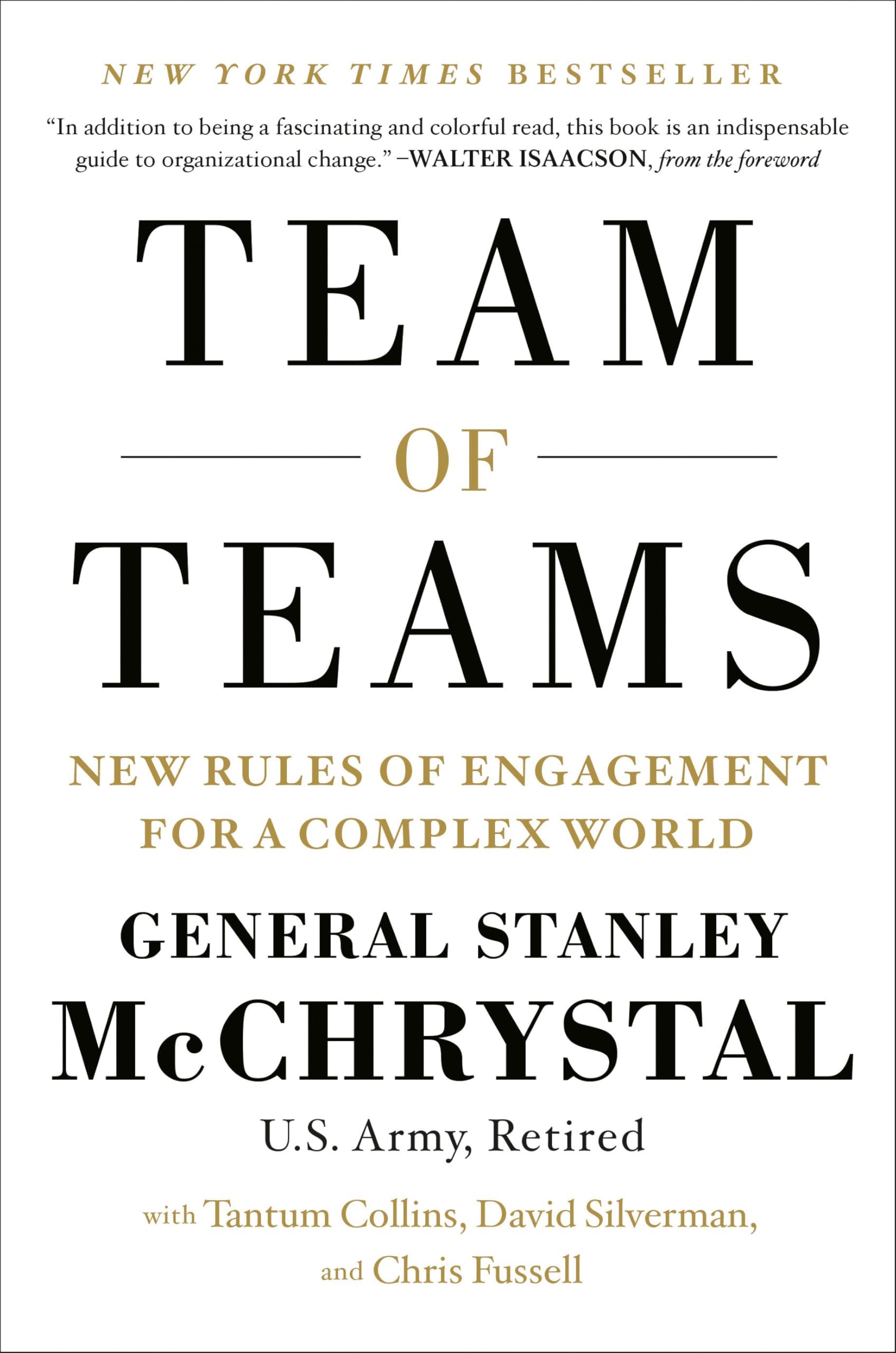
Team of Teams: New Rules of Engagement for a Complex World
Product ID: 14528554
Desertcart purchases this item on your behalf and handles shipping, customs, and support to Iceland.
Team of Teams: New Rules of Engagement for a Complex World [McChrystal, General Stanley, Collins, Tantum, Silverman, David, Fussell, Chris] on desertcart.com. *FREE* shipping on qualifying offers. Team of Teams: New Rules of Engagement for a Complex World Review: This May Not Be Just Another Book About Leadership - The stereotypical U.S. military general is a different figure for each of us, depending on our own experiences and attitudes toward the armed forces; and possibly also depending on the day of the week. Some may picture a cigar-chomping, trigger-happy warrior with an outsized ego. Others, a well-read, scholarly man-of –the world who thinks very deliberately about the lives that can be affected by his every decision. Still others may view the general as politician: after all, how else could a woman or man rise to the very top of the hierarchy if not for use of MacArthur-like charismatic flair to step over all challengers on the ladder to the top? If “Team of Teams” is an honest reflection of Stanley McChrystal’s views on what it takes to lead organizations that deal with the complex challenges brought about by the volume and speed of 21st century information, this ex-commander of the US Joint Special Operations Command (JSOC) in Iraq, may be a guy who will shatter some stereotypes about general officers. And, he deserves the ear of anyone, in any human endeavor, who wants to lead. This is a general who speaks of his leadership role as that of a gardener. And a good gardener works hard, knowing the plants and the soil intimately. Some of the book's critics have said that there is little new offered in the way of management theory. Possibly true: as a student of Agile leadership, I didn't see any novel ideas presented. Yet in the examples provided and the unique juxtaposition of ideas, "Team of Teams" offers something persuasive and memorable. McChrystal and his team of co-authors weave a series of gripping short stories about business successes and failures into the narrative, serving both to make “Team of Teams” an engrossing read, and to powerfully illustrate their viewpoint that successful leadership and management requires much different emphases than the focus on efficiency which made companies such as General Motors great in the 20th century. Whether contrasting the fates of two different passenger airline flights which ran into trouble while airborne, or candidly admitting the failures of JSOC to stop Al Qaida violence under his own command, McChrystal and his team relate each story to their central thesis that adaptability, information-sharing and decentralized authority have replaced efficiency and centralized decision-making as more and more 21st-century world challenges cross the threshold from being complicated (lots of moving parts, but potentially understandable) to complex (too many variables moving too quickly for any single human genius to master). This is a general who will tell you that trust and “shared consciousness,” both of which have to be cultivated, combine to form the epoxy that hold the 21st-century organization together. One powerful image found in “Team of Teams:” that the successful organization is no longer as a “well-oiled machine,” but rather, a “living organism.” The point is not that the organism no longer needs to stay in great shape, but rather that living organisms succeed to the extent that they respond appropriately and rapidly to the constant changes that take place both within it, and in its surroundings. Of the many stories and real-life examples which McChrystal’s team of authors use to buttress their case, the remembrance of British Admiral Horatio Nelson’s stunning victory over the combined French and Spanish fleets at Trafalgar in 1805 is a tale that contains many pearls for someone who wants to lead according to the “Team of Teams” approach. It is an oversimplification to say that Nelson broke naval convention by allowing his captains to break ranks and engage the enemy at will, without taking central direction from the flagship. The British victory had been years in the making, as Nelson had worked long and hard to develop his captains into the kind of team that would be capable of success in a naval engagement where anticipating each other’s actions was more important than which side had the superior firepower. The lesson for today’s leaders: it is not merely about turning people loose, but moreover about equipping them with the right tools, building the team mindset, focusing them on the common mission, and then trusting them to act in real time, in response to the ever-changing environment. “Team of Teams” should be read by anyone who wants to understand how to apply Agile leadership to their particular team, whatever the industry, sport, or other team endeavor. Review: Hard fought lessons created a new model - Team of Teams offers insights into the modern practice of leadership and management required to navigate and succeed in this complex world. The book is not a military history, but instead a concise and exceptionally “fun to read” collection of insightful ideas told through entertaining stories ranging from industry to hospital emergency rooms. I recommend it for leaders and associates from all types of organizations who need to break down the effects of siloed teams in which information flow and decision making is ineffective in today’s increasingly complex environment. If you are working your teams harder and putting more resources against a problem that isn’t improving, READ this book and be prepared to look closely in the mirror. The discussions in the book are grounded in organizational management theory and leadership methods, but along the way gives a once in a lifetime look at the inside of the most storied Special Operations Forces (SOF) unit in existence today. This is not a book about the latest way to become a great leader. In fact it’s about becoming the kind of senior leader that can develop and sustain an entire workforce of great leaders. The lessons the authors put forward to challenge the typical (and often failing) organizational models and leadership approaches were paid for in blood over the last decade. I do not come at this review as a scholar of organizational management but rather as a participant and recipient of the Team of Teams approach in the military where I was a leader for over 20 years. I have known the author for more than 2 decades having served as a front line Soldier and leader in his unit and also as his assistant/confidante/advisor during his most senior command. Stan, along with his 3 co-authors, believes that the world is now so complex (vice complicated) that the old models of command and control are extinct. They are so passionate about this evolution that they have started a successful consulting firm to share their lessons. I have worked with 90 plus U.S. and international organizations in and out of government and I cannot think of one that would not benefit from this study. An alternate title to this book might have been Trust and Purpose meets Empowered Execution. The Task Force’s journey towards shared consciousness and smart autonomy starts in 2003 with the stunning realization by the commander of the world’s most precise and lethal Counter-Terrorism Task Force that they were losing the strategic war against Al Qaeda. From there the authors interlace examples and case studies of organizational models, leadership techniques, and technological advances from a myriad of areas. They include weather forecasting, basketball and soccer, engineering marvels, big data, airline customer service, aircraft crews, NASA, SEAL training, plastic surgeons at the Boston Marathon bombing, GM versus Ford, MIT studies, and the enduring effects of Ritz Carlton and Nordstrom. My favorite example is the Star Wars bar comparison. The discussions found in the various chapters of the book are wide-ranging but relevant to leading all organizations in this modern world. The following should be of interest to today’s leaders: the difference between complicated and complex environments; how having more information available does not improve prediction nor mean lead to smarter decisions at the top; Taylorisms and efficiency ideals may actually cost you more than they save; the ‘need to know’ fallacy; the value of using your best people as ‘liaison officers’ or ‘embeds’; how resilient people make organizations stronger because they can adapt to changing environments; learning from your adversary is time well spent--they might have a better organizational model not necessarily better people; how to delegate authority to take action until you are uncomfortable; how to build trust and a shared awareness of the big picture; ‘eyes on, hands off’ leadership; and the difference between creating Strategic Corporals and an organization full of Lord Horatio Nelsons. The book carries you forward in time to see how far the Task Force had come by changing their culture, structure, and habits to allow the larger corporate command to become as agile and capable as its commandos. Pages 184-188 detail the successful operations that the “Task Force” were able to undertake after the shift. This short example, that covers just 46 minutes of a follow-on-target operation, highlights sharply the outcome of The Task Force’s investment in transparency, trust building and empowered execution. The command took risks and luckily their bosses supported them and let them learn to beat AQI at its own game. Sir Lieutenant General Lamb, a close friend of Stan McChrystal, shared a paper with me once that he titled 'In Command and Out of Control' and it raises a lot of the same questions and concepts about how to lead in a complex and fast-paced world. The conclusions were similar. Success comes from giving freedom to subordinates, increasing speed of action, achieving self-synchronization---in a nutshell: decentralized command. The concept is literally about getting 'out of the control' business and realizing that in order for organizations to take advantage of fleeting opportunities teams must be empowered at the lowest levels to take action. McChrystal echoes this and the need to repeatedly broadcast so that everyone knows the goals and strategy of the organization. This includes letting everyone in the organization have a say about the direction of the ship and feel free to alert others of impending icebergs. McChrystal and Lamb’s cooperation in Iraq was not by accident but from years of trust building and a shared awareness of the big picture. Missing from the book is a deeper discussion on the role of planning, plans, strategic thinking and strategy. While the Team of Teams approach allows organizations to be adaptable and resilient there is still a key role for planning and strategy. Maybe it’s as simple as the old adage ‘the plan is nothing but planning is everything’ or maybe this is the topic for their next book. Although its demonstrated throughout the book its unstated that great leaders are often well-read. Only by studying leaders and organizations can you begin to see the need for the Nelson touch, to avoid the Perry principle, or understand the butterfly effect. The book is only 250 pages long but it is full of simple time-tested ideas that can be put into action with little cost. The difficult part of acting within the shared consciousness that Stan McChrystal describes is getting your people to realize they are empowered to make decisions. This task mostly falls on the senior leaders of an organization. This method can be exhausting and requires resilient and disciplined leadership at all levels, but the rewards are unmatched. I have personally served in organizations that utilize shared consciousness and empowered execution or have previously undergone a Team of Teams evolution. The fact that the culture endures after the leader departs says a lot about how powerful a culture change in an organization can be. I have also served in government agencies that just couldn’t accept that their strength truly lied in informed and empowered employees. Luckily the latter are destined for the dustbin of history. More and more often today leaders reinforce an environment that speeds up business failure. The world has changed and leadership models haven't kept up. This book can show you how to adapt to the complex world we find ourselves in. Team of Teams documents how the most professional and deadly special operations force found itself humbled by an enemy that was better adapted to the 21st century way of war. More importantly it’s about how leaders at all levels need to be humble enough to realize when to change their old ways and trust their people to make rapid yet informed decisions.


| Best Sellers Rank | #13,076 in Books ( See Top 100 in Books ) #8 in Workplace Culture (Books) #84 in Leadership & Motivation #116 in Business Management (Books) |
| Customer Reviews | 4.6 out of 5 stars 4,552 Reviews |
D**O
This May Not Be Just Another Book About Leadership
The stereotypical U.S. military general is a different figure for each of us, depending on our own experiences and attitudes toward the armed forces; and possibly also depending on the day of the week. Some may picture a cigar-chomping, trigger-happy warrior with an outsized ego. Others, a well-read, scholarly man-of –the world who thinks very deliberately about the lives that can be affected by his every decision. Still others may view the general as politician: after all, how else could a woman or man rise to the very top of the hierarchy if not for use of MacArthur-like charismatic flair to step over all challengers on the ladder to the top? If “Team of Teams” is an honest reflection of Stanley McChrystal’s views on what it takes to lead organizations that deal with the complex challenges brought about by the volume and speed of 21st century information, this ex-commander of the US Joint Special Operations Command (JSOC) in Iraq, may be a guy who will shatter some stereotypes about general officers. And, he deserves the ear of anyone, in any human endeavor, who wants to lead. This is a general who speaks of his leadership role as that of a gardener. And a good gardener works hard, knowing the plants and the soil intimately. Some of the book's critics have said that there is little new offered in the way of management theory. Possibly true: as a student of Agile leadership, I didn't see any novel ideas presented. Yet in the examples provided and the unique juxtaposition of ideas, "Team of Teams" offers something persuasive and memorable. McChrystal and his team of co-authors weave a series of gripping short stories about business successes and failures into the narrative, serving both to make “Team of Teams” an engrossing read, and to powerfully illustrate their viewpoint that successful leadership and management requires much different emphases than the focus on efficiency which made companies such as General Motors great in the 20th century. Whether contrasting the fates of two different passenger airline flights which ran into trouble while airborne, or candidly admitting the failures of JSOC to stop Al Qaida violence under his own command, McChrystal and his team relate each story to their central thesis that adaptability, information-sharing and decentralized authority have replaced efficiency and centralized decision-making as more and more 21st-century world challenges cross the threshold from being complicated (lots of moving parts, but potentially understandable) to complex (too many variables moving too quickly for any single human genius to master). This is a general who will tell you that trust and “shared consciousness,” both of which have to be cultivated, combine to form the epoxy that hold the 21st-century organization together. One powerful image found in “Team of Teams:” that the successful organization is no longer as a “well-oiled machine,” but rather, a “living organism.” The point is not that the organism no longer needs to stay in great shape, but rather that living organisms succeed to the extent that they respond appropriately and rapidly to the constant changes that take place both within it, and in its surroundings. Of the many stories and real-life examples which McChrystal’s team of authors use to buttress their case, the remembrance of British Admiral Horatio Nelson’s stunning victory over the combined French and Spanish fleets at Trafalgar in 1805 is a tale that contains many pearls for someone who wants to lead according to the “Team of Teams” approach. It is an oversimplification to say that Nelson broke naval convention by allowing his captains to break ranks and engage the enemy at will, without taking central direction from the flagship. The British victory had been years in the making, as Nelson had worked long and hard to develop his captains into the kind of team that would be capable of success in a naval engagement where anticipating each other’s actions was more important than which side had the superior firepower. The lesson for today’s leaders: it is not merely about turning people loose, but moreover about equipping them with the right tools, building the team mindset, focusing them on the common mission, and then trusting them to act in real time, in response to the ever-changing environment. “Team of Teams” should be read by anyone who wants to understand how to apply Agile leadership to their particular team, whatever the industry, sport, or other team endeavor.
J**K
Hard fought lessons created a new model
Team of Teams offers insights into the modern practice of leadership and management required to navigate and succeed in this complex world. The book is not a military history, but instead a concise and exceptionally “fun to read” collection of insightful ideas told through entertaining stories ranging from industry to hospital emergency rooms. I recommend it for leaders and associates from all types of organizations who need to break down the effects of siloed teams in which information flow and decision making is ineffective in today’s increasingly complex environment. If you are working your teams harder and putting more resources against a problem that isn’t improving, READ this book and be prepared to look closely in the mirror. The discussions in the book are grounded in organizational management theory and leadership methods, but along the way gives a once in a lifetime look at the inside of the most storied Special Operations Forces (SOF) unit in existence today. This is not a book about the latest way to become a great leader. In fact it’s about becoming the kind of senior leader that can develop and sustain an entire workforce of great leaders. The lessons the authors put forward to challenge the typical (and often failing) organizational models and leadership approaches were paid for in blood over the last decade. I do not come at this review as a scholar of organizational management but rather as a participant and recipient of the Team of Teams approach in the military where I was a leader for over 20 years. I have known the author for more than 2 decades having served as a front line Soldier and leader in his unit and also as his assistant/confidante/advisor during his most senior command. Stan, along with his 3 co-authors, believes that the world is now so complex (vice complicated) that the old models of command and control are extinct. They are so passionate about this evolution that they have started a successful consulting firm to share their lessons. I have worked with 90 plus U.S. and international organizations in and out of government and I cannot think of one that would not benefit from this study. An alternate title to this book might have been Trust and Purpose meets Empowered Execution. The Task Force’s journey towards shared consciousness and smart autonomy starts in 2003 with the stunning realization by the commander of the world’s most precise and lethal Counter-Terrorism Task Force that they were losing the strategic war against Al Qaeda. From there the authors interlace examples and case studies of organizational models, leadership techniques, and technological advances from a myriad of areas. They include weather forecasting, basketball and soccer, engineering marvels, big data, airline customer service, aircraft crews, NASA, SEAL training, plastic surgeons at the Boston Marathon bombing, GM versus Ford, MIT studies, and the enduring effects of Ritz Carlton and Nordstrom. My favorite example is the Star Wars bar comparison. The discussions found in the various chapters of the book are wide-ranging but relevant to leading all organizations in this modern world. The following should be of interest to today’s leaders: the difference between complicated and complex environments; how having more information available does not improve prediction nor mean lead to smarter decisions at the top; Taylorisms and efficiency ideals may actually cost you more than they save; the ‘need to know’ fallacy; the value of using your best people as ‘liaison officers’ or ‘embeds’; how resilient people make organizations stronger because they can adapt to changing environments; learning from your adversary is time well spent--they might have a better organizational model not necessarily better people; how to delegate authority to take action until you are uncomfortable; how to build trust and a shared awareness of the big picture; ‘eyes on, hands off’ leadership; and the difference between creating Strategic Corporals and an organization full of Lord Horatio Nelsons. The book carries you forward in time to see how far the Task Force had come by changing their culture, structure, and habits to allow the larger corporate command to become as agile and capable as its commandos. Pages 184-188 detail the successful operations that the “Task Force” were able to undertake after the shift. This short example, that covers just 46 minutes of a follow-on-target operation, highlights sharply the outcome of The Task Force’s investment in transparency, trust building and empowered execution. The command took risks and luckily their bosses supported them and let them learn to beat AQI at its own game. Sir Lieutenant General Lamb, a close friend of Stan McChrystal, shared a paper with me once that he titled 'In Command and Out of Control' and it raises a lot of the same questions and concepts about how to lead in a complex and fast-paced world. The conclusions were similar. Success comes from giving freedom to subordinates, increasing speed of action, achieving self-synchronization---in a nutshell: decentralized command. The concept is literally about getting 'out of the control' business and realizing that in order for organizations to take advantage of fleeting opportunities teams must be empowered at the lowest levels to take action. McChrystal echoes this and the need to repeatedly broadcast so that everyone knows the goals and strategy of the organization. This includes letting everyone in the organization have a say about the direction of the ship and feel free to alert others of impending icebergs. McChrystal and Lamb’s cooperation in Iraq was not by accident but from years of trust building and a shared awareness of the big picture. Missing from the book is a deeper discussion on the role of planning, plans, strategic thinking and strategy. While the Team of Teams approach allows organizations to be adaptable and resilient there is still a key role for planning and strategy. Maybe it’s as simple as the old adage ‘the plan is nothing but planning is everything’ or maybe this is the topic for their next book. Although its demonstrated throughout the book its unstated that great leaders are often well-read. Only by studying leaders and organizations can you begin to see the need for the Nelson touch, to avoid the Perry principle, or understand the butterfly effect. The book is only 250 pages long but it is full of simple time-tested ideas that can be put into action with little cost. The difficult part of acting within the shared consciousness that Stan McChrystal describes is getting your people to realize they are empowered to make decisions. This task mostly falls on the senior leaders of an organization. This method can be exhausting and requires resilient and disciplined leadership at all levels, but the rewards are unmatched. I have personally served in organizations that utilize shared consciousness and empowered execution or have previously undergone a Team of Teams evolution. The fact that the culture endures after the leader departs says a lot about how powerful a culture change in an organization can be. I have also served in government agencies that just couldn’t accept that their strength truly lied in informed and empowered employees. Luckily the latter are destined for the dustbin of history. More and more often today leaders reinforce an environment that speeds up business failure. The world has changed and leadership models haven't kept up. This book can show you how to adapt to the complex world we find ourselves in. Team of Teams documents how the most professional and deadly special operations force found itself humbled by an enemy that was better adapted to the 21st century way of war. More importantly it’s about how leaders at all levels need to be humble enough to realize when to change their old ways and trust their people to make rapid yet informed decisions.
R**R
Could be shorter but still worth reading
This book basically has one very good idea that doesn't need an entire book to explain. You can skip to the chapter called 'team of teams' and understand that idea rather quickly. So, I am of two minds. One the one hand, I'm glad I read the book. On the other hand, a volume a quarter it's length could have conveyed the idea better and saved me a lot of time.
W**K
The Best View Yet of What 21st Century Organizations will Look Like
If you’re worried that a book with this title by a prominent retired General is just another version of “Super leadership secrets of the Navy SEALs” don’t worry. The lessons in Team of Teams: New Rules of Engagement for a Complex World were learned in war, a crucible that produces a lot of innovation. In this case, the innovation is in thinking about what most business writers call “management” or “leadership” or “organization,” and it’s one of the best books I’ve read on those topics. A decade ago, Gary Hamel and Bill Breen asked us to cast our mind “forward a decade or two” and ask what management will be like then. That was in their excellent book The Future of Management. Guess what? They got some things right, but missed a lot because they were the early warning system. Team of Teams is the latest report on today’s best thinking. The through-line of the book is about the formation and evolution of the Joint Special Operations Task Force. It is the story of the quest for members of that task force to find and defeat Abu Musab al-Zarqawi. It is not a story about a planned change. What McChrystal and his co-authors write about is an iterative evolutionary process of developing to understand and adapt to defeat an organization that was better suited for the modern battlefield than they were. It is also the story of how General Stanley McChrystal’s understanding of his role as the task force leader evolved. If he had stopped there, this would be another “this is how I did it” book. But McChrystal supplemented his experience with extensive research. Two Different Models In the beginning, the Task Force confronted Al-Qaeda in Iraq with a typical Industrial Age organization. It was designed to thrive in a complicated world, where relationships were linear and organizations strove primarily for efficiency. For that reason, the Task Force, like the rest of the Army, was hierarchical, with decisions moving up and down the chain of command. The task force relished planning, and had a culture of making decisions at the top. Al-Qaeda in Iraq was very different. Their organization was suited to today’s complex world. They shared information horizontally in an essentially flat organization. They were resilient because they were made up of many small units with freedom to act as fast as information-sharing suggested it was a good idea. In the beginning, Al-Qaeda in Iraq had the upper hand. Chapter 1 of the book outlines that situation. “To win, we had to change. Surprisingly, that change was less about tactics or new technology than it was about the internal structure and culture of our force – in other words, our approach to management.” The Task Force structure was the typical Army structure. It’s also the typical organizational structure since the Industrial Revolution. Those organizations are great at efficient execution of known and repeatable processes. McChrystal and his team concluded that efficiency is no longer enough. The challenge for the Task Force and for most organizations today is that technological changes have speeded up the world and made it more interdependent. In the old industrial world, complicated challenges would succumb to careful analysis. That made them predictable. Today, a fast-paced interdependent world is a complex phenomenon. Analysis doesn’t help much here. Instead of planning and prediction, what the task force found that it needed was resilience and adaptability. That requires a different style of management as well as different structure. McChrystal compares a command structure to a team. In a command, hierarchy, planning and executing the plan were the way to succeed. But, if you’ve ever been part of a great team, either a military team or a sports team or a business team, you know that teams are qualitatively different from commands. Teams are usually small but characterized by trust and information-sharing. Great teams grow by collaborating in several successful ventures. Working together is how teams learn what teamwork is for them. Team members learn each other’s strengths and weaknesses and tendencies. That’s why, on most great teams, there is almost a sense that each team member knows what the others are thinking. Transparency and information-sharing do not come naturally to most organizations, or even to most teams. For the task force to achieve what it needed to achieve, it had to go through several iterations where everything, ultimately, came up for review. By the end of the series of changes, the physical spaces where the teams worked were different, and almost every procedure had been changed in some way. McChrystal uses SEAL teams as his model for a great team. The book describes basic SEAL training and team development, and in the process, gives a different picture than most treatments of the SEALS. McChrystal and his team point out that the primary purpose of SEAL training is not to develop super fit warriors as much as it is to develop the interdependence and trust you need to function effectively as an elite combat team. Again and again, the book returns to trust and transparency and collaboration as keys to the way organizations can work in today’s environment. Other books that I’ve read have done a good job of describing elements of the kind of team organization that McChrystal and his co-authors are outlining. This book is different in two important ways. First, the book describes the development of team thinking in an organization that had to adapt to win. What results is a real-world example of actual changes that almost certainly would not have happened if some planning committee had tried to come up with them. The second thing the book does is bring in research in many different fields to explain why some of the changes they made in a process of trial and learning work the way they do. What that means for you, the reader, is that you don’t have to look at McChrystal’s experience and the team he and his colleagues developed as the only way things can work. You can learn from their experience, but adapt to your experience because of the additional insights the book brings you. There’s another big benefit to this book. Most of the key points about what makes a great team were things we already knew. McChrystal’s book puts them into a framework that’s helpful, but the book goes on to talk about how you expand that sense of trust and that transparency to a larger organization. The truth is that one reason teams can have the transparency and trust they do is that they’re small. Most combat teams are six to eight people at the most. The largest athletic teams may have 85 players, but only a core of maybe twenty work together regularly enough to develop a team chemistry. McChrystal and his co-authors describe techniques that can expand the trust, transparency, agility, and resilience model to a larger organization. That, alone is worth the price of the book, but you wouldn’t understand it without the 130-some pages that come before it. Bottom Line If you’re interested in or concerned about the ways organizations must change to be effective in a complex and fast-moving world, this book is a must-read. If you want a good study of team dynamics, this book will be worth your time. It will also be a good read for you if you’re intrigued with the military aspects of this, how the Joint Special Operations Task Force adapted to be more effective in Iraq. Overall, Team of Teams: New Rules of Engagement for a Complex World is the best answer I’ve seen so far to the question Gary Hamel and Bill Breen asked a decade ago.
S**H
Highly Relevant With Priceless Insights On Achieving Spectacular Results For The Organization and for the Participants
General McChrystal uses his tightly successful experience in transforming the way we organize to fight and fight wars of insurgency as the foundation of a program for transforming classical organizations into effective competitors in the information age. Although McChrystal does not mention the events, Obama's removal of McChrystal from command was costly to our nation and to the troops he so effectively lead. The book should be required reading for MBA students, middle level managers and executives in both government and private enterprise. Our business schools seldom look outside the business models to see how leaders inspire peak performance in those arenas where the immense (to the point of obscenity) financial rewards are not available - including college and Olympic athletics, theology and a few other areas of endeavor, the military being one of them. McChrystal gets it. His book is written agains the backdrop of the instant information democracy where vast volumes of information is available to gift to every member of the organization and in real time. McChrystal breaks the rules by not only spreading the raw information and analyses across the organization but also diffusing authority to allow the organization to react to opportunities and threats in real time without senior management acting as a gatekeeper.He identifies his position as more of the coach, picking the right people, developing situational awareness , keeping their eye on the ball and making great decisions in real time. There's a delusion in many contemporary business that by retaining authority the executive is maintaining control when the opposite is often the case. One of two things happens, the subordinate sends the information to the senior who probably knows less about the real situation and will take time to make the decision ( which is based on less information ). McChrystal recognizes other organizations who re-defined task priorities and empowered employees decades ago as the foundation of their success. However, it is a vastly higher risk process of empowerment in a warzone where people die as a result of both bad and good decisions. One of the revelation moments in the book is when McChrystal and his staff recognize that the Taliban and others are not reacting to specific orders to attack targets but rather that their responses are so quick that it is apparent that they are reacting to opportunities and the organizational doctrine. Col Boyd would note that the insurgents were operating inside the OODA loop of the Americans despite the vast technological advantage of the west. Their combatants were armed with the knowledge of objectives and tactics to be implemented at the local level . McChrystal's techniques for getting both military and civilian (FBI, CIA, White House etc) to play nice are highly relevant to many organizations and even more so in multi organizational projects such as major real estate or technology projects where many teams are involved. There is a lot of thought and effort devoted to getting everyone to share assets and insights although the lives of the operators depend on it. Most of us have seen the pictures of Obama, Hillary , Biden and their camp followers watching the direct TV feed from the raid on bin Laden's headquarters. While the politicians and press liked to pretend that the White House was a participant the truth was that they were simply potentially meddlesome spectators, much like the very drunk ( with power ) guys screaming from the Green Bay Packers field level seats. The real decisions were being made by people far down the chart who were far more qualified to make the decisions. The concept of a team of teams has very significant impacts on how we organize to do business and the facilities which will be needed to support the activities. But more importantly it requires a new way of thinking about achieving optimal performance within the organization and how we keep the optimal performers, protect the culture, grow great performers and prevent others from becoming an impediment to performance. McChrystal recognizes that new leadership is not about control but rather about building a great organization. The coach can not pick out the best positioned receiver to throw the ball to, understand the dynamics of the defense on that play or actually throw the ball. But he find the right people, identify the opportunities , provide leadership , protect the organization and train the organization to achieve those goals. Sadly McChrystal was setup by Rolling Stone magazine in an article written by reporter s who were embedded with him for some time including a brief bit of rest in Europe. When some comments not so favorable to Obama were published the President made a very selfish decision and sacked McChrystal rather than simply taking him out to the woodpile and sending him back to continue the great job he was doing. Our nation suffered for it and it's highly probable that troops on the ground died because of a very selfish decision. McChrystal's career was marked by extraordinary service to the nation performed with courage, sacrifice and distinction. Team of Teams is a great contribution to our knowledge of making government and private industry more productive by better utilizing people and their native desire to do well.
T**E
Traditional Leaders and Organizations are Becoming an Endangered Species - A Must Read for 21st Century Leaders
General Stanley McChrystal, U.S. Army Retired, took command of the Joint Special Operations Task Force in the Middle East in 2003 and transformed it from a hierarchical organization built on efficiency and discipline to a fluid, information-rich, decentralized organization. The revamped organization was built for speed and agility and led to the defeat of Al Qaeda and more recently with coalition forces, ISIS. “Team of Teams” is the work of McChrystal, Dave Silverman and Chris Fusell, former Navy Seals who fought in combat and Tantum Collins, a Marshall Scholar who was a student of McCrystal’s. McChrystal and his colleagues learned that complexity at scale has rendered reductionist management ineffective for leadership in our increasingly networked world. Efficiency is necessary but no longer sufficient for an organization to be successful. Speed and the exaggerated impact of small players, such as terrorists, start-ups, and viral trends are overwhelming traditional organizations. Traditional organizations are not adaptable. As author Pat Lencioni (“Silos, Politics, and Turf Wars,” “Five Dysfunctions of a Team”) has pointed out, organizations seeking creativity, collaboration, agility and speed need to break down silos and work across groups. Agility and adaptability are normally limited to small teams and cannot be scaled. McChrystal in his “Team of Teams” shares insights and his personal evolution that led to the transformation of his Task Force from one that suffered frequent and disastrous set-backs to one that could match, and then beat back networked terrorist organizations which could strike rapidly, reconfigure in real time, and integrate its globally dispersed actions. McChrystal’s first action item was to “unlearn.” He had to tear down familiar organizational structures and rebuild them along completely different lines swapping the traditional organizational architecture for organic fluidity. His focus had to shift from getting rid of silos that had once contributed to efficiency to integrating and scaling those behaviors that enable agility and speed at the enterprise level. “Team of Teams” is organized around five topics: The challenge of the new environment: Accelerating speed and interdependence in today’s world has created levels of complexity that confound even the most superbly efficient organizations. Contrary to popular belief, big data will not offer any relief from the unrelenting demand for continual adaptability. The myths and magic of teams: What is it that creates the trust and common purpose that bond great small teams and why do so many small teams and firms falter as they grow and scale. It concludes that it does not take supermen to forge super teams. The keys to today’s increasingly complex environment: Trust, transparency and communication can produce extraordinary outcomes across even large groups. But the simple concept of trust is anything but simple to create. A historical review of leadership to the new evolving model of “Eyes On-Hands Off”: The advantages and imperatives of truly empowered execution and organization – pushing decision-making and ownership to the right level for every action – are examined. Included are stories of Commodore Perry; and on-the-spot decisions in Iraq on who will live and who will not. The fundamental changes needed for leaders and organizations to succeed and survive in the new environment. McChrystal makes a compelling case that his experience can provide a template for leadership across any industry or domain in a world filled with growing change and complexity. “Organizations need new rules for engagement for an increasingly complex world,” according to McChrystal. Whatever field you’re in or whatever stage of leadership, he feels these insights and skills will prove necessary to learn. There is a new and increasingly important role for senior leaders. Traditional leaders and organizations are an endangered species. “Team of Teams” resonated with my experience at American Hospital Supply Corporation. The company’s founder created an environment of trust and pushed decision-making down to the lowest level. AHSC was ahead of its time with its team of teams (19 Divisions) organizational structure that proved collaborative, agile and fast…and an incubator for industry leaders. (American Hospital Supply - An Historic Incubator of Leadership Talent; Arons and Ruh; Korn Ferry; April 2012)
A**K
Real lessons in management
A decade after it first came out McCrystals leadership philosophy still inspires. The backdrop of war is always rather grim, but the learning points for managing teams and organizations has great value. I'm not a fan of all these special forces writing up their life stories of gore and glory, but General McCrystal is the exeption (one of few) that really inspires and has valuable lessons to teach. If you haven't read it - I think you should.
A**E
Easy to read, intellectually stimulating, relevant, one of the best books on leadership
Gen McChrystal is probably best remembered as the dangerous looking Special Forces commander who led the US forces in Iraq then Afghanistan. After leaving the armed forces, he started a new career as a thinker in the field of leadership. His new book on leadership, "Team of Teams" was released a few weeks ago. The book is part memoir, part lessons learnt from McChrystal's experience in the Middle-Eastern conflicts and part intellectual discourse. It is a truly enjoyable read, both easy to read, yet intellectually challenging and stimulating. The gist of the book is the need to adapt quickly and move fast in a highly complex world. It highlights the inadequacies of Taylorism-inspired planning which can break down complicated problems into manageable parts but cannot easily adapt to rapidly evolving situations. The book goes back and forth between examples from the everyday world and military operations in Iraq. This is an effective an particularly vivid way of conveying and illustrating ideas. The US army fought an utterly unconventional war in Iraq. Insurgents were using tactics that were completely different from anything present in a conventional theatre. And although they were outgunned, they were still at one point winning the war. To counter them, McChrystal moved away from conventional methods of warfare derived from Taylorist principles of breaking down complicated problems, into what he calls "Teams of teams". Along the way the book covers related topics such as complicated vs complex, trust and relationships (oh so important), information sharing and secrecy (need to know vs sharing), systems thinking, the importance of physical space (the hated corner office, which protects the haves from the have nots), weekly update meetings on a grand scale (7000 people attending from around the world), Wikileaks and Snowden, game theory (overcoming the prisoners dilemma between teams in an organisation), the critical importance of transparency and communication in fostering trust, and more. The book summarises the two core requirements for successful teams of teams: shared consciousness which is achieved by extreme participatory transparency, and strong internal connectivity between teams. The main role of the leader in such a system is to dynamically shape the ecosystem (network of networks) so that teams can perform. The experienced business leader will ask: how do lessons learnt from fighting an insurgency in Iraq apply to the business world? And is there any particular relevance to readers in Asia? We in Asia typically have to contend with a very broad diversity in cultures, distances and economic development. This in turn creates a lot of complexity for leading our businesses. Teams of Teams are practically a necessity for us to blend together all our resources for optimal performance. We too have to contend with unpredictability and rapid change on a daily basis. Note: a version of this review is available on my website www.ciblantadvisory.com
Trustpilot
3 weeks ago
2 weeks ago