
DOWNLOAD THE APP


Customer Services
Copyright © 2025 Desertcart Holdings Limited
DOWNLOAD THE APP
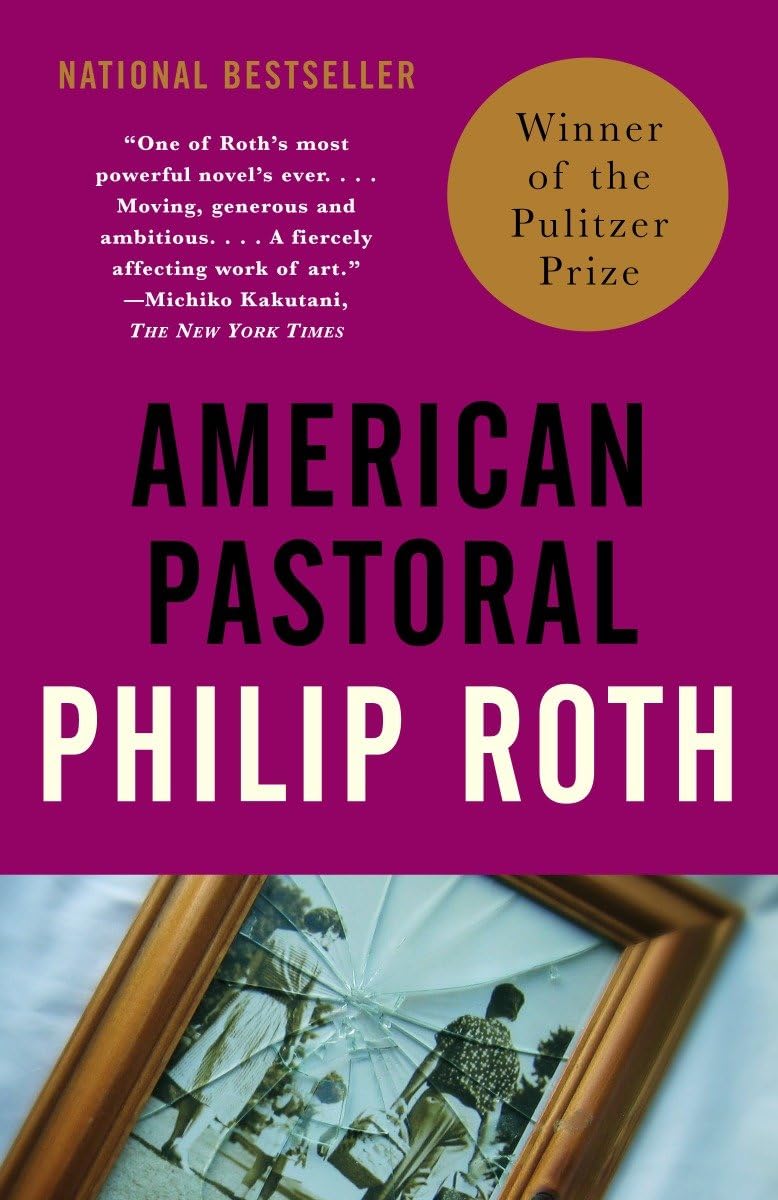
American Pastoral: American Trilogy 1 (Pulitzer Prize Winner) (Vintage International) [Roth, Philip] on desertcart.com. *FREE* shipping on qualifying offers. American Pastoral: American Trilogy 1 (Pulitzer Prize Winner) (Vintage International) Review: Interesting from the first page- I loved it-A must read! - As Mrs Seinfield says of her son "How can you not love him?" the reader may say as well of the protagonist of AMERICAN PASTORAL- Seymour Irving Levov. And yet long before the end we may also conclude that "the Swede" as he is affectionately called, is an unsympathetic and hollow soul. To me this book is about America. Where has she been? Where is she now? What will she become? The book also ends with questions and to some readers these questions may remain unanswered and may even be unanswerable. And yet, Mr Roth, at least to my mind, does provide some answers, at least by implication. The central question asked is this: Isn't it enough for the hero Seymour Irving Levov just to BE and to take in his life what he finds before him? What does Seymour take? In a nutshell, the bounty of being born in America at a particular time. He takes what his father had built(a successful glove factory); he takes as his wife Miss New Jersey 1949; he takes a heritage home and a parcel of richly productive land on which to raise his family. He leaves school at 14 in order to take up this bounty. In the novel as a representative of the past, the hero's father rants about American having strayed from her "path", whilst his idealistic daughter, representative of the future, acts to give reality to her beliefs by disowning her mother and her family and becoming a "terrorist" and murderer. Maybe it isn't enough to take what's offered. Maybe there is an obligation on the Swede, and by extension on all those who enjoy the bounty. How, when, where and to whom these obligations are directed is a larger question. AMERICAN PASTORAL may be described as a novel of ideas, but to me the characters are so vivid and memorable, and the narrative so strong, that such a description amounts to a disservice. In addition, the information provided on the glove making process I found fascinating and memorable and an important element in establishing the growth of America as an industrial powerhouse. The decline of the industry too, and the whims of fashion, the effect of Jacqui Kennedy on that industry ( Camelot indeed)all helped to complete the beguiling background against which the lives of the characters are played out. I found this novel a profoundly interesting and moral examination of matters crucial to the survival of those things for which America professes to stand tall - freedom, equality before the law, justice - as well as a moving creation of a range of characters. A must read. Review: A Dense, Often Heavy Read, Great Erudition - "American Pastoral" is a deep and dense novel set primarily in New Jersey in the 1960s. The narrator is a fictional author, apparently alter ego, of the author, who tells the story of a successful Jewish family until a terrible tragedy overtakes the family. The novel is widely considered iconic and often appears on various lists of great novels. While I can understand why that is the case, this is definitely not a light read and one has to really be in the mood to persevere. I am glad I read the novel and did like it, but I definitely need a break from both Philip Roth and, for the moment, another heavy read. The protagonist of this novel is a decent Jewish gentleman from New Jersey who becomes a successful business man and has a fine family. The events and history overtakes him and his family. There are times I found the story very painful. There is also some very witty, if dark, humor. The author, Philip Roth, while an avowed atheist later in life, was brought up in New Jersey in a Jewish Cultural environment. Innthat context, the novel has a vaguely semi autobiographical aspect to it. There is a good deal of description of various cultural and religious interactions. As stated above there are some very deep and lengthy passages that really demanded my full concentration. I had to reread many passages. As I often do I read the book on Kindle, and listened simultaneously to an audiobook. In other cases of other books, I sometimes need to speed up the listening speed on my device to keep up with my normal reading speed. In this case, I often had to SLOW down the listening speed due to the dense nature of the writing. There were times I just plain needed a break. In summary I am glad that I read this book and liked it a lot more than I did not like it. However this is, at times, a heavy, slow read. I read some other reviews prior to writing this review. At least once the word "slog" was used. Honestly I feel that is apt and thought of that word myself,. But as is often the case, I am glad that I stuck with this book. It was worth it and I am glad that I can say that I read it. Thank You for taking the time to read this review.


| Best Sellers Rank | #19,965 in Books ( See Top 100 in Books ) #218 in Fiction Satire #1,288 in Literary Fiction (Books) #1,532 in American Literature (Books) |
| Book 1 of 3 | American Trilogy |
| Customer Reviews | 4.2 4.2 out of 5 stars (5,278) |
| Dimensions | 5.15 x 0.95 x 8 inches |
| Edition | Reprint |
| ISBN-10 | 0375701427 |
| ISBN-13 | 978-0375701429 |
| Item Weight | 2.31 pounds |
| Language | English |
| Print length | 423 pages |
| Publication date | February 3, 1998 |
| Publisher | Vintage |
I**N
Interesting from the first page- I loved it-A must read!
As Mrs Seinfield says of her son "How can you not love him?" the reader may say as well of the protagonist of AMERICAN PASTORAL- Seymour Irving Levov. And yet long before the end we may also conclude that "the Swede" as he is affectionately called, is an unsympathetic and hollow soul. To me this book is about America. Where has she been? Where is she now? What will she become? The book also ends with questions and to some readers these questions may remain unanswered and may even be unanswerable. And yet, Mr Roth, at least to my mind, does provide some answers, at least by implication. The central question asked is this: Isn't it enough for the hero Seymour Irving Levov just to BE and to take in his life what he finds before him? What does Seymour take? In a nutshell, the bounty of being born in America at a particular time. He takes what his father had built(a successful glove factory); he takes as his wife Miss New Jersey 1949; he takes a heritage home and a parcel of richly productive land on which to raise his family. He leaves school at 14 in order to take up this bounty. In the novel as a representative of the past, the hero's father rants about American having strayed from her "path", whilst his idealistic daughter, representative of the future, acts to give reality to her beliefs by disowning her mother and her family and becoming a "terrorist" and murderer. Maybe it isn't enough to take what's offered. Maybe there is an obligation on the Swede, and by extension on all those who enjoy the bounty. How, when, where and to whom these obligations are directed is a larger question. AMERICAN PASTORAL may be described as a novel of ideas, but to me the characters are so vivid and memorable, and the narrative so strong, that such a description amounts to a disservice. In addition, the information provided on the glove making process I found fascinating and memorable and an important element in establishing the growth of America as an industrial powerhouse. The decline of the industry too, and the whims of fashion, the effect of Jacqui Kennedy on that industry ( Camelot indeed)all helped to complete the beguiling background against which the lives of the characters are played out. I found this novel a profoundly interesting and moral examination of matters crucial to the survival of those things for which America professes to stand tall - freedom, equality before the law, justice - as well as a moving creation of a range of characters. A must read.
F**Y
A Dense, Often Heavy Read, Great Erudition
"American Pastoral" is a deep and dense novel set primarily in New Jersey in the 1960s. The narrator is a fictional author, apparently alter ego, of the author, who tells the story of a successful Jewish family until a terrible tragedy overtakes the family. The novel is widely considered iconic and often appears on various lists of great novels. While I can understand why that is the case, this is definitely not a light read and one has to really be in the mood to persevere. I am glad I read the novel and did like it, but I definitely need a break from both Philip Roth and, for the moment, another heavy read. The protagonist of this novel is a decent Jewish gentleman from New Jersey who becomes a successful business man and has a fine family. The events and history overtakes him and his family. There are times I found the story very painful. There is also some very witty, if dark, humor. The author, Philip Roth, while an avowed atheist later in life, was brought up in New Jersey in a Jewish Cultural environment. Innthat context, the novel has a vaguely semi autobiographical aspect to it. There is a good deal of description of various cultural and religious interactions. As stated above there are some very deep and lengthy passages that really demanded my full concentration. I had to reread many passages. As I often do I read the book on Kindle, and listened simultaneously to an audiobook. In other cases of other books, I sometimes need to speed up the listening speed on my device to keep up with my normal reading speed. In this case, I often had to SLOW down the listening speed due to the dense nature of the writing. There were times I just plain needed a break. In summary I am glad that I read this book and liked it a lot more than I did not like it. However this is, at times, a heavy, slow read. I read some other reviews prior to writing this review. At least once the word "slog" was used. Honestly I feel that is apt and thought of that word myself,. But as is often the case, I am glad that I stuck with this book. It was worth it and I am glad that I can say that I read it. Thank You for taking the time to read this review.
S**K
Ik heb het geprobeerd, maar kwam echt niet door die eerste hoofdstukken heen. Heb het boek dus netjes teruggelegd. Wie weet, voor later.
L**L
Philip Roth’s Pulitzer prize-winning American Pastoral is beautifully written, deeply disturbing and at times offensively misogynistic. It is also bitter, angry, sharply incisive about the frailty and illusion of the American Dream – and, heart-breakingly tender about the ties that bind us, particularly the love of a parent for their child, however wayward, however lost. And, as well as all this, it is a fascinating series of challenges about the nature of writing and the nature of the writer. Roth throws down the gauntlet from the start, asking us not to forget that one of the central characters is his continuing alter-ego , Nathan ‘Skip’ Zuckerman. The story we reading, presented by Zuckerman, into the life of Seymour ‘Swede’ Levov, Zuckerman’s childhood hero, is possibly Zuckerman’s invention. Certain events happen to Levov, but the reason they happened, the psychoanalytical unpicking of them, may be only the writer in the book (not to mention the writer of the book) shaping a chimera. Seymour ‘Swede’ Levov, whose story Zuckerman tells, was a gifted athlete, an inheritor and emblem of the aspirational dream of America’s European immigrant community. Looking like a WASP, he is Jewish, his family, a generation or so back, by hard work, dedication and talent, rising in the Promised Land. Swede’s success at football, basketball and baseball, and his upright, hard-working personality have made him envied and adored, a kind of hero to others. One of whom is the slightly younger Zuckerman. Meeting again, in late middle age, it is now Zuckerman who has achieved fame, as a writer, and he is long past a time of adulating the seemingly much more simple character of a former sporting hero. Zuckerman in fact perceives the apparently settled straight as a die, unthinkingly patriotic, successful businessman, husband and father that Levov has become as a bit of a simp. The writer rather takes a position of intellectual, metropolitan, sophisticated arrogance. Though written in 1998, there are definite pointers and echoes here of the roots of our divided nation – both here and in the States, between the cultural intelligentsia and those who ‘seem’ as if they inhabit and engage with nuance less. Zuckerman indulges in various fantasies and theories, trying to worm behind the simple, satisfied persona Swede seems to represent. There are several writerly inventions Zuckerman engages in, each of which, again and again, proves wrong. Finally, Zuckerman, sophisticated in his cynicism, dismisses Levov “There’s nothing here but what you’re looking at. He’s all about being looked at……..He always was…..You’re craving depths that don’t exist……The guy is the embodiment of nothing” And then Zuckerman finds out how wrong, how very wrong he has been, and how he knew nothing of Swede, nothing of his life. Swede had reached adulthood and maturity shortly before the end of the Second World War. Enlisting as a marine, trying to meet the manly, right, patriotic challenge of the war, he was still going through boot-camp training when the bomb was dropped at Hiroshima. He took his desire to serve his country into the post-war world. A model citizen, her worked hard, had a developed awareness of social responsibility, married his childhood sweetheart, Dawn, entered and successfully ran the family glove-making business, and fathered a beloved daughter. Meredith, the daughter, was a teenager in the 60’s, at the time of the Civil Rights movement, resistance to Vietnam, and she became intensely radicalised, revolutionary. Merry, the apple of Swede's eye, committed a shocking and violent act whilst still at high school, and then went on the run, hunted as a terrorist. Swede’s family, marriage, business and life suddenly shattered. Belatedly discovering these events, Zuckerman then weaves this into story. He creates a narrative of motive, a narrative to ‘explain’ how this normal family, and privileged, loved child could have so violently changed. However……because of the constant reminders earlier in the book that narrator Zuckerman was inventing stories and sub stories which were wrong, Roth is reminding us that this too is narrative, story, invention. We know certain facts happened, but the interpretation of why Swede, Merry and Dawn got to where they did, may not be right. Zuckerman ‘blames’ a childhood event for Merry going to the bad – but the event is Zuckerman’s imagined narrative, and may never have happened. Going forward, to after Merry has gone underground, is a deeply disturbing, highly misogynistic section in the second part of the book, with the introduction of a young Jewish woman who may have been responsible for Merry’s violent radicalisation. This is a section distasteful to read, and highly unsettling – are we being shown an unconscious misogyny, particularly towards Jewish women, which comes from Roth himself, through his alter ego as Zuckerman – or is the author placing himself firmly and consciously on a slab, for the reader to dissect Roth himself? And then, at the point where the reader might think they have been able to negatively ‘get’ Roth himself, as the creator of all this, comes a section, where, after many years of searching for his vanished daughter in hiding from the law, Swede finds her, living in utter degradation, weirdly, most weirdly, transformed. This is a section of utter heartbreak, riven tenderness and almost unbearably painful humanity. Roth took my breath away in this raw exposure of all our suffering, poor, magnificent, broken complex humanity. Like Zuckerman with Swede, we get it wrong with each other, again and again. American Pastoral rightly won its Pulitzer prize. It is not in any way an easy book; it is a greatly, painfully challenging one – by turns horrible, horrific, stony, violent, hating and hateful – and full of compassion and suffering. Published in 1998, looking back over a roughly 50 year sweep, it is far from dated, and seems horribly pertinent today. I shall for sure, read more of Roth’s later work, though I am still, months after finishing this one, processing it.
L**O
Adquiri este livro para aprimorar meu inglês. No entanto, achei a linguagem dele um pouco difícil para quem não tem o inglês como língua nativa. Depois de algumas páginas parece que o cérebro se ajusta e fica mais fácil. O dicionário do Kindle ajuda bastante, mas na próxima vez em que for adquirir livros em língua estrangeira vou pesquisar antes para saber se é adequado ao meu nível de conhecimento daquela língua.
O**A
My comments cover all of the three books in the trilogy: American Pastoral, I Married a Communist, and The Human Stain. Roth captured my attention throughout the three books and was certainly skilled at bringing out the psyche of the main characters. In particular, two events stood out and were completely "gripping". The adult daughter of the main characters in American Pastoral had devolved into a menacing and destructive individual who had shut off all contact with her parents. This state of affairs had carried on for a number of years during which the parents continued to search for her. Suddenly the daughter wants to re-connect with them and will arrive at the same time that the parents are hosting an event at their home for friends. In the midst of socializing, the father is anxiously awaiting her arrival. Roth stretched out the anguish of the Father over at least fifty pages ; I was unable to put down the book during this event. The second event occurred in The Human Stain. One of the main characters deliberately meets the man believed to have caused the death of two acquaintances. However, he has to pretend that the meeting is a chance occurrence, which is difficult since they meet on a frozen lake while ice fishing. The character has to carry out a credible conversation on the merits of fishing techniques while neither being an ice Fisher nor being familiar with the lake. A high risk and remote setting that does not offer much, if any, protection. The American Dream of economic progress is played out throughout the three books. Most of the characters have. advanced relative to their parents. In contrast to this, Roth highlights the treatment accorded to Black Society and to the race riots that occurred at that time in New Jersey. The author also highlights the unsafe and dangerous conditions in which Miners had to work. As well, the abandonment of some of the ideals of the Republic were drawn out when the Federal Government over reacted to the threat of Communism and curtailed many political rights. Roth posed an ethical dilemma in the American Pastoral. The parents, distraught about their daughter's actions, were stymied in making contact with her over a lengthy period. Later in this timeline, the parents learn that an acquaintance (who is also the Daughter's Psychologist) was aware of her whereabouts but never shared any information with the parents. A shortcoming is that the author quickly switches back and forth between characters which, at times, makes the story disjointed. Also, some of the Jewish terms used were not defined in the Kindle Dictionary.
A**I
Un capolavoro. Un libro stupendo. Lo stile inconfondibile accompagna il lettore nella straordinaria disgregazione del sogno americano. Assolutente da leggere
Trustpilot
1 month ago
1 week ago