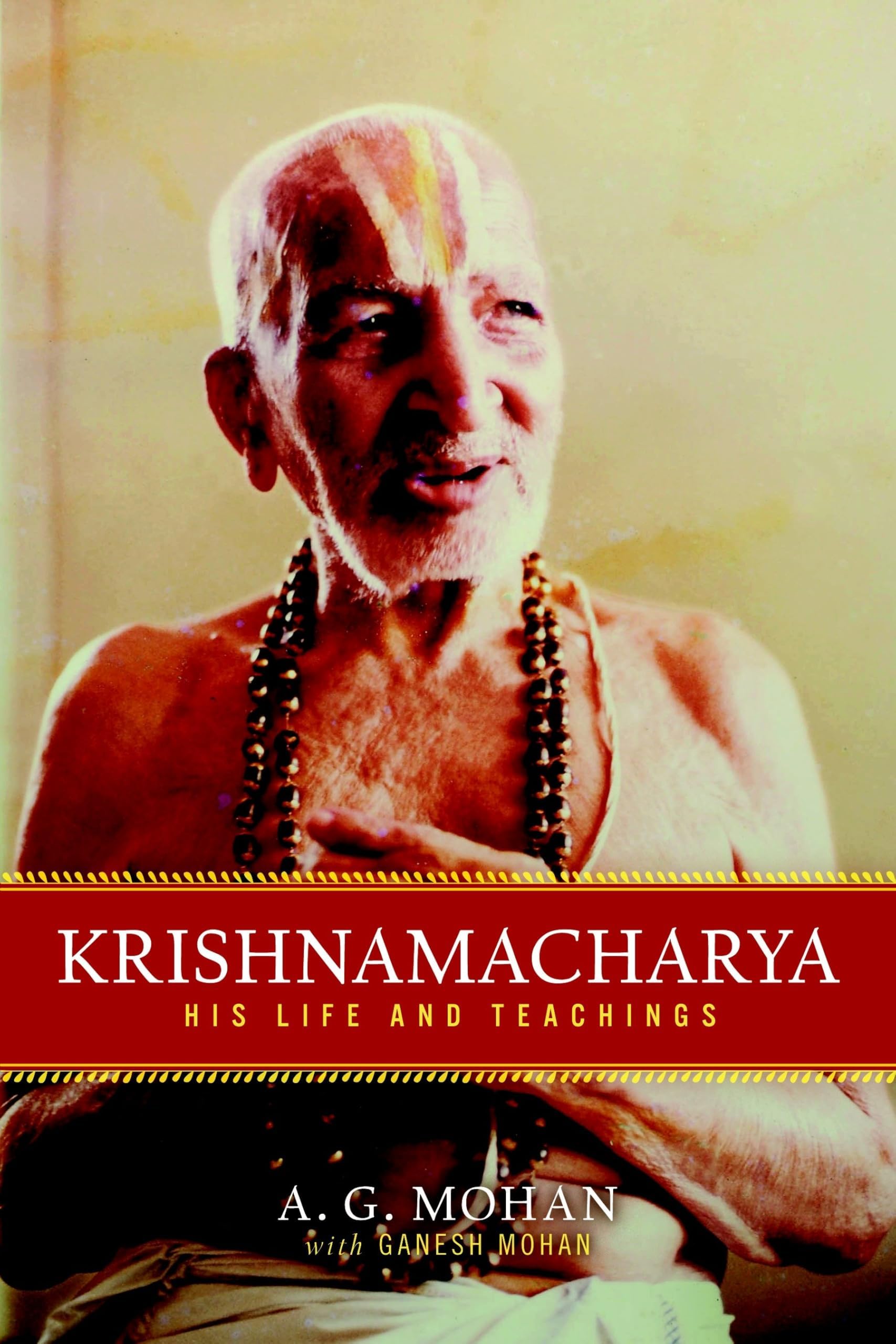
Krishnamacharya: His Life and Teachings
Product ID: 12785619
⏳Timeless wisdom from a century-long life
📚Deep dive into yoga legacy
🧘♂️Authentic teachings from the father of modern yoga
Desertcart purchases this item on your behalf and handles shipping, customs, and support to Iceland.
🧘♀️ Unlock the original source of modern yoga mastery — don’t just practice, belong.
This used book offers a compelling tribute to Sri Tirumalai Krishnamacharya, the father of modern yoga, through the eyes of his disciple A.G. Mohan. It provides authentic insights into Krishnamacharya’s teachings on asanas, pranayama, and yoga therapy, enriched by personal anecdotes and rare archival material. Ideal for yoga teachers and serious practitioners, it connects readers to the profound origins of contemporary yoga practice.
| Best Sellers Rank | #939,356 in Books ( See Top 100 in Books ) #196 in Historical India & South Asia Biographies #1,527 in Yoga (Books) #3,957 in Philosophy Movements (Books) |
| Customer Reviews | 4.7 out of 5 stars 200 Reviews |
C**A
Infinitely Inspiring
Krishnamacharya died on February 28th, 1989. I first realized that he was the master behind my lineage (and pretty much any lineage around these days) in the early 2000s, so as much I as I would have wished to travel and meet him, I never had a chance. This is why a book like Krishnamacharya: His Life and Teachings by A.G.Mohan is so valuable, so precious. Consider for example when Mohan attends his first lecture with him: "... The subject of the lecture was ancient rituals, but Krishnamacharya linked the practices of yoga to the subject, I became spellbound, immersed in Kirshnamacharya's discourse and the power of his presence, as if I were sitting at the feet of an ancient sage". And a sage he was. Kirshnamacharya was, for what I gather in the book and by sheer force of the devotion of his direct students, a Guru's Guru. I was impressed at how he would refuse students he did not consider serious. He used unconventional methods to test the level of truth behind the desire to learn from potential students, for example when once Mohan asked him what would he do if a wealthy student of dubious intentions came by asking for teachings and he replied he would, for example, ask for him to come back with the equivalent of, say, 5000 dollars, and if the student did bring it, then he would return the money, content in the knowing that the student was serious. Krishnamacharya was fiercely and one pointedly committed to the spread of yoga, and he succeeded. I almost felt he would wink to all people out there showing fancy poses, talking about yoga, discussing through blogs, propagating, advertising, letting yoga work its way into our collective imagination. This, is the reason behind all his (and students) demonstrations of advanced asanas, even to people who could clearly not do them at once, or so he told Mohan, it was advertising. However, when it came to actually teaching: "Taking into the account the structure of the body and the distortions in the body, one should do the appropriate asana. Only experts can guide the student..." On the chapter of asana, his words about headstand are quite remarkable: "Remember, headstand is not just an asana. It is classified as a mudra".... "He [Krishnamacharya] felt that the rate of breathing [in headstand] should slow down to as few as two breaths per minute, for a duration of at least tenty-four breaths" When Mohan suggested buying a tape recorder to retain his teacher's words for posterity Krishnamacharya was actually all in favor. This is why some of the quotes are so vivid, and this is a great asset which I as a student rejoice in. Mohan still has these recordings and they are available for purchase in his website (although the links do not seem to work for me at the moment), here with all proceeds going for the preservation of Vedic knowledge. On the chapter of pranayama, kryias and yoga teraphy there is an excerpt of an interview where he discussed how stopping his pulse and heart beat" "...All happened automatically... I did it by practicing pranayama, vishama vrtti, in nadishodana pranayama and meditation as well..." Easy does it, you see? I almost do not want to tell more for fear of spoiling it, but let me just for a moment take you to a room where the master is about to die, he is 100 years old, and Mohan asks him "What is most important in life?" among other things, he replies: Health, longevity, a tranquil mind. I am very glad I read the book, and I think I will be re-reading it, this one of those rare "long term keepers"
M**N
Very nice presentation
I am a recent student of yoga asanas but as a practicing SriVaishnava Brahmin is always curious about Pranayama etc. My regular practice includes pranayama with mantra chanting as part of sandhya worship as well as Salagrama Aradhanam and as part of researching some literature regarding traditions, came across the name T.S. Krishnamacharya. Then I had a chance to listen to his cassettes regarding Sandhya worship and wanted to know more about him. This book by Mohan gives very good insights on the legend. It looks TSK is multi-faceted and is one of the few authentic yogis of recent times well versed in Philosophy, Religious practices as well as remarkable grasp of Yoga techniques (asanas, pranayama etc) to achieve physical and spiritual well being. Mohan maintains a simple writing style. His reverence for his Acharya comes forth. He avoids hyperbole about TSK (TSK's achievements need no embellishments) and I enjoyed his matter of fact narrative. After reading the book, it will be obvious that current "Yoga" classes are mostly about asanas and for TSK, asanas, Pranayama, niyama, yama etc are just different tools or steps to the ultimate goal of Moksha or divine bliss. Please do not expect biographical study of TSK. It is more of what the author has observed in his 20 years of interaction when TSK is already well into eighties. In combination with accounts from B.K.S. Iyengar, T.K.V Desikachar, Pattabhi Jois, Srivatsa Ramasamy, this book will enable people to understand who is T.S.K as well as his lifetime contributions to the resurgence of Yoga/ Ayurveda etc. TSK can be considered as the fountain head of modern yoga - He collected, mastered different yoga sashtras and made it accessible to everybody. From various accounts, it looks like each book of TSK students talk about TSK influence on the corresponding student rather than sharing some common observations... It will be nice if people can come up with documenting T.S.K's studies in Ayurveda etc in a book that can serve as an introductory study on yogic healing I am seriously looking for Mohan to update his website with regard to online studies
M**N
Humility, devotion, love and respect
Wonderful book that takes you inside the constant and deeply respectful relationship between Krishnamacharya, the father of modern yoga, and his devoted student A.G. Mohan. There are many new insights here on methods to communicate and develop difficult aspects of yoga tradition. The examples of the simplicity and humility of Krishnamacharya's life provide exemplifications of the yamas and niyamas. These inspirational vignettes and accounts of teaching method are leavened by personal anecdotes showing the Guru's sense of humour, sophistication and affection for his student. Among the many publications on yoga available, the unique contribution of this book is the revelation of how surrendering to a Guru chosen with discernment brings meaning and purpose to A.G. Mohan's life. One of the hardest things for Western students of yoga to understand is how liberating and empowering it can be to give over your critical and competitive ego and embrace the wisdom of a teacher. The account of the Guru/ student relationship is particularly compelling and accessible to Westerners because the authors are themselves liminal subjects - A.G.Mohan was a management consultant and Ganesh is a qualified medical doctor in both Ayurvedic and Western medicine - with whom Western students can readily identify. It is precisely because of A.G. Mohan's intelligence and thoughtfulness (and not blind faith or tradition) that he seeks to be and is accepted as a student of Krishnamacharya. Therefore the narrative is direct challenge to the Western notion that critical distance, rationality and scepticism (as opposed to devotion to a gifted teacher) is the only path to truth.
W**T
At the feet of the master
You always learn something from the life of a great master, and so too, I learnt important things in reading this biography of Krishnamacharya. Some of the most important things I learnt were gleaned from snippets of how the master lived, including his disciplined life and daily schedule which begun at 2am in the morning when he awoke, and ended at 8pm at night when he went to sleep. Other instructive examples included Krishnacharya's approach to chanting and devotional ritual as modes of mental discipline, and his habit of casting his eyes down while walking and sitting as a way of withdrawing the senses. Krishnamcharya's thought and comments on aspects of yoga, his advice to A.G. Mohan and others, and his personal response to different situations including economic and moral choices as well as health conditions, were all instructive. As the author A.G. Mohan himself said in his book, he himself learnt most from just sitting at the feet of his guru Krishnamacharya, and imbibing the example of his being and personal conduct. Reading this book, we have a little taste of what it means to sit at the feet of this great master of yoga, and to learn from his personal example. Even a little drop can take us a long way.
D**N
Teacher and devoted student
I really enjoyed this book. This book was insightful on the teachings and life of the great yogi Krishnamacharya. Krishnamacharya was a great scholar of the Vedic, yoga sutra, ancient hindu, and yoga texts. His style of teaching was unique. He taught specifically and tailored to his student's needs, not his. Asthanga and Iyengar yoga are the offsprings of this great yogi's teaching. Krishnamacharya was a man of God. He lived a disciplined life. His life style was simple. He never wanted to be famous. He didn't care about money or fame. His life was simple. He was a devoted man of God, disciplined in his studies and practice of the 8 limbs of yoga and a giving teacher to his students. A nice and easy read. Very enjoyable. I would recommend it to anyine that teaches yoga. Insight to a great yogi and teacher. Om Shanti
L**S
Intelligently written, but easy to read.
I found this book to be an easier read than many other Yoga Texts. It was understandable from begining to end - and quite informative. I've always been curious to know more about the master yoga teacher Sri Krishnamacharya. This text helps us to see his intellect & influcence on our ideas of Yoga today. But, also speaks about the man himself, and we get to hear a bit about his personality. I wish I would have been born ealier to have been able to been graced with his direct teachings.
K**N
Nicely elucidated experiences of learning from the yogi - Krishnamacharya
This book is written by a direct student of Krishnamacharya who spent 20-25 years learning from a great yogi - Krishnamacharya. A.G.Mohan has very clearly elucidated his experiences of learning from Krishnamacharya. Rather than going into sensationalizing the yoga practice he learnt from Krishnamacharya, a sincere effort has been made to explain the underlying principles behind those practices. Highly recommend this book to anyone who is interested in learning about the core values & teachings of Krishnamacharya.
J**R
Precious Knowledge of Parampara (Lineage)
This beautiful book answers many questions for those in the West who, like me, are ardent practitioners of Ashtanga Yoga in the tradition of Sri K. Pattabhi Jois (Guruji). Largely because of his reclusive nature and his disinclination toward any sort of publicity, Krishnamacharya has been a mysterious persona. We all know Guruji studied with him for several decades, beginning in his childhood, but we have known precious little of this towering figure in the pantheon of yoga masters. A.G. Mohan has done a singular service in presenting this valuable information on the life and teaching of Krishnamacharya. I shall be forever grateful.
F**A
Maravilloso
Un libro muy inspirador.
B**N
Very interesting insights into the real Yoga
In our society people associate Yoga mainly with poses and movements, so called asanas. This book takes you to the origins of Yoga which comprises a lot more. Krishnamacharya's students are responsible for the most popular Yoga styles today like Iyengar and Ashtangar Yoga. An Mohan, the author, has been his personal student for over twenty years. This book taught me that asanas are merely meant to prepare the body for the more advanced disciplines of Yoga like Pranayama and meditation. Most yoga schools don't even teach those components nowadays. If you're interested in Yoga or not, this book will teach you many things about yourself and your health. And it will show you many tools to be happier and healthier.
J**A
Five Stars
Great book
K**C
Teachers' Teacher!
If you are a practitioner of Ashtanga Vinyasa or Iyengar yoga and wish to learn more about these lineages, this will be of interest. Krishnamacharya was Patabhi Jois' and BKS Iyengar's teacher - Jois and Iyengar are arguably the two most influential teachers in yoga in the West. The remembrances of Krishnmacharya are recounted with great love and devotion by his disciple Mohan.
S**T
A revelation
I got engrossed in this book, which is well written and fluid. It gave me an insight in the life of Shri Krishnamacharya.
Trustpilot
2 weeks ago
1 month ago