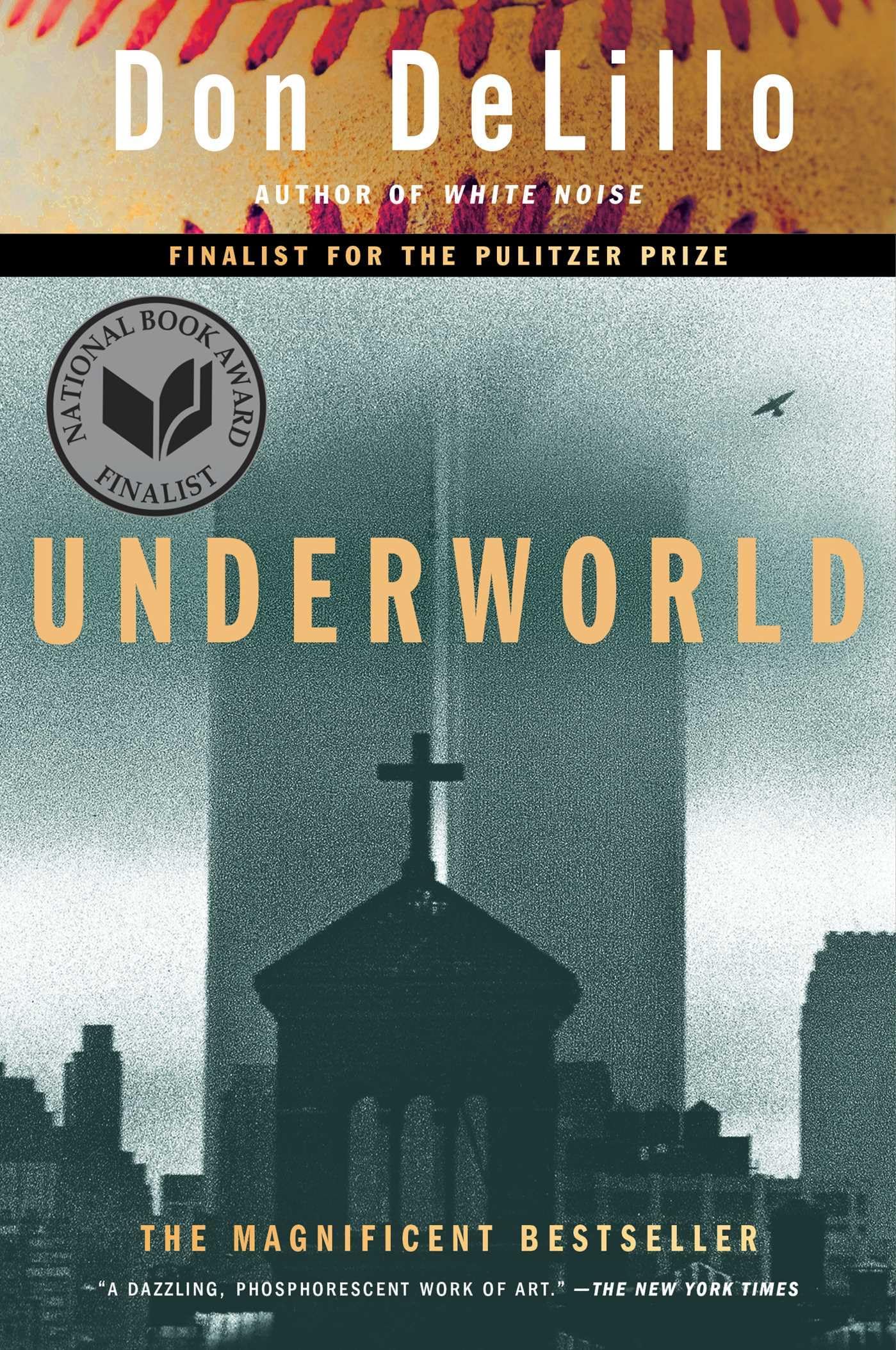
Underworld: A Novel
Product ID: 12161129
Buy anything from 5,000+ international stores. One checkout price. No surprise fees. Join 2M+ shoppers on Desertcart.
Desertcart purchases this item on your behalf and handles shipping, customs, and support to Iceland.
Finalist for the Pulitzer Prize Finalist for the National Book Award Finalist for the National Book Critics Circle Award Winner of the Howell’s Medal of the American Academy of Arts and Letters “A great American novel” ( San Francisco Chronicle ) that spans five decades of American history, following the intimate lives of the men and women who lived through them. It begins with a moment of legend: the 1951 baseball game between the New York Giants and the Brooklyn Dodgers in which the winning homerun known as the Shot Heard Round the World coincides with news of the Soviet Union’s first hydrogen bomb test. The baseball itself, scuffed and passed from hand to hand, becomes the thread that weaves an astonishing tapestry that spans the Cold War, the Civil Rights Movement, Vietnam protests, and beyond, telling the story of Nick Shay, Klara Sax, and the hidden histories of a nation both haunted and illuminated by its past. Sweeping yet intimate, Underworld is an astonishing story of men and women brought together and torn apart against the backdrop of half a century of American history. Review: It reminds me of a Pynchon romp, which is a good thing. - UNDERWORLD is so large in scope, its sprawling 800+ pages can barely contain it. It reminds me of a Pynchon romp, which is a good thing. UNDERWORLD encompasses nearly a half century of American life and history, following a cast of characters through the Cold War, the duck-and-cover drills, the Vietnam War, sixties unrest, the civil rights movement, the Cuban Missile Crisis, the 1965 Northeast US Blackout, among other major events. It begins with a 60-page prologue putting the reader at the Polo Grounds in New York on that day in October 1951 when Bobby Thompson hits a pennant-winning home run for the NY Giants off of Brooklyn Dodger pitcher Ralph Branca. It came to be called “The Shot Heard Round the World.” Though in reality the home run ball was never found, DeLillo imagines it recovered by a scrawny kid, Cotter Martin, and proceeds loosely to follow the ownership of that ball, in a sort of six-degrees of separation manner, down through the decades. Their paths crisscross, intersect and overlap in an amazing display of literary skill. For example, on page 608 we see Charles Wainwright Jr., one time owner of the ball, navigating a B-52 bomber over Vietnam in 1969, the very same B-52 dubbed ‘Long Tall Sally’ -- with cheeky nose art to prove it -- the very same plane mothballed and depicted in the opening chapters circa 1992 as the canvas for Klara Sax and her band of desert artists. There are many such links, past, present, future. There is nothing here in UNDERWORLD that passes for a plot. Not really. DeLillo builds his edifice with vignettes, short clipped sections, sometimes abruptly shifting in person, place and time. UNDERWORLD is visual, cinematic, in style. His dialogue, unlike any author I’ve read, rings true, authentic, and captures that pragmatic, nonverbal element in conversation, the way shared histories, context, and physical gestures fill in the gaps. And then there’s the conversations that don’t click at all, people just talking past one another. But something else important happened on that day when Thompson hit the home run, something of a more ominous sort that would change lives: the Soviet Union exploded their first atomic bomb. Another “shot heard round the world.” From the 1951 events, the Giants-Dodgers game and the Soviet test explosion, DeLillo jumps to 1992 and the Arizona desert and a group of artists using mothballed B-52s as their canvass. From there, the novel moves backward chronologically, back to 1951. Was this to mimic the countdown of a rocket, or atomic blast? No matter, it works. We see some of the characters in their full development in 1992, then over the next 700+ pages learn how they got that way. It’s a huge cast of characters, many historical figures like J. Edgar Hoover, Frank Sinatra, Lenny Bruce, Jackie Gleason, and Harry Caray. If there is an overriding theme or motif in the novel, it is the obsession with trash. Garbage. Where the home run baseball is the antithesis of trash - a treasured piece of baseball history - the atomic bomb has the ability to turn the world to trash. And then there’s the problem of the spent plutonium, that ultimate of all hazardous wastes. Even one of the main characters, Nick Shay, owner of the 1951 baseball, works for an international waste company. The Jesuits taught me to examine things for second meanings and deeper connections. Were they thinking about waste? We were waste managers, waste giants, we processed universal waste. Waste has a solemn aura now, an aspect of untouchability. White containers of plutonium waste with yellow caution tags. Handle carefully. Even the lowest household trash is closely observed. People look at their garbage differently now, seeing every bottle and crushed carton in a planetary context. [88] The writing is as good as it gets. And while there is certainly joy in the first reading, I’m finding it equally entertaining after turning that final page to return to the first chapters and reacquaint myself with the characters I just left, forty years older in DeLillo’s reverse chronology, and a few months after I’d begun reading. Like a lot of post-modern literature, UNDERWORLD isn’t for those looking for linear plotting, or plotting at all, for that matter. And the characters are not particularly fleshed out. But the journey is certainly worth the time and effort. Review: Look Elsewhere for an Easy Read - If you're someone used to reading page turners like James Patterson novels or other potato chip fiction, this isn't the novel for you. If you want to read something that is a sumptuous multi course feast that will stick to your ribs then I recommend this novel. That all being said, you have to have the gumption to actually sit down and read this beast of a novel. It comes it at over 800 pages. It follows multiple characters and only in a small section does it actually give you the date in which the events are happening. The novel is told in some sections from the point of view of a waste management executive who was a juvenile delinquent named Nick Shay. His brother was a chess prodigy who now designs weapons for a secretive Pentagon project. Their father was a minor bookmaker who was/wasn't killed by the Mafia in New York City when the boys were young. The novel intros with the 1951 National League Pennant where Bobby Thompson blasts a home run to win the pennant. Jay Edgar Hoover, Jackie Gleason, and other notables including Jay Edgar Hoover are present at the game. Hoover gets an urgent message during the game that the Soviets have just tested their first nuclear device. This sets up the swirling series of events which intertwine like a fabric spun from a loom. These characters are all astraddle of two different ages. Don't read this novel looking for a easily discernible plot. Don't read the characters like the entire story arc of their lives will be laid out for you. If you're hoping the young scamp in the beginning of the novel who fights for the Bobby Thompson home run will get old in the novel, get married, have children, then you're out of luck. Delillo treats many of his characters like pebbles and rocks in the stream of life that he is portraying. Like life, they are with you for a moment, they make you smile, cry, or annoyed and then they're gone. Forever. This novel is a wonderful antidote and inoculation for the fractious Facebook existence that is spreading through the world. If you're a patient person, if you've already tackled novels of substance, girth, and heft such as other Delillo novels, David Foster Wallace's Infinite Jest, or anything by Leo Tolstoy you may be ready to try and tackle this one. It's well worth the effort.


| Best Sellers Rank | #26,485 in Books ( See Top 100 in Books ) #19 in Literature #376 in Contemporary Literature & Fiction #658 in Classic Literature & Fiction |
| Customer Reviews | 4.2 out of 5 stars 1,423 Reviews |
M**N
It reminds me of a Pynchon romp, which is a good thing.
UNDERWORLD is so large in scope, its sprawling 800+ pages can barely contain it. It reminds me of a Pynchon romp, which is a good thing. UNDERWORLD encompasses nearly a half century of American life and history, following a cast of characters through the Cold War, the duck-and-cover drills, the Vietnam War, sixties unrest, the civil rights movement, the Cuban Missile Crisis, the 1965 Northeast US Blackout, among other major events. It begins with a 60-page prologue putting the reader at the Polo Grounds in New York on that day in October 1951 when Bobby Thompson hits a pennant-winning home run for the NY Giants off of Brooklyn Dodger pitcher Ralph Branca. It came to be called “The Shot Heard Round the World.” Though in reality the home run ball was never found, DeLillo imagines it recovered by a scrawny kid, Cotter Martin, and proceeds loosely to follow the ownership of that ball, in a sort of six-degrees of separation manner, down through the decades. Their paths crisscross, intersect and overlap in an amazing display of literary skill. For example, on page 608 we see Charles Wainwright Jr., one time owner of the ball, navigating a B-52 bomber over Vietnam in 1969, the very same B-52 dubbed ‘Long Tall Sally’ -- with cheeky nose art to prove it -- the very same plane mothballed and depicted in the opening chapters circa 1992 as the canvas for Klara Sax and her band of desert artists. There are many such links, past, present, future. There is nothing here in UNDERWORLD that passes for a plot. Not really. DeLillo builds his edifice with vignettes, short clipped sections, sometimes abruptly shifting in person, place and time. UNDERWORLD is visual, cinematic, in style. His dialogue, unlike any author I’ve read, rings true, authentic, and captures that pragmatic, nonverbal element in conversation, the way shared histories, context, and physical gestures fill in the gaps. And then there’s the conversations that don’t click at all, people just talking past one another. But something else important happened on that day when Thompson hit the home run, something of a more ominous sort that would change lives: the Soviet Union exploded their first atomic bomb. Another “shot heard round the world.” From the 1951 events, the Giants-Dodgers game and the Soviet test explosion, DeLillo jumps to 1992 and the Arizona desert and a group of artists using mothballed B-52s as their canvass. From there, the novel moves backward chronologically, back to 1951. Was this to mimic the countdown of a rocket, or atomic blast? No matter, it works. We see some of the characters in their full development in 1992, then over the next 700+ pages learn how they got that way. It’s a huge cast of characters, many historical figures like J. Edgar Hoover, Frank Sinatra, Lenny Bruce, Jackie Gleason, and Harry Caray. If there is an overriding theme or motif in the novel, it is the obsession with trash. Garbage. Where the home run baseball is the antithesis of trash - a treasured piece of baseball history - the atomic bomb has the ability to turn the world to trash. And then there’s the problem of the spent plutonium, that ultimate of all hazardous wastes. Even one of the main characters, Nick Shay, owner of the 1951 baseball, works for an international waste company. The Jesuits taught me to examine things for second meanings and deeper connections. Were they thinking about waste? We were waste managers, waste giants, we processed universal waste. Waste has a solemn aura now, an aspect of untouchability. White containers of plutonium waste with yellow caution tags. Handle carefully. Even the lowest household trash is closely observed. People look at their garbage differently now, seeing every bottle and crushed carton in a planetary context. [88] The writing is as good as it gets. And while there is certainly joy in the first reading, I’m finding it equally entertaining after turning that final page to return to the first chapters and reacquaint myself with the characters I just left, forty years older in DeLillo’s reverse chronology, and a few months after I’d begun reading. Like a lot of post-modern literature, UNDERWORLD isn’t for those looking for linear plotting, or plotting at all, for that matter. And the characters are not particularly fleshed out. But the journey is certainly worth the time and effort.
J**S
Look Elsewhere for an Easy Read
If you're someone used to reading page turners like James Patterson novels or other potato chip fiction, this isn't the novel for you. If you want to read something that is a sumptuous multi course feast that will stick to your ribs then I recommend this novel. That all being said, you have to have the gumption to actually sit down and read this beast of a novel. It comes it at over 800 pages. It follows multiple characters and only in a small section does it actually give you the date in which the events are happening. The novel is told in some sections from the point of view of a waste management executive who was a juvenile delinquent named Nick Shay. His brother was a chess prodigy who now designs weapons for a secretive Pentagon project. Their father was a minor bookmaker who was/wasn't killed by the Mafia in New York City when the boys were young. The novel intros with the 1951 National League Pennant where Bobby Thompson blasts a home run to win the pennant. Jay Edgar Hoover, Jackie Gleason, and other notables including Jay Edgar Hoover are present at the game. Hoover gets an urgent message during the game that the Soviets have just tested their first nuclear device. This sets up the swirling series of events which intertwine like a fabric spun from a loom. These characters are all astraddle of two different ages. Don't read this novel looking for a easily discernible plot. Don't read the characters like the entire story arc of their lives will be laid out for you. If you're hoping the young scamp in the beginning of the novel who fights for the Bobby Thompson home run will get old in the novel, get married, have children, then you're out of luck. Delillo treats many of his characters like pebbles and rocks in the stream of life that he is portraying. Like life, they are with you for a moment, they make you smile, cry, or annoyed and then they're gone. Forever. This novel is a wonderful antidote and inoculation for the fractious Facebook existence that is spreading through the world. If you're a patient person, if you've already tackled novels of substance, girth, and heft such as other Delillo novels, David Foster Wallace's Infinite Jest, or anything by Leo Tolstoy you may be ready to try and tackle this one. It's well worth the effort.
M**A
The Great Big Book of Don DeLillo
By all accounts his "magnum opus," *Underworld* is indeed a great ((and a great big)) novel--a sweeping panoramic epic of life as Don DeLillo has known it from an Italian-American Bronx neighborhood in the 50s to the end of the 20th century and our post-Cold War global society. Believe it or not, the two main themes of this massive text are the nuclear arms race and the crisis of waste management. And weaving these two seemingly--but not in reality--disparate themes together is a third: Bobby Thompson's famous homerun that clinched a miraculous pennant for the New York Giants on the last day of the season. As it happens, on the same day, the Soviets detonated an atomic bomb thereby announcing what seemed for the next thirty years to be the countdown towards the end of the world. DeLillo brings these elements together in a dazzlingly orchestrated work that credibly characterizes an entire era in a story rich in character and incident, both real and imagined. There are walk-on cameos by Jackie Gleason, J. Edgar Hoover, Frank Sinatra, and Lenny Bruce, among others, that seem too authentic to be entirely made up. There are cultural references to products, advertisements, and TV shows of the period, particularly the 50s and 60s, that lend the proceedings the echoing realism of nostalgia. There is drama, violence, infidelity, love, greed, faith, faithlessness, philosophy, and humor--in short, *Underworld* is a kind of huge shambling Americanized version of a Dostoyevsky or Tolstoy novel, a work that seeks, as far as its possible, to capture the experience of life whole and still breathing. *Underworld* is like a symphony--outsized, loud, ambitious, packed with thematic repetition, variation, and improvisation. It's unwieldy in places, verbose, grandiose--there's more of it than strictly necessary, but this is often the case with `masterpieces.' By their very nature, they are often imperfect. It fails, but it fails magnificently. *Underworld* reads like DeLillo's swan song, even though he'd go on writing for the next decade, and is writing still. You get the feeling, though, that he wanted to get everything down once and for all before it was too late. He is opening up the memory banks in *Underworld,* giving it all away, the rich ore of his personal past. Of the last two hundred pages or so of this 800+ page novel, he could have lost 40% and done no harm to the plot. Incident is multiplied upon incident, many of these from the boyhood of the main character Nick Shay and you suspect many of these episodes were memories more factual than fictional from DeLillo's own boyhood, things he wished to immortalize. But for the most part, you don't mind the excess length and anecdotal bric-a-brac because DeLillo is the kind of writer who can describe someone chewing gum and make it fascinating reading. More tellingly, this elegiac and `confessional' spirit lends a mellowness to *Underworld,* a sweetness that doesn't exist in his work before or since. The acerbic cynicism, the edgy paranoia, the dark outrage, the insidious conspiracy theories are all tempered by a gentleness for those things which are still good about life, or bittersweet, as the case may be. DeLillo is making a summation, it seems, of life as he's known it, and he's trying to be as fair to it all as possible. He's saying, "And it was good." Masterpiece it might be, his biggest and most inclusive book it no doubt is, but *Underworld* is not my favorite Don DeLillo novel ((*White Noise is*)). Its not even in my top three. Still, I don't have the heart to give such a monumental effort anything less than five stars. DeLillo gave it all up in *Underworld* and for that he earns my unreserved appreciation and admiration.
A**R
Captivating
One of the best books I have ever read. I was absolutely captivated by it. The way DeLillo is able to paint such vivid pictures with words and how he is able to get you emotionally invested and connected to the characters and their circumstances is just incredible.
R**D
Flashes of Brilliance, but Overall Not a Compelling Read
Don DeLillo can write spellbinding sentences and paragraphs. There are also a few set-piece scenes in this book that are intriguing. But over the course of this very long book he was not able to sustain my interest. This is primarily because I just didn't care about any of the characters. It's difficult to feel emotion for someone who clearly is not flesh and blood but is simply a pawn in the author's hand, being pushed around to fulfill his/her spot in the grand theme. The problem of believing in the characters was made worse by the fact that we see some of them at different points in time, decades apart, and although the names were the same I couldn't believe that they were the same person. Stylistically, DeLillo has some unfortunate habits. One of these is repeating thoughts in kind of a round-robin cycle every three or four paragraphs. Perhaps he trying to get into some kind of "jazz rhythm" but the effect on me is that of a bad saxophone player who keeps honking away on the same riff over and over. Another habit is that of having characters not end their sentences, despite the fact that DeLillo decides to plop down a period at the end of what they're saying. Particularly in the New York 1950's sections, it gets irritating. Did people really talk like that ALL THE TIME? I certainly wasn't there, so maybe I'm wrong, but I am suspicious of this note-perfect fast-patter dialog everyone seems so adept at. On the plus side, DeLillo does a great job of evoking the atmosphere of the Giants-Dodgers playoff game, and he has made me (finally) appreciate Lenny Bruce, more so than listening to actual Lenny Bruce recordings. (Are these Lenny Bruce bits real? Or did DeLillo make them up?) And I enjoyed the bit where a married couple go to the "Float" section (?) of San Francisco to track down a baseball. I got the feeling here that DeLillo is just loosening up and having fun, setting aside his pursuit of The Theme for a few pages. I wished he had done that more often. To sum up, DeLillo is capable of great writing, and I admire the ambition of this book, but based on this he has a ways to go before he can write a novel that could be considered good. I was probably a quarter of the way into this book when I felt like throwing in the towel, but forced myself to keep going. Was it worth it? Maybe not ...
S**D
Relentlessly Readable
First, please do not believe this book is unreadable. If you are new to DeLillo (as I was; this is the first book I read by this author) know that the tag "unreadable" is a reductionist generalization. It is important to understand, that while this book admittedly may be difficult in some ways (the episodic nature of the narrative, the leaping forward and - mostly - backward in time, its haunted lyricism), it is more reader-friendly than books that are generally cited as "unreadable," books like *Finnegan's Wake," "Gravity's Rainbow," even "Ulysses." *Underworld* is difficult sort of like Faulkner is difficult; the style is personal to the author, it is new and wildly, but also precisely imagined; it does not fly off the planet - or if it does, it does so on a literary kind of bungi cord, i.e., you will always be called to earth, via the vast, but essentially traditional humanism that is this novel's deeply embedded anchor. The paradox is clear: critics who advise that the book is unreadable, by definition, cannot have read it - and thus are not qualified to review it. If they have, then, by definition, it is not unreadable. Duh. This book gives pleasure because it has taken pains. I won't try to summarize the book and its many specific qualities because I think the Amazon review does that better than I could. Bottom line: I loved this book, in spite of the question marks that hover over many of the passages (don't worry if you don't get something the first or second time it appears in the prose; you aren't supposed to get it yet). As I read along, I came to realize that the novel was teaching me how to read its own prose, and so I allowed the novel to lead me through its mysteries. I do not regret it. I trusted the story teller to tell me the story he meant to tell, and I trusted my own ability to wait for the punchline, and I stand in awe as a result. If you are willing to trust an 800+ page book with an investment of time and attention, this book should not disappoint.
-**-
Underworld
Underworld is an ambitious book. By examining politics, economics, and popular culture in the United States during the last half of the twentieth century, author Don DeLillo engages in some interesting speculation about hidden meanings and connections that lie beneath our notice. In the world that he depicts, people and events sometimes seem to be connected by some kind of field or ether through which unnamable forces operate. In his opening scene, the lives of hundreds of thousands of people are joined by an historic baseball game, where a young man senses "the body heat of a great city ... small reveries and desperations, the unseen something that haunts the day." In other passages of the book, these connections take the form of history or a system: "that thing you feel in an office ... sensing the linked grids lap around you." The book focuses on Nick Shay, a man with some grit who escapes a meaningless life in the Bronx and becomes an executive in a waste disposal firm and a kind of savant. It takes a long time and many people to produce this transformation, and this results in a pretty long book: 827 pages in the hard cover edition. DeLillo is even more interested in conspiracy theories and secrets than in Nick's personal transformation, so along the way he shares a lot of arcane knowledge with the reader about the nuclear weapons industry, environmental degradation, and J. Edgar Hoover. The connections between a few of the minor characters and subplots and the rest of the book are not obvious, and I would venture to say that a few of these could have been omitted without great harm. Also, DeLillo's dialogue has a definite style: his characters seem to hoard their words, and an awful lot of them don't finish their sentences. Whether these are defects or not probably depends on the reader's tastes. For me, this is a much better book than DeLillo's White Noise and Libra, which have been widely praised.
A**E
One of the Finest American Novels of the Last Quarter Century
UNDERWORLD is nothing less than the story of America in the second half of the 20th Century. Although there are plenty of interesting characters and engaging moments, the real character of this novel is the American character, in both senses of the word character. DeLillo is concerned by what we as a nation lost when, at the end of WWII, we became something larger than ourselves. Nuclear bombs and the threat of nuclear war are a reoccurring theme. As is the management of waste. There are failed marriages. Missing fathers. Homeless youth. A serial killer. Art made on and made from cultural leftovers. Lenny Bruce appears as the embodiment disorder. J. Edgar Hoover appears as the embodiment of control. And there is baseball, specifically a baseball, which was the home-run baseball that advanced the Giants to the World Series in a legendary 1951 game. That baseball, and the quest to find it and prove its provenance, weaves together many eras and characters and symbolizes both the yearning for a simpler time and the desire to acknowledge and have some kind of control over what we've lost. Many will say the novel has no plot. This is true only if one narrowly defines plot as a single overarching story. There are, instead, dozens of stories in UNDERWORLD, each with its own plot and each fitting into the others not unlike in a short story collection where characters move in and out of each other's lives, some appearing multiple times, some appearing only once or twice, but all of them thematically linked and each one building upon what came previously to create a beautiful resonance. Few writers could achieve this. But DeLillo has a rare gift for sentences that uplift you and characters that move you. Even when nothing is happening, DeLillo creates the sense that, beneath the surface, the currents are flowing fast. This novel is a unique and uniquely rewarding reading experience. One that is well worth the 800+ pages. Indeed, I was sad to have it end.
M**L
OPINION
Magnífiico libro. Muy bien escrito: uno de los libros que se quedarán en mi biblioteca y seguro reeleré. Lo recomiendo fervientemente.
V**A
Imprescindibile
Delillo è in grado di passare dal grandangolare allo zoom estremo senza farti perdere il filo. Un maestro.
A**E
A Significant Act
Around the time I started reading this book, a critic said that reading a novel can be a significant act. Having taken around four months to read this from start to finish and having read six books at the same time, I can safely say that at a physical level, this is a book that is a significant act in its reading: you will feel that you have accomplished something at the end of it, in the same way you might feel after having read 'Bonfire of the Vanities' or 'Gravity's Rainbow', two other examples of the great American novel. Therefore, it goes without saying that in its writing, this is also a significant act. The craft with which Delillo reveals the characters, with the vista of the Cold War roaring across savannahs and cities throughout the US takes you to that time and place. His sense of rhythm in speech is unmatched in American writing: it is perhaps only Amis of the English writers who can compare and I am never certain if he is serious or deliberately tabloid in his patter. The art really is in Delillo's ability to make the banal into a prism not far short of ecstasy. This is a novel about waste and rubbish, trash and garbage, which, as he says, 'will end up consuming you'. This book will have the same effect: its proclivity for consuming hours of your time, before bed, over weekends, is unmatched and unrivalled. Its subject matter and its length make it perhaps the perfect book for our ages. It is a semi-fictional (with some real characters and places) account of the world teetering on the edge of tomorrow, with atomic warfare only moments away. Given where we are now, unable to experience the world with our senses and only through screens, means that this story is perhaps the ideal lockdown book: you will not regret reading this and it may even change the way you look at our history and your present. A note of caution: I tried to read this book over ten years ago and couldn't manage it. Then, last summer I picked up 'White Noise' and worked through Delillo's work before ending up with this. I would recommend, if you are unfamiliar with his writing to try 'White Noise', 'Mao II' or 'Libra' before this as they are more 'conventional' in the sense that they tell a tale through their progressive narrative. You won't be disappointed with any of these, but I believe that Underworld stands apart as the most significant act by one of the world's greatest living writers in the English language.
M**I
Really liked !
Ok, wow. A little long but well worth plowing through. I love this author and highly recommend his work, particularly this one.
M**S
Leia com urgência
Delillo merecia o Oscar, sua obra é fenomenal.
Trustpilot
2 days ago
3 days ago