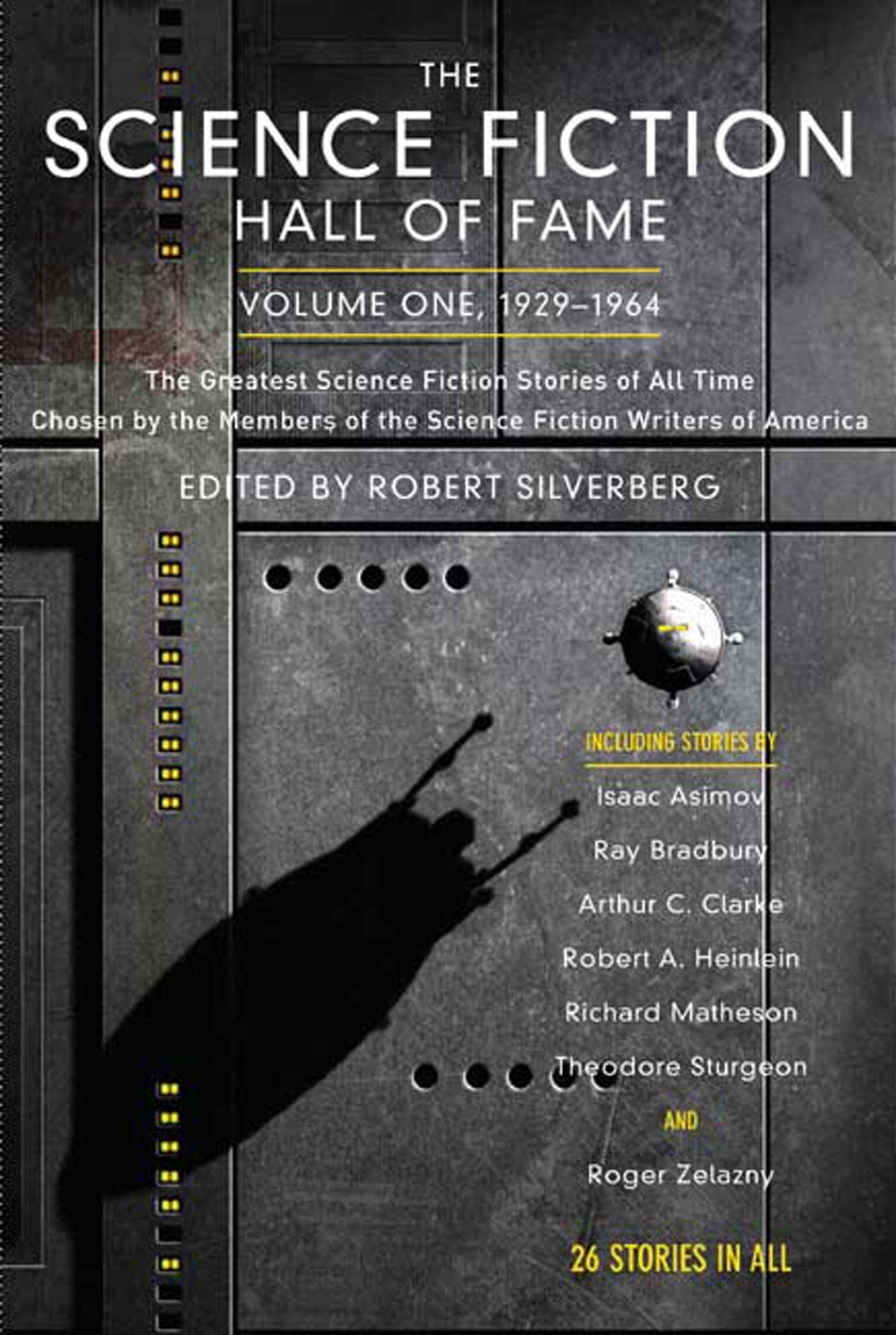
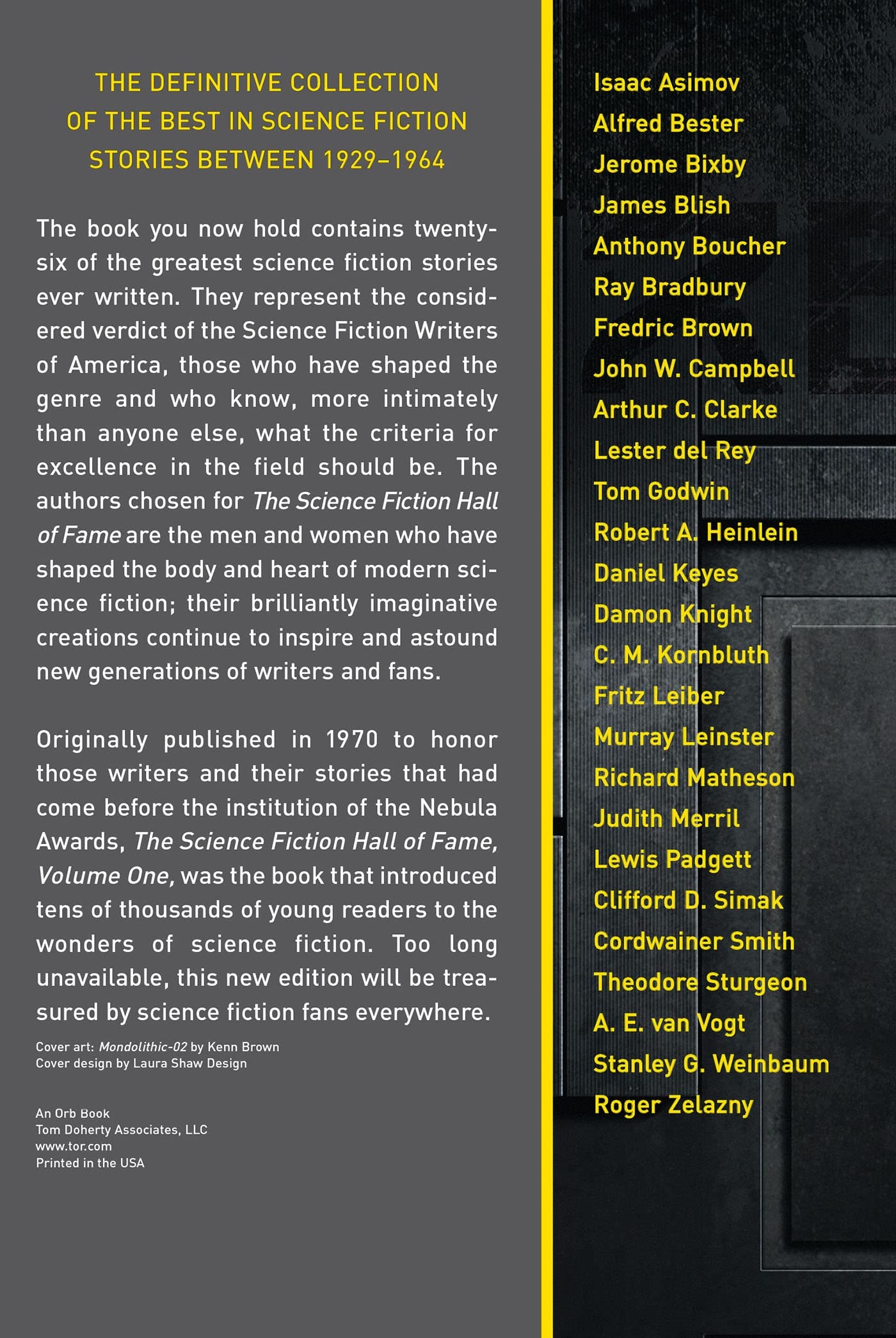
The Science Fiction Hall of Fame, Vol. 1: 1929-1964 [Silverberg, Robert, Silverberg, Robert] on desertcart.com. *FREE* shipping on qualifying offers. The Science Fiction Hall of Fame, Vol. 1: 1929-1964 Review: Great Collection of early SF - Some really great stories in here by the greats of science fiction. Hard to pick a favorite but I think Flowers for Algernon would be mine. Review: The SF Hall of Fame, Vol. 1 - My Favorite SF Anthology: READ IT! It will be your favorite too! - The SF Hall of Fame series was established to recognize quality SF writing before the era of the HUGO and NEBULA awards. What a wonderful gift to the early SF pioneers who were shamefully treated by the mainstream of creative writers. Of course, SF writers themselves changed these negative impressions by the higher literary standards achieved in the 1950s and beyond by such writers as Arthur C. Clarke, Ray Bradbury, Isaac Asimov, Roger Zelazny, Ursala Le Quin, Joanna Russ, Frank Herbert (I'm having fun proving my point with this list, which could go on and on . . . .). This first volume is framed by two stories of a journey to Mars: "A Martian Odyssey" from 1934 (I wanted to make a movie version with Jack Nicholson as the hero) and "A Rose for Ecclesiastes" from 1963 (I wanted to make a movie version with Jack Nicholson as the hero). In those intervening 29 years SF writing matured from Stanley Weinbaum's rather primitive pulp fiction to Roger Zelazny's stunning modernist prose. The first story is just an action fantasy, with little science and the most rudimentary fiction techniques. Still it's a great read! It has action, humor, suspense and one of the great alien characters in the whole genre, the bird-like and noble-hearted Martian, named Tweel. Trust me: once you meet Tweel you will never forget it (?). The later distinction between Hard SF and Soft SF did not yet exist and I doubt it would have mattered to Weinbaum, who was not a professional writer. However, three decades later, we have a very professional, and polished writer in Roger Zelazny, who had internalized the main currents of modern literature as his references to Hart Crane, Rainer Maria Rilke, the Mahabharata, Shakespeare, Rimbaud attest. You get the point. For Zelazny, goddamit, SF is literature and occupies its own niche in world literature. His main character is a poet, an anti-hero with illusions of heroism, a scoundrel and a brilliant, imaginative individual who single-handedly saves a dying civilization from imploding. And what does he get for his efforts. Nothing, no material rewards, no recognition. In this, he resembles the existentialist anti-hero of main stream fiction in the 1960s. And Zelazny's style is breathtaking: metaphorical, lyrical, sarcastic (even sardonic), allusive, persuasive and, beneath Gallinger's tough talk, deeply moving, even empathetic. And Zelazny knew he was writing Soft SF, so he could indulge his imagination in creating his version of a SF Mars and an alien race inhabiting it. The distinction between Hard and Soft forms of SF clarified the intentions of writers so that their readers did not misinterpret the results. This volume is contains a plethora of short masterpieces which together create a vivid primer in the varieties of SF.
| Best Sellers Rank | #58,932 in Books ( See Top 100 in Books ) #30 in Science Fiction Short Stories #52 in Science Fiction Anthologies (Books) #415 in Short Stories Anthologies |
| Book 1 of 1 | SF Hall of Fame |
| Customer Reviews | 4.6 4.6 out of 5 stars (1,013) |
| Dimensions | 8.25 x 5.5 x 1 inches |
| Edition | First Edition |
| ISBN-10 | 0765305372 |
| ISBN-13 | 978-0765305374 |
| Item Weight | 2.31 pounds |
| Language | English |
| Print length | 576 pages |
| Publication date | February 1, 2005 |
| Publisher | Tordotcom |
A**R
Great Collection of early SF
Some really great stories in here by the greats of science fiction. Hard to pick a favorite but I think Flowers for Algernon would be mine.
D**.
The SF Hall of Fame, Vol. 1 - My Favorite SF Anthology: READ IT! It will be your favorite too!
The SF Hall of Fame series was established to recognize quality SF writing before the era of the HUGO and NEBULA awards. What a wonderful gift to the early SF pioneers who were shamefully treated by the mainstream of creative writers. Of course, SF writers themselves changed these negative impressions by the higher literary standards achieved in the 1950s and beyond by such writers as Arthur C. Clarke, Ray Bradbury, Isaac Asimov, Roger Zelazny, Ursala Le Quin, Joanna Russ, Frank Herbert (I'm having fun proving my point with this list, which could go on and on . . . .). This first volume is framed by two stories of a journey to Mars: "A Martian Odyssey" from 1934 (I wanted to make a movie version with Jack Nicholson as the hero) and "A Rose for Ecclesiastes" from 1963 (I wanted to make a movie version with Jack Nicholson as the hero). In those intervening 29 years SF writing matured from Stanley Weinbaum's rather primitive pulp fiction to Roger Zelazny's stunning modernist prose. The first story is just an action fantasy, with little science and the most rudimentary fiction techniques. Still it's a great read! It has action, humor, suspense and one of the great alien characters in the whole genre, the bird-like and noble-hearted Martian, named Tweel. Trust me: once you meet Tweel you will never forget it (?). The later distinction between Hard SF and Soft SF did not yet exist and I doubt it would have mattered to Weinbaum, who was not a professional writer. However, three decades later, we have a very professional, and polished writer in Roger Zelazny, who had internalized the main currents of modern literature as his references to Hart Crane, Rainer Maria Rilke, the Mahabharata, Shakespeare, Rimbaud attest. You get the point. For Zelazny, goddamit, SF is literature and occupies its own niche in world literature. His main character is a poet, an anti-hero with illusions of heroism, a scoundrel and a brilliant, imaginative individual who single-handedly saves a dying civilization from imploding. And what does he get for his efforts. Nothing, no material rewards, no recognition. In this, he resembles the existentialist anti-hero of main stream fiction in the 1960s. And Zelazny's style is breathtaking: metaphorical, lyrical, sarcastic (even sardonic), allusive, persuasive and, beneath Gallinger's tough talk, deeply moving, even empathetic. And Zelazny knew he was writing Soft SF, so he could indulge his imagination in creating his version of a SF Mars and an alien race inhabiting it. The distinction between Hard and Soft forms of SF clarified the intentions of writers so that their readers did not misinterpret the results. This volume is contains a plethora of short masterpieces which together create a vivid primer in the varieties of SF.
K**R
Interesting thinking about how these stories were selected for inclusion in the book.
This is an okay anthology. Some of these stories are great. Others are, "Why was this written?". Overall it is worth reading. A few of these stories are outstanding indeed. I am glad I bought this book but would not buy it again.
R**E
a fun read
A great re-read for an old dinosaur who rejoices in the sheer genius of these writers in their time. A bit like time travel itself
B**N
Solid Gold
This was a great read. The stories, practically without exception, were superlative SF: imaginative, clever and very well written. I even feel somewhat ... saddened ... to realize that many of the stories, and one in particular (from the mid-to-late 40's), were much, much better written than a lot of the work available today: I enjoyed everything immensely, but was amazed to discover this writer of nearly 70 years ago seemed to have a much better understanding of (and abilty to utilize) basic grammar, mathematics, and rudimentary scientific principles than do many of the "modern" authors I have read. Indeed, the capacity of readers to understand what many of these wonderful authors from long ago took for granted, could easily be described as "advanced" topics and concepts for many contemporary readers. I highly recommend this to fans of SF short stories. A few of the stories you may already know, but to me, they were even better on re-reading. Altogether, it's a wonderful anthology of many standout works and I am very glad I bought it.
E**L
Wonderful
I was really impressed with this book. I'm a fan of classic science fiction, so I was prepared to like it, but I expected at least one dud. But this book really delivers on the HALL OF FAME premise. No point in listing favorite stories -- I've liked every one I've read. What amazes me is the ability of these writers to craft a LASTING sci-fi story. Usually, when something is good, its imitators dilute your perception of the original work. Something that was new once now seems trite, viewed in the context of having seen its formerly novel ideas repeated and recycled. But I didn't feel that way with the stories in this book, even the oldest ones -- while I recognized elements that would become fixtures of the genre over time, the originals still radiated creativity and energy. Fun, consistently impressive, and food for thought -- the best things sci-fi can be.
S**R
Cheap cover/Thin paper. But great stories.
Here's an example of what has been bothering me about the publishing world lately. But only are the prices going sky high but the quality of prints are getting just plain awful. Let me first say the stories are fantastic. I had this book in hardcover many years ago and it's a wonderful collection. My problem is with the quality of the edition. Cheap thin paper. A cover that is magazine cover thin. Why?? Probably because someone decided to cut corners and give another reason for their yearly bonus. "Let's cut costs and give the consumer a cheap paper cover. They will never notice" WE NOTICE!! Note to publisher: respect your own work and product. Respect your customer.
L**️
The first of three volumes of the science fiction hall of fame..these stories are of an era before the Nebula awards were given to the best science fiction stories. The best science fiction writers have selected the best science fiction stories from 1929 to 1964 and presented in this volume. If you love this genre you have got to get this. This contains works from the grand masters like Asimov, Clarke, Bradbury, Heinlein. Contains 26 stories.
K**V
Very entertaining.
M**R
It really is an excellent book.
A**R
Das ist die Mutter der SF Gemeinde, manche dieser Stories sind so genial und dienten oft als Grundlage für Viele nachfolgende Geschichten und Filme, danke für diese Zusammenstellung (von SF Autoren selber). Dieses Buch ist für mich die Essenz intelligenter SF ! Toll wäre es, dieses Buch übersetzt kaufen zu können, manche Stories bedienen sich einer Form von "Slang Englisch" (geniale Schriftsteller eben...) mit Wörtern, die mir nicht geläufig waren, aber ich konnte durch Wörterbuch verwenden mein Englisch auch noch verbessern, ein Vorteil! :) Eine Kaufempfehlung meinerseits für alle Menschen, die "relativ gut" Englisch lesen können und SF lieben.
O**B
The stories in this volume of science fiction may be dated now and some may feel that the premises of some of the stories in this collection have been overtaken by advances in our scientific knowledge. however every story is from a recognised master of science fiction and each is in itself a really good read. Although given a background of science fiction these stories are about human behaviour and the human condition and in this respect they are timeless. Although from the last century and thus as I said somewhat outdated I could suggest that the theme of the story The Roads Must Roll might be considered by our transport engineers as an interesting idea. I would be happy to recommend this book to anyone who enjoys SF or anyone with an enquiring mind. I would like to mention two stories in particular which is not to suggest that any of the others is in any way inferior. "The Nine Billion Names Of God" is fascinating and made me smile. The beautifully written "The Cold Equations" is truly compelling and will somewhat dent the idea of space travel as a romantic adventure as it is often portrayed. I am thinking Star Trek etc.
Trustpilot
4 days ago
1 month ago