Buy anything from 5,000+ international stores. One checkout price. No surprise fees. Join 2M+ shoppers on Desertcart.
Desertcart purchases this item on your behalf and handles shipping, customs, and support to Iceland.
🔭 See more. Miss less. Own the night sky.
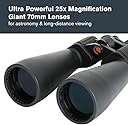
The Celestron SkyMaster 25x70mm Porro Binoculars deliver professional-grade 25x magnification paired with large 70mm objective lenses and premium BaK-4 prisms for bright, sharp images in low light. Designed for serious astronomy and long-distance terrestrial viewing, they include a built-in tripod adapter for stable, hands-free use. Rugged, water-resistant, and backed by a limited lifetime warranty, these binoculars are a must-have for millennial pros who demand clarity, durability, and style in their optical gear.


| ASIN | B003AM87Q4 |
| Age Range (Description) | Adult |
| Age Range Description | Adult |
| Apparent Angle of View | 2.7 Degrees |
| Best Sellers Rank | #112 in Camera & Photo Products ( See Top 100 in Camera & Photo Products ) #72 in Binoculars |
| Brand | Celestron |
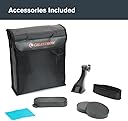
| Built-In Media | Carrying case, Instruction manual, Lens cloth, Neck strap, Objective lens cap, Rainguard, Tripod adapter |
| Coating | Multi-Coated |
| Color | Black |
| Compatible Devices | Tripod |
| Customer Reviews | 4.3 out of 5 stars 9,089 Reviews |
| EU Spare Part Availability Duration | 10 Years |
| Enclosure Material | Synthetic |
| Exit-Pupil Diameter | 2.8 Millimeters |
| Eye Relief | 13 Millimeters |
| Features | Ultra sharp focus across the field of view |
| Field of View | 141 Feet |
| Focus Description | Manual Focus |
| Focus Type | Center Focus |
| Global Trade Identification Number | 00050234710084 |
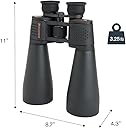
| Item Dimensions L x W | 11"L x 8.7"W |
| Item Dimensions L x W x H | 8.7"L x 4.3"W x 11"H |
| Item Type Name | Binoculars/Monoculars |
| Item Weight | 3.1 Pounds |
| Low Light Technology | Yes |
| Magnification Maximum | 25 x |
| Manufacturer | Celestron |
| Manufacturer Part Number | 71008 |
| Model Name | SkyMaster 25x70mm Porro Binoculars |
| Model Number | 71008 |
| Mount Type | Tripod Mount |
| Objective Lens Diameter | 70 Millimeters |
| Prism Type | Porro Prism |
| Relative Brightness | 7.84 |
| Size Map | Full Size |
| Special Feature | Ultra sharp focus across the field of view |
| Specific Uses | Astronomical or terrestrial viewing |
| Specific Uses For Product | Astronomical or terrestrial viewing |
| UPC | 050234710084 |
| Unit Count | 1.0 Count |
| Warranty Description | Limited Lifetime Warranty |
| Water Resistance Level | Water Resistant |
| Zoom Ratio | 25 multiplier x |
P**A
Celstron 25 x 70 vs 15 x 70
I own both the Celestron 15x70 and 25x70 binoculars. After comparing both here is WHAT I'VE COME UP WITH: Both binoculars excel and have a clear crisp view. The optics are truly amazing at this price point! I did have to send back a set of the 25x70's due to interior dust being seen as I looked through them, but Amazon sent me a new pair no problem. Both binoculars use the same body. The 25x70's are a touch shorter (1/4 inch) in length due to shortening of the Ocular (eye) to the Objective lens distance. The 25x70's also have a larger Ocular lens due to the increased magnification. Both binoculars need a tripod (especially the 25x70's which are more effected by shaking). GET A 70" or greater TRIPOD! I have a 60" tripod and I'm a short5'5" but when something is near 90 degrees over your head the "60 height of the tripod won't cut it. I posted an example of the magnification and the Field of View difference between the 15x70 (1st Pic) and the 25x70 (2nd Pic). As you can see the 25x70 gives you a greater MAGNIFICATION but the trade off is the FIELD OF VIEW which is greater with the 15x70's. The actual views through the bino's are sharper as the cellphone doesn't do it justice. LOOKING AT OBJECTS: In looking a celestial objects the MOON totally fills the frame with the 25x70's. The 4 Galilean moons of JUPITER (yes you can seem) look great in both set of binos. Another thing I love to look at are AIRPLANES. With the use of a tripod I was able to see and follow JETS at 35,000 ft. IT IS A MARVEL! The 25x70's work well here as I can read the writing on the planes. MY RECOMMENDATION: I would choose the 25x70's. The 25x70's are $3 more so why not go for more magnification. The wider field of view on the 15x70's does allow a better "hand-held" experience but you are still going to need a tripod for celestial viewing no matter which bino's you buy. ALSO: Both the 25x70 and the 15x70 come with a tripod adapter but I'd upgrade to a METAL one as these binos are heavy. The Barska adapter is metal with a larger rubber tightening screw and is only $8 (see photo). I'd also get some Field Optics Research Binocular EyeShields ($14) to help keep out peripheral light in daytime viewing (see photo).
M**9
Fantastic for anything where you won't have to change focal distance much.
I originally gave these four stars because the focus has play in it. I bumped them up to 5 stars because of the low price and the fantastic astronomical views. They stay in the focus you put them in, but the play occurs only during adjustment. My 16x50 is much better for daytime sight seeing. 1. The eyepiece lens is 23mm, vs 18mm for my Nikon Aculon 16x50, 16mm for my Celestron 10x50, and 13mm for my Tasco 7x35. Despite this, they have the same eye relief as the smaller binoculars, and also a moderately smaller apparent field of view. 2. I followed the exit pupil, drew a triangle, and quickly and accurately measured the apparent field of view of the Celestron 25x70 to be only 57.5 degrees, and that is the maximum no matter where your eye is. My Nikon's are 61 degrees, my Celestron 10x50 is 60 degrees, and my Tascos are 58 degrees. Visual observation confirms these math measurements. 3. They are noticeably heavier than my other binos, but not a lot. 4. They are easy to hand hold very steady in the day time, without resting my elbows on anything. At night it is much better to have something to brace my elbows on. 5. They look like they are good quality, other than the thin strap. 6. They are 10.4 inches long, and 8 inches wide. 7. There depth of focus is less than that of lower powered binoculars, so I really have to adjust them as I aim around at stuff terrestrially at different distances. These are better for astronomy than for birding. My 10x and lower did not need to be adjusted much unless I looked at something really close. My 16x is in between, but still pretty forgiving. 8. The focus is smooth but has a short lag, and requires diopter adjustment of the right eye to compensate for the lag. In cold weather, the focus wheel is tighter than any of my other binos, but still reasonable enough to turn. 9. I am a bit near sighted, so I get a closer near focus at around 50 or 60 feet instead of the advertised 75 ft. My nikons near focus at 18 ft, not their advertised 28 ft. As many other reviewers already said, the eyepiece barrels seem too big around, and pinch my nose if I try to get closer to the eyepiece. However, if I carefully measure the interpupilary distance, I can place them so I see the full field of view without the pinch. It just does not come as naturally as with my 10x50. I separated them to see if getting one eye closer would give a bigger field of view, but it did not. I guess how close I get is close enough. It just feels weird them being that far out on my nose and making that third point of contact like that. Edit: next day: I'm getting used to the new feeling. The correct place to hold these binoculars is by the barrels in front of the prisms. That is how to get steadier views. Better yet, slouch down in a chair and put your elbows on the arm rests. Then all you'll see is your heart beat. I looked at a distant light, and compared its size to the Nikon's 16x. I find it very believable the Celestrons are 25x. The field of view is not as wide as advertised. The apparent field of view is 57.4 degrees, not 61. The belt of Orion just barely fits in the view. The moon is 30% of the view. The true field of view is 2.4 degrees, not the advertised 2.7 degrees. The arms of the eyepiece adjuster also have some wiggle in them causing a 1/4 inch delay when turning the adjuster wheel. I have had to re-adjust the right diopter even when I did not touch the center wheel, indicating it might be moving a bit. But it does not take long to get back into focus. There is also a flare visible off to the side of the exit pupil, though I don't see it during astronomy. Despite these flaws, I can't subtract a star at only $70 shipped. These binoculars are a league above my 10x50 for astronomical viewing, at least in terms of looking at individual targets. A telescope has many advantages, but these are grab and go. However, to see the phase of Venus, you need to stop down the aperture and sit down to brace your view. ------------------------- I easily saw the correct shape of the Orion nebula on a half moon when my 10x50 could see nothing. I could see the dark side of the half moon, whereas my 10x50 could only see the bright side. My 16x50 also saw the dark side. Jupiter looks much bigger in the 25x70, but I may need to reduce the aperture to see the stripes. I can see bands on Jupiter 114mm f8 Newtonian telescope at 28x, but I can't see bands at 25x in the binoculars. The Pleiades look much better in the 25x70 than in the telescope or my other binoculars. The double cluster in Perseus is clearly visible in the 25x70, and looks tiny with an almost stellar core in my 10x50. Andromeda, M31, looks better, with M32 and M110 noticeable by it, and very hard to see in my 10x50. I can see a tiny ring around Saturn at 28x in my telescope, but at 25x, I sometimes see a ring around Saturn and sometimes I don't. On the day that I could see a ring, my 16x50 detected ears. I can see M13 and other globular clusters as small fuzzy balls. I could find them in my 16x, but smaller. In my 10x, I can locate most of them, but they look like stars. Maybe I can detect a little fuzz on M13. In my 7x, I can't locate most of them, but I can see M13 and maybe a few others, though I don't remember. All of my observing was hand held, unbraced. I could point them at whatever I wanted and hit my targets just fine. I had trouble hitting Andromeda right away because I could not see it naked eye. M82 and M81 are easy to identify in my 25x70 as I sweep over them. I can see the cigar shape of M82 in my 16x50 too, though I can't find either one in my 10x50. I can see a mountain range on the moon in the 25x70 when my elbows are braced. I've not yet found it in my 16x50. Airplanes look bigger but take longer to find in my 25x70. At 25x, you can't tell where you are in the sky from the star orientations. You just have to point and look, and you know where you are when you see the object you are looking for. At 16x, I can pan around from bright star to bright star and figure out where I am by memory. At 10x, I can see some bright stars in the same field of view, but have to pan for others. And at 7x, you can easily see where you are. I actually think my view of M31 was more enjoyable in a 15x70 than in these 25x70, though I know the Orion nebula is better at 25x. It keeps getter better even at 60x. M33 can be located at lower power, but the 25x70 gave the best view, giving maybe a hint of spiral structure.
M**G
Enjoyable and Reasonably-priced Binoculars
My interest in enjoying long-distance viewing, both terrestrial and celestial, had been on the rise as of late. So I decided to do some checking. The telescope that interested me looked to be well-suited to this activity, but I realized that I'd have to purchase a mount and tripod, at the least, and possibly some other accessories (lens, etc.). This, I figured, was going to run at least $500; not an amount I was ready to invest. So as my research progressed, specifically in the direction of binoculars, I came across this Celestron SkyMaster 25 x 70mm binoculars. Touted as appropriate for both celestial and terrestrial viewing, especially given the less-than-$100 price tag, the binoculars seemed to me to be a good fit: not a huge investment and would also be a significant step up from my current binoculars. And the price was about 1/3rd that of the 25 x 100mm while still, in my opinion, providing a decent long-distance viewing experience. I've had these binoculars for about a month now and I have to say that I really do enjoy them. I should note that I ordered and use the "Barska Binocular Tripod Adapter" instead of the one that came with the binoculars. (Other reviewers recommended this upgrade due to the Barska seemingly being a bit sturdier than the one that came with the binoculars.) In any event, I already had a modest tripod that is working well enough for me, although the little, almost imperceptible shake that occurs is quite obvious when looking at airplanes, satellites and other celestial objects. Still, I'm not disappointed with my setup. Now, with these binoculars I can see Jupiter, and at least two of her moons, Saturn, including the "ring," and, of course, many stars. In fact, aiming the binoculars in an area that seems void of stars when viewed with the naked eye reveals even more stars and whatnot. And the view of the moon is spectacular. Passing airplanes stand out with these binoculars. And while I've yet to actually read lettering on planes (they're usually at an altitude of 35,000-plus feet, moving at 500MPH or so, and miles downrange), I can clearly detect planes' colorations, engines, winglets, etc. What fun! For terrestrial viewing, again these binoculars provide me a good look. The only thing I could say that would be even remotely critical would be this: trying to accurately aim the binoculars without the aid of a "finding scope," especially at very distant objects, is challenging. Some times I actually get it right, but most times not. This is especially true of fast-moving objects (satellites, planes, etc.) But this isn't a "problem" with the binoculars, but rather one aspect to consider when using/purchasing such high-powered binoculars. Overall I'm very pleased with this purchase. I find the binoculars came usable and in great shape right out of the box.
S**R
Easy to use, fairly wide field, nearly emulates an entry level telescope & lighter than anticipated,
The 3rd large Skymaster Binos I've acquired and likely to become my favorite. Also have 15x70 and 20x80. About the same feel as my beloved 15x70 and I can hold steady enough for short glimpses without use of tripod. Apart from the next two sentences, my comments regard casual astronomical use. Did take it with me yesterday on the Blue Ridge Parkway for scanning faraway features. Excellent performance and reach for terrestrial viewing yet not as convenient to handle nor as portable as my 10x50. As others point out, a tripod is recommended if you intend on lingering longer than several seconds. A Bakelite tripod adaptor is included yet I still utilize the traditional metal Celestron one because it provides an extra inch of vertical clearance which eases visual access. While the view is 2.7 degrees, an expansiveness is remarkably maintained. Some observational notes follow, especially in comparison with the 15x70 and bear in mind my suburban skies suffer from light pollution: Saturn was a tease as it is definitely seen as elongated. However, it may be that at opposition the rings just might be inferred. I saw it closer to the setting sun so not a good circumstance. Jupiter was a bright disc and there was greater separation between its moons and disc. Could not resolve it's two dark belts. Venus was a very bright morning star and I could not be assured I could detect its shape with certainty. The Pleiades (M45) fills the field of view with breathtaking magnificence!! Orion's sword plus the cluster NGC 1981 can be seen simultaneously. The Orion Nebula (M 42) approaches what I can see in my telescope and some of the Trapezium stars can be viewed. NGC 1981 is truly a charming cluster. The very rich open cluster M35 in Gemini is partially resolved while the Wild Duck Cluster (M11) seems just under threshold, appearing more like an irregularly shaped hazy area. However, it might be partially resolved with darker skies. Globular clusters M13 and M22 are larger fuzz balls than in the 15x70. Double star Albireo in Cygnus can be resolved. The great Andromeda Galaxy (M31) truly resembles a comet which provides insight into the false alarms it likely triggered for historical comet chasers like Charles Messier who put it down as #31 on his list of stellar distractions to avoid. The delightful Beehive (M44) open cluster is contained in one view and I can now relate to the imagery of, "The falling tears of Christ" earlier observers reported. The open clusters of Auriga,(M36, 37 & 38) are tantalizing yet, for me, on the verge of resolution. The asterism Coathanger (aka Brocchi's Cluster) fills one field. All in all, for under $100, the 25x70 Skymasrter is an excellent investment when not seeking higher priced premium binoculars. It is recommended to be used with a tripod; yet quick, informal views can be relatively easy to accomplish hand held, especially while grasping it by the objective ends. The lenses are situated deeper on the front end than the 15x70, possibly suggesting a type of dew/sun shade purpose. Other differences to keep in mind in comparison with the 15x70 include the smaller observational field of view (of course) and the merely point and look aspect of the smaller bino is diminished in the 25x70 (of course) with the greater magnification coupled with that narrower field. These are just part of the game and should be of no surprise. With more use, I am inclined to suggest this may become my preferred set at first use. BTW, my 20x80's, apart from increased weight, are hardly used at home due to light pollution. Its larger objectives, at 80mm, bring in more light so are reserved for observation under darker skies. It was because of this suburban atmospheric limitation that I sought an alternative for increased magnification beyond the 15x70 and settled on the 25x70.
J**.
Awesome but use a tripod
Standard for all my reviews: When reviewing products, I always remain objective and honest about the product or service. I always review with information that I feel others would like to know about the product as I always assume what I'm writing will influence for or against the purchase. I always try to go above and beyond surface characteristics and input into quality, value and application. Most importantly, I will always end the review with an answer as to whether I'd purchase the product again which I believe is the most critical question pertaining to the item. To manufacturers: Want me to review your items, just let me know! I see the negative reviews and get what people are saying but it's unfair to Celestron to offer poor marks on something they can't well control. I purchased these 25x70 binoculars knowing there is better glass available but wanting something reasonably priced that would offer better celestial body viewing along with long distance wildlife viewing while in Yellowstone. I have yet to use them for wildlife but have used them for night sky viewing. Firstly, the 25x magnification REQUIRES a very sturdy tripod, preferably one that can extend closer to 7'. Being an amateur photographer I use a Manfrotto and Bogen Ball head mount. It's very heavy and very sturdy. Cheaper tripods won't give you the solid base needed, could have an issue with the weight of the binoculars and will sway with the wind. Even on a tripod, the slightest bump, shake or allowing your eyes/brow to touch the binos will send your target image shaking across your field of view. They are best used by not touching them after properly focusing with the focus wheel and diopter, looking at your target without making contact with the binos. The 70mm objective lens size makes for a long and heavier binoculars and the 25x magnification is great for budget based viewing. Funny story: I purchased these to get a better view of Jupiter and it's Galilean moons. I mounted on the tripod, found the brightest start in our southern sky (Jupiter), spent a few minutes focusing one eye at a time and then prepared to be wowed. Instead, I was very disappointed in that it was just a larger bright star. Then I realized I was one star to the right of Jupiter. Repositioned and immediately saw the difference. Refocused and immediately saw Jupiter and all four moons visible. Make no mistake, you won't see detail, but you can tell it's a planet and the moons are visible. Again, you can find better glass/optics at much higher price points but for our first set of star gazing binos without going to full telescope, it's hard to beat this price point for a brand like Celestron. We're going to have a lot of fun with these. I can't wait to get these to Yellowstone to see if they are too powerful. But do NOT attempt to use these hand held otherwise you will be sorely disappointed. The field of view is too tight and the magnification is too great to use anywhere but on a tripod. The binos do come with a tripod mount. I had purchased one separately.
M**7
Terrible quality control but good binos
These binoculars would be one star if I was just ranking them off of quality alone. The first set I got was horridly out of collimation. So bad that I don't think it could even be fixed. I contacted their support and their solution was "return them to Amazon". I did, and the second set was better but not perfect. Celestron's support again said "return them to Amazon", and the second option was "pay for a repair". Neither pair should have left their warehouse. I think their quality control is non-existent. For the collimation issue, they are technically adjustable, but not in an easy way. I watched several YouTube videos on how to access the screws, but they're almost impossible to see; I spent an hour messing with them and didn't improve anything. I've just learned now to use either one eye, or stare through them sort of cross-eyed to even everything out. Other than that, they're pretty damn good. 3 of Jupiter's moons are easily visible. I've definitely seen a few nebula. There are tons of stars visible through these binoculars I couldn't otherwise see. I live in the NYC metro area and light pollution is horrible. The moon is absolutely stunning- you can see so much detail. These are so much easier to see things compared to a telescope since stuff isn't upside down. You definitely need a good tripod. They're very heavy, and pretty much impossible to hold still. I have a good solid metal camera tripod I use with these. It's nice because I can use the height crank to make them comfortable to view for people of various heights. I can locate something and then lower the tripod height to a child's height without having to reacquire the object.
C**C
Highlyn recommended binoculars for astronomy
These are excellent binoculars!! I have some restaurants about 1/2 mile from our house, you can see the logo, lights inside the restaurant and more. And for the primary use of these binoculars, which is astronomy, they do excellent! I have had them for probably a month. I have been able to see... 4 of Jupiter's moons, the moon in great detail, the seven sisters, an amazing star cluster in great detail, I could see the vibrant colors of the stars, blue, golden and more. I also saw Rigel, a bright star and another star cluster. I could see the colored clouds in that cluster too. I could also see Saturn. Its rings are tilted to earth currently, so I couldn't see the rings. But I have heard that you can see them as "ears" on both sides of the planet when they are tilted enough. I also saw loads of other stars, also. These binoculars are excellent at showing the color in stars, better than my Celestron Astro Master 90 telescope, which is also highly recommended. These binoculars get five out of five. With the included dust caps, case, and cleaning cloth, if you are a astronomer like me wanting to be amazed at what you see, these are for you.
B**F
STURDY BUILD, CLEAR IMAGES
I ordered this pair of binoculars for viewing images across a lake we camp beside and for viewing stars in the night sky. I also wanted a pair like this for a tripod because it's impossible to view things at extreme distance with anything not on a tripod. I was not disappointed when these showed up at my door and I rate them 5 stars across the board for what I was looking for in a pair of extreme magnification binoculars. Too heavy and too big to carry around on a trail looking occasionally at a bird or two, a waste of money for that purpose, these binoculars require a tripod for any good views to be appreciated. Sure it has a strap for around your neck but you'll soon realize the strap is meant to hold the eyepiece so you don't lose it, not to carry the binoculars. If you carry these around your neck on a trail you will damage them, they are heavy and large. Also, with high performance magnification using quality lenses set with precision means these binoculars are extra vulnerable to bumps and bangs. I find the build to be exceptional. They used metal throughout the construction. I'm not a lenses expert but with an object lense of 70mm, lots of light enters the binoculars producing bright images. The magnification of 25x is crisp and clear also. I'm pleased with this pair of binoculars. If you order a pair expect to use a tripod for any decent viewing experience.
S**A
Excellent Binocular for Stargazing
I bought this for around ₹8,000 with card offers, the best ₹8K I’ve spent so far. This binocular is excellent for sky and stargazing. If your budget is around ₹10,000 and you’re looking for a powerful astronomy binocular, go for this without a second thought. The lens quality is very good, and the overall build feels solid and well-engineered. What I was able to see through this binocular: - Full Moon – The Moon does not fully occupy the lens; it covers roughly 60–70% of the field of view, which gives great perspective and clarity. - Jupiter and its 4 moons – Clearly visible on a good night. - A few star clusters – Bright and beautiful. - Orion’s Belt – You cannot see all three stars at once; they can only be viewed separately, which gives a good idea of the high zoom level. Important Note: This binocular is heavy, so a strong and sturdy tripod is mandatory (don’t go for cheap ones). If you want to capture photos through the binoculars, a phone mount is also recommended. I still remember the night I pointed this binocular at the sky and saw a star cluster for the first time, it was truly magical. If you are a space enthusiast, this is an absolute must-buy. Highly recommended!
G**Y
Binoculars
Very nice gadget, just as described on site
B**T
Awesome
Awesome for long range view if you look at the mountains or buildings you can clearly see it thank you :)
K**S
Kraftfull
Bra kraftfull och billig kikare !
L**T
Excelente calidad de material e imágen.
Hace falta decirlo, a mi parecer, una excelente relación calidad/precio, vienen cuidados, limpios, las lentes son de excelente calidad, se sienten robustos y cumplen lo que prometen. Sin embargo hay que aclarar, estos binóculares requieren de un tripié, es posible observar con ellos con solo las manos pero pesan bastante y se vuelve cansado, igualmente es necesario mencionar que el aumento (el cual es increíble para observación de astros, la luna, paisajes etc) deja al límite la posibilidad de tener una imágen estable sin tripié. Hace unos días estuve observando el cielo en busca del cometa C/2022 E3 (ZTF), el famoso cometa verde, a pesar de lo tenúe que era y de estar cerca de una ciudad densa logré vislumbrar el manchón verde del cometa, ver nebulosas como orión o conjuntos estelares como las pleyades es increíble, desde que los tengo observo el cielo cada noche (si el clima se presta claro). Algo más, si quieres estos binóculares es posible que estés pensando también en un teléscopio, la realidad es que comprar estos binóculares es una excelente opción, no solo tienen el alcance y la luminosidad suficiente para competir con un telescopio de bajo costo sino que son mucho más económicos (en perspectiva, se requeriría de un telescopio de cielo profundo de al menos 4 mil a 6 mil pesos), son mucho más comodos de transportar por obvias razones y en general, a menos que quieras dedicarte de lleno a la astronomía, unos binoculares como estos son una alternativa más que excelente. Para teminar, dejé un par de fotos, la primera es como se ve con los binoculares y el adaptador para teléfono, la segunda es una toma con un teleobjetivo 300mm.
Trustpilot
3 weeks ago
5 days ago