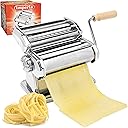
🍝 Elevate your kitchen with Italy’s pasta perfection machine!
The Imperia IPasta Classic Line is a premium manual pasta machine, 100% made in Italy with durable chromed steel. It offers 6 adjustable roller thicknesses to create dough sheets, fettuccine, and tagliolini, and supports electric motor upgrades and various pasta accessories. Designed for versatility and longevity, it includes essential tools and storage solutions, making it the ideal choice for fresh pasta enthusiasts seeking authentic Italian quality.


| Best Sellers Rank | #29,543 in Kitchen & Dining ( See Top 100 in Kitchen & Dining ) #24 in Manual Pasta Makers |
| Blade Material | Steel |
| Brand | Imperia |
| Color | End of line |
| Customer Reviews | 4.5 out of 5 stars 6,818 Reviews |
| Item Weight | 7.6 Pounds |
| Material | Alloy Steel |
| Product Dimensions | 8.05"L x 7.2"W x 6.2"H |
M**Y
Used in Italy
Very sturdy. Used the exact machine in cooking class in Italy. Easy to set up and use. A nice little bag is included for storage. No washing required.
S**A
Beautiful High Quality Heavy Metal Machine
Beautiful machine! Works like a dream. Heavy duty. This machine is not a flimsy light weight thing. This feels like quality - something hard to find these days. I "cleaned" the rollers of any left over factory debris by making a throw away dough and rolling it many times through each roller. A couple tiny dark marks came out and then it all ran clean. After that I made sheets for ravioli. It was a dream and so fun. Now, I do have modern countertops with an extra thick countertop. So the clamp, being made for average sized tops didn't fit. So, I clamped it to the edge of a thik wood cutting board and this worked well. I can see myself using this machine often. It was too fun.
A**S
What a great pasta machine!
After reading several reviews on slightly cheaper models and considering the advice given in Marcella Hazan's "Essentials of Classic Italian Cooking", I chose this model. It sat under the cabinet for 3 weeks after I bought it because life's demands didn't afford any time to play with my new toy. I finally scored a Saturday with nothing else to do and pulled it out of the cabinet. Here are a few observations: 1. This model is a product of Italy and the instructions (which are written in several languages) are written in poor English. Since the product is a simple design, I found that I didn't really need the instructions to figure out how to assemble the double cutter attachment. Thankfully, attaching the double cutter is the only assembly required. 2. The pasta machine came with a recipe for pasta dough. The recipe was also written in several languages but the English instructions were a bit clearer than the assembly instructions. I didn't use the recipe provided by the machine's manufacturer though. I used the instructions provided in Marcella's book mentioned above. 3. This machine is heavy and unbalanced when the double cutter is attached. It comes with a clamp to clamp it to your counter top or table if you choose to use the hand crank provided to operate the machine. I bought the "Villaware V180 Pasta Machine Motorizer" along with the pasta machine. Using the motor with the pasta machine not only eliminates the need to use the hand crank, it eliminates the need to clamp the pasta machine. Not having to use the clamp means that you can position the machine anywhere you wish on your work surface, not just on the edge. I found it was more comfortable to place the machine about midway to the wall on my counter top. Using the motor also frees up both hands for manipulating the pasta dough as it is being processed. I honestly don't think I could have used the thinnest settings with just one hand to manipulate the pasta dough. The dough becomes quite fragile when it thins and tends to want to stretch and presumably, break at the thinner settings. By using two hands to manipulate the dough, I found it easy to process the dough through the machine even at the thinnest settings. 4. One of Marcella's suggestions was to buy a machine with a double cutter because you will be able to make wide fettuccine style noodles and narrow round spaghettini style noodles. I made both using the fettuccine style noodles to make fettuccine in butter and cream sauce (Alfredo) and short spaghettini style noodles to make chicken noodle soup. Both cutters worked flawlessly. 5. The machine/motor's over all performance was also flawless. The motor switch has two speed settings and I used the slow setting throughout. The pasta machine and motor combination worked the dough easily through all the width settings. The motor also has a separate ravioli button that I have not tried yet. I ended up processing three batches of dough. The first was used to clean the pasta machine of metal bits and thrown away as was instructed in the manual. Conclusion: This is a well made pasta machine. It's parts are well designed and made of stainless steel. Maintenance is a breeze. Just wipe it down when finished using it. This is a great little pasta machine. In short, it does what it is supposed to do - and - it does it with ease. It makes pasta.
H**2
Great little pasta machine
I took cooking classes while in Italy, and the Imperia was the machine that my instructor used. Needless to say, I wanted to buy one myself upon returning to the US - this is identical to the machine I used in Italy. I was somewhat dubious that I'd be able to replicate the results from my cooking class given that I'd never made pasta before, but I have been very pleased with this machine and have had great results. The only assembly instructions are in Italian, though it is pretty intuitive when you look at the photos. The fettuccine/spaghetti attachment slides on to one side, and you slot the handle into the main roller or the fettuccine or spaghetti rollers, depending on what you're using. I found the little tray (for feeding the dough in?) unnecessary and don't use it. I almost bought the motor (an additional $100) based on reviews I read saying that it is necessary because otherwise two hands aren't enough to make the pasta and the crank is too hard to turn. I'm glad I didn't. I have had no problems feeding the pasta dough in with one hand while turning the crank with the other. The machine attaches securely to the countertop with the included clamp, and you don't need another hand to "catch" the pasta when it comes out of the machine - if the dough is made correctly, it will not stick to itself and you can just pick up the sheet or noodles after they've fallen out the bottom. I have made sheets of pasta for pappardelle and ravioli (hand filled, not using the Imperia ravioli attachment), fettuccini, and spaghetti, all with success. The advice we got in Italy when making sheets of pasta for ravioli, etc., was to start with the widest setting, and roll it through each setting twice, dusting with flour as needed in between (ending on the second thinnest for ravioli). We were also told to crank the dough through quickly, to prevent sticking. These tips have worked very well and I have had zero problems with sticking, or it being too difficult to turn - my friend's four year old was able to turn it to make her own spaghetti after I set up the machine for her and helped her feed in the sheet of pasta. The recipe I use is the one I learned in Italy - ratio of 100 grams of flour to 1 egg, pinch of salt, and optional olive oil. Knead the dough until very soft and smooth and then let it rest for at least 20-30 minutes before rolling out. The instruction book says that the first batch should be a "test batch" to be discarded, as any grit, etc. lingering from the manufacturing process will adhere to the dough. I would not skip this - while I did not see any metal bits in the dough that other reviews have mentioned, my machine did have what appeared to be a bit of black oil on the rollers that was picked up in that first batch of dough. Unfortunately, it seems that there is still some oil in the edges of the machine - I have made pasta at least 10 times now and still have a problem with oil/black streaks in the dough if it is allowed to go all the way to the edges of the roller, which then of course has to be cut off and discarded. That, honestly, is the only negative I have experienced with this machine and my only reason for giving it 4 stars instead of 5. Finally, I have read complaints that it is "not washable." If you are making your dough correctly, you shouldn't need to wash it! You're only going to have a problem if the dough is too sticky. There is nothing on my machine after I use it except a few bits of flour that brush right off. Getting the texture of the dough right is the most important thing!
V**S
gift
amazing machine to make pasta
T**H
Fun, easy to use
I loved my pasta maker so much , I bought it for my niece and her husband. They are having so much fun with it, making different types of pasta. It’s simple to use and stores away easily.
R**L
Fun way to make Pasta and Advance to other types
Cucina150 Pro Imperia Pasta Machine I had a very peculiar experience with this consumer product, and took me a lot longer than any used before, simply because this is literally the first time I ever owned an Italian-make product. The delicacy and excellent material that goes into this product aside, the trouble was making the device work as it says and explained in the manual, which was accompanied with disappointment after disappointment. It is essential to be able to use any new device for the first time, or a new brand of one used previously, to understand the very fabric and culture of the makers. For example, some places the steering wheel is on the right, and so on so forth. To actually be familiar with the point of view and other wide scope views of designers and builders of any item, goes a long way in getting started right away, or otherwise getting stuck, and ending up frustrated. Having had to deal with this type of machine, was hard enough. The delicate movements and order of things to do, are much more diffuicult for the same reason that one finds it difficult to drive in a different manner. However, it is worth the effort, and one is able to appreciate and experience and observe the Art and inguniety that is inherent in the Culture that stands out in any form and field of Art, Engineering, and Science and Mathematics, practicing cation to leave any other Culture intact and respectful in its own right, only to note that each is peculiar in its own right, and it is plainly interesting to observe a new one from closeby. The device works perfectly, provided one has gained sufficient experience and sufficiently skilled to do so. Many tips and method of use is missing from the users manual, but I think it serves better the purpose on hand, because each user has to devise methods of use which suits him or her best, and not necessarily something that is described and to be followed by everyone. A lot of trials and cracking puzzles and problems are involved to come up with the right product that it is claimed to provide, but that is what gratifying about this machine. As a sideline, automatic types might ease the work a lot, but less control is available, which is the price one pays to spend less effort.
E**N
Just like the one my mom had
Pros: -Nice weight to the unit. Feels solid. -The noodle slicer attachment slides on nice and snug -The noodle slicers are machined close enough to slice paper, yes I tried. The only "uncut" noodles I had were due to freshly cut dough sticking back together. Roll it into flour, toss a little, problem solved. -The flat rollers are very well aligned, with no discernible play, at all settings. -The clamp holds well. I used it on the edge of a corian bar counter. Never had a problem with the unit walking or shifting. Just make sure the surface and rubber feet are clean of flour. -It's great for 3 year old kids who want to help in the kitchen. Play-dough you can cook and eat. Cons: -The overall finish is maybe not quite as nice as my mom's, lacking in depth of polish in the chrome. Metal knob feels thinner, but going from memory here. It's otherwise identical, but could be a different brand. -The tray attachment (not pictured) tends to wiggle loose, and unless you flour the heck out of the dough, it will catch. It's not really needed anyway. -I have some physical flaw in my arm I guess, because removable handles always wiggle loose while I turn. Ok, so a 5 star machine would be machined out of a solid hunk of steel, chromed to look like a car bumper from the 50's, weigh 35 lbs, and cost $200. I review on advertised function and met expectations... ...I found none of the faults the 1 and 2 star reviews indicated. The cons really are minor. The fact is, it's a unit designed to make two types of noodles out of the box, and pretty much whatever flat pasta you want to roll out and shape. That's what it does, and does it well. I've made lots of noodles, and bunches of ravioli. I used to roll ravioli with a french rolling pin, this is so much easier. I like "traditional" hands-on methods (personal enjoyment reasons only), but this is a totally worth it compromise. Will fresh pasta change your life? Probably not. I prefer it, it's a mouth feel, texture and taste thing for me. Pasta is so cheap, there is probably little cost benefit. It takes a little more effort than dumping a box into boiling water, but if you're reading this you should get it, it will be worth it to you. (I am increasingly disappointed in Amazon's packing, but this is not a review of Amazon)
Trustpilot
3 days ago
1 month ago